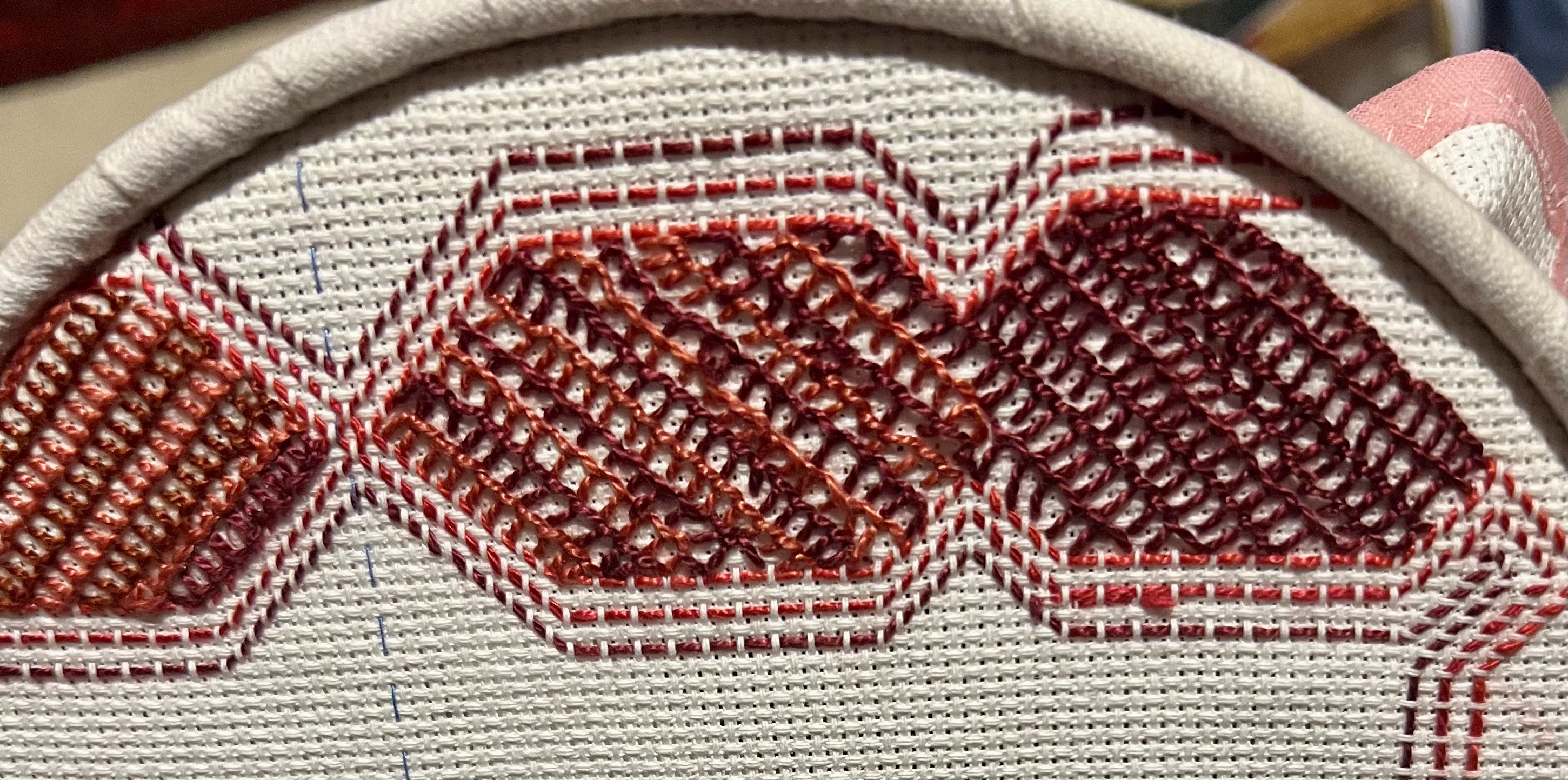
Returning to the Huckaback on Aida border I created as a result of the Embroiderers’ Guild Certificate Course Workshop in January, I decided to add to the centre. I had purchased a pattern for a Hamsa from Etsy for the talk I’m giving later in the year on the Evil Eye in Embroidery. As I had no plan for it beyond working it as a sample, it seemed this was an opportunity. The pattern came with instruction for working it in 22 shades of blue cotton. Hamsas, however, are worked in red in a number of cultures. If anything, red amplifies the protection - and fits my colour scheme!
I therefore gathered all the Perle 5 threads I had in shades of red and set to work. I didn’t try to follow the shading on the pattern, rather began with what I had and made it up as I went along. I reverted to perle 5 because this was a cross stitch pattern over one square of Aida and perle 3 would be too bulky.
In fact tent stitch was more than adequate with perle 5. I worked the basic outline using about 6 shades of red.

I didn’t want so much white space, so added extra flames in shades of orange.
At the workshop it was suggested that I put this in the Guild Exhibition, so I had a deadline.

While I’m happy with the remaining white background , it should be filled with white, or ecru, stitches rather than left, as it is, with the Aida as background. I simply ran out of time.

As it was, I took it out of the hoop at midnight last night and dropped it at the Guild today. I haven’t decided yet whether to use it as a sample, a cushion or a bag. Probably the last. I will decide after the WES talk in May.

I didn’t have time to block it, but steam-pressed it this morning. I can still see a faint hoop mark, a sign of a woman who is no domestic goddess, but tried. 🤷🏻♀️