Search This Blog

Showing posts with label drawn thread. Show all posts

Wednesday, October 26, 2022

Embroidery in a Void - drawn thread work

 Last Saturday was another fabulous Certificate Course Workshop with Di Kirshner on drawn thread work where threads are removed altogether and the space filled with embroidery. I've done some of this before, but have much to learn, and Di is a very accomplished teacher.

I'm not going to give much detail. The class was very much the intellectual property of Di and I'm trying not to breach that. 


Much of the class time was taken up preparing the spaces in which to embroider. It is, I think, a really nice design, and simple enough to work as a sampler, in part or whole.

It took me a couple of days to finish at home and I was excited to find a way to make it up in an appropriate form.

I tested a couple of ideas out on Katherine, Niamh, Veronica and Anthony. Their views, while not unanimous were similar enough to guide me to a pouch, or pocket.


I found some dark green silk, which they all agreed was appropriate, so this is the result. I did think of a Christmas present that would fit into it!. I lined the piece completely with the silk, then folded it to form a long thin pouch, folding the corners in at one end and stitching up the other end.

I even ironed it very carefully


before stitching the back seam down using four-sided stitch and adding a Dorset button I had from some previous class.  I also stitched the lining down on the inside - not strictly necessary since it was firmly attached to the linen, but neater and less likely to catch on any contents.


I have every reason to be pleased with this result.

I'm really grateful for these classes. Many thanks to all who helped along the way.

Wednesday, January 9, 2019

B2B - Basics to Beyond with Embroiderers' Guild of SA

I attended the Embroiderers' Guild monthly Basics to Beyond classes all last year, working on my counted sampler - the fifth project in the B2B course. It has been slow,  rewarding work. Generally speaking, I have worked one row of the sampler each month, getting help to get started during the meeting, then finishing the row at home.

The first three rows to be done were a variety of counted thread patterns. I chose a bargello, a Sollerosom, a pattern darning from Yvette Stanton's Smoyg and a  variation on a Kogin chart from Phyllis Maurer's Techniques of Japanese Kogin.


In between the bands I worked a single row of a variety of stitches, a series of linked horizontal fly stitches, chain stitch. feather stitch and a couple of variations on cross stitch.


The remaining bands were worked in a series of drawn thread.


This one was simple but, I think, effective.


I had a bit more trouble with the needle-weaving but managed in the end to produce a pattern.


In the last class of the year, I began the pulled-thread border around the piece. I have now finished that. It looks predictably scrappy - but will block up nicely when finished.


I have the hem to do. I've decided to leave that until my first class this year, which will not be until April. On the day of the February class I will be boarding a plane for England, and returning just after the March class.

One of the joys of B2B is taking time - progressing at  your own pace and learning as you need.

It's a mindful exercise.

Sunday, August 5, 2018

B2B Project 5

Part of my reason for doing the Hems and Edges counted thread class last year was that I am now on Project 5 at the Guild's Basics to Beyond group. This is the last project in the standard program - a counted thread sampler.

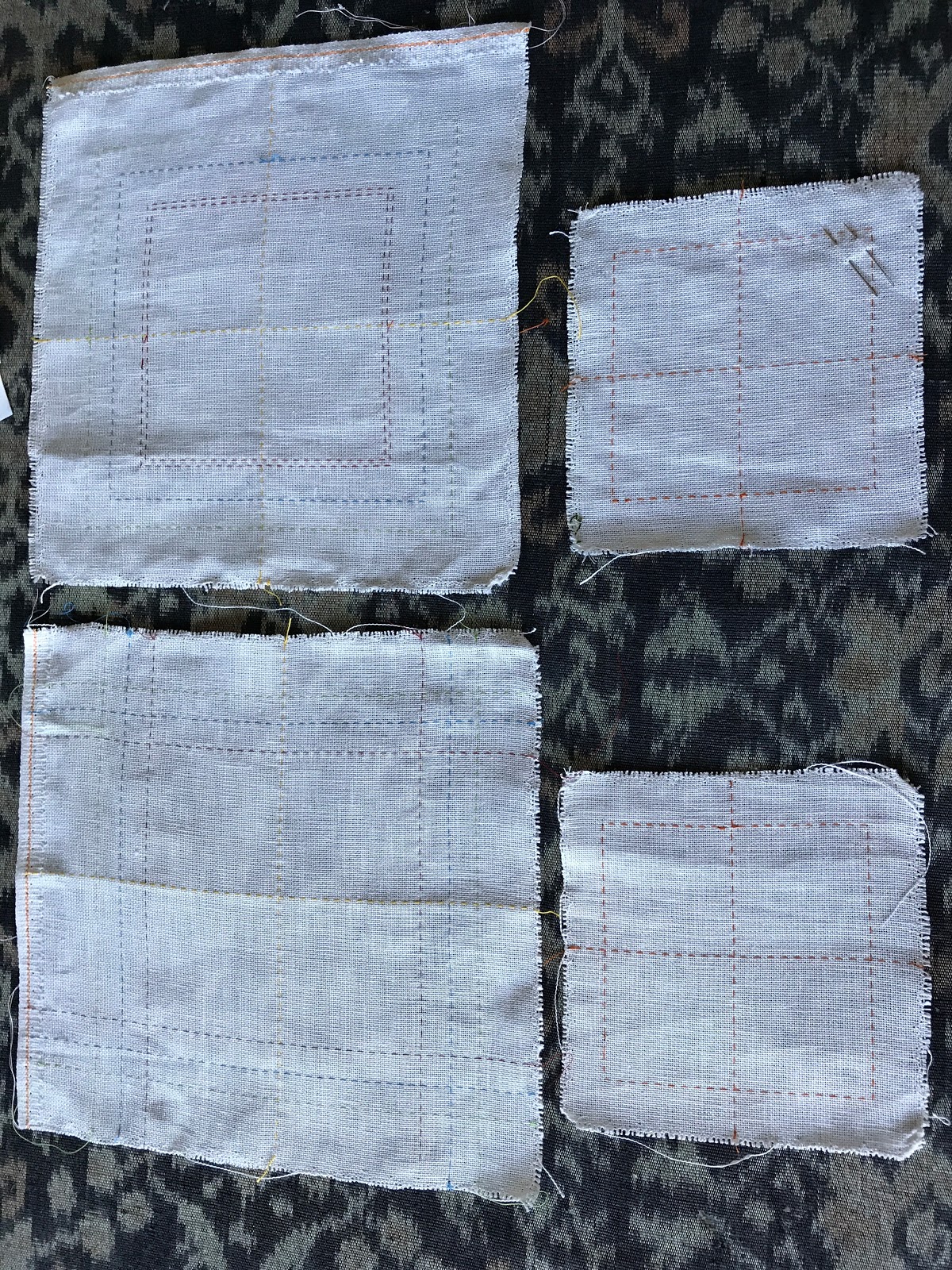
Predictably, the first step in the project is to tack all the boundaries of the work in colour-coded machine thread - three threads under, three over. These provide the boundaries for the various panels required to complete the project for assessment.  It took me a couple of weeks of whenever-I-could stitching to complete this task - and a bit of unpicking. You know, of course, if you have it wrong, as your edges and intersections do not work out.
There are three squares in the centre of the piece. These are to be worked in our own choice of three different pulled thread patterns or stitches. I chose mine from Danish Pulled Thread Embroidery a book I liked so much I sourced and bought my own copy.
These are far from perfect, but I don't plan to undo them. The diagonal line on the one on the left show where I started - then repeated a line when I picked up the other half.

I  worked my first free-choice panel with a bargello stitch over 4 threads, with an off-set of two threads. I started with a stitch over 3 threads, but soon learned that working over three threads meant off-setting by 1 thread only, creating a very tight pattern and considerably more work.  The 4 thread version looks bolder and neater.


As my second counted thread panel, I chose a design from Japanese Kogin.


My third is Swedish Sollerosom.


 For my final counted thread panel I tried a pattern from Yvette Stanton's latest book, Smoyg: Pattern Darning from Norway. It is a simple motif - chosen because, at 21 threads wide, it fits my panel!


This post is a summary of many months work. I have averaged one panel each month on this project. There is no hurry - no pressure to do anything other than learn. It's a lot of fun researching and choosing the stitches.

Now I have to do the drawn thread panels and the numerous edging sections. This needs to wait until I get some help later this month!


Thursday, October 5, 2017

Hems and Edges Day 2

The second day of Gay Sanderson's Hems and Edges class at the Embroiderers' Guild of SA in September was every bit as good as the first. 
We began on a new square of linen, folded and pinned our hem, taking care to match our corner folds before tacking the hem down.
We then worked a pulled thread hem along one side. I had a go at a drawn thread hem in the same stitch on the other side of the square.

I preferred the drawn thread version on this 28 count linen, but I can see that the pulled thread one might be  preferable on a fine handkerchief linen.
I then worked an edging stitch without a hem - designed for such things as bookmarks or other items where you do not have room to turn a hem. This is a great stitch to learn and satisfying to do.


We needed to work enough to turn a corner, but I liked this one so much I finished it off at home and worked the fringe as well.


We finished with a picot edge. 'Satisfying' is the word that keeps coming to mind for this work. When I  worked such edges for tablecloths many years ago I had the same feeling.


There is something deeply fulfilling about completing something very simple yet so neat and shapely with a needle and thread where there was once a raw edge.
Again, I worked the whole hem around at home to get the effect.


I left, however, the back in several stages in order to use the piece as a sampler, to remind me how I did it.


Towards the end of the session, Gay produced a box of various objects she had created using these techniques. Amongst them was a hanging decoration made from a strip of linen twice as long as it was wide. She also gave us each a couple of pieces of linen she had machine-edged so we could try out extra ideas.

At home I used one of these to have a go at a hanging decoration, using a simple motif I found in the tiny Coats 50 Counted Thread Embroidery Stitches I had inherited from my mother many years ago.

I worked up quite quickly. Alas, I had checked the size of the fabric by folding, but did not get it right.


The technique worked, but did not deliver an object based on perfect squares.


It does, however, show the technique and the kind of result I can expect to achieve.

Once again, it was lovely way to spend a Sunday - learning techniques with a great teacher and sharing my learning and endeavours with a small group of like-minded women. Bliss.

Wednesday, September 13, 2017

Hems and Finishes class at Embroiderers' Guild of SA

When the Embroiderers' Guild Class program for the second half of this year came out I debated whether to enrol in Gay Sanderson's class on Hems and Finishes for counted thread work or whether to launch into completely new territory with Glenys Leske's Seascapes - creating scenes with layers of fabric and embellishment. I decided I should push my boundaries and go with the Seascapes. However, when I received the requirements for the course I chickened out. It was the sprung hoop for machine  embroidery (plus the machine itself) that decided me. I didn't want to go there. So I swapped my enrolment for Hems and Finishes.

This is a challenge of a different kind for me. I have done a reasonable amount of counted thread work over the years and enjoyed it. My eyes, however, find it a challenge, and the level of accuracy required is not my natural inclination. On the other hand, I love the effects achieved and I also love the history of various kinds of counted work.

So I took a deep breath and got on with the preparation work for the two day workshop - four pieces of even-weave linen to be tacked up in colour-coded machine thread - tacking to be three fabric threads under and over.

At the same time that I was doing this, I was also preparing a piece of linen for Project 5 of Basics to Beyond - a counted thread sampler (more in another post).  I figure this is reinforcement and will maximise my learning.

The class is over two Sundays, and I am writing this after the first of the two days. I simply loved it- which is just as well, because in attending I missed my grandson's Under 12 football team win their Grand Final and my grandson being awarded Best on Field!

 Gay is a great teacher - clear, organised, experienced and knowledgable, disciplined and pragmatic. I respond to her capacity to adapt within the framework of her skill and knowledge - which is huge.

Her projects are also really well designed. They teach specific techniques in a logical way, with completion of discrete steps. We worked a sample of pulled and drawn stitches on one piece of fabric before putting them into practice on a second piece, providing us with both a complete example and a sampler of the stages for future reference.

Some of the techniques we learned were hemstitch, antique hemstitch, creating an internal selvage  and mitred corners.


Even though I find the tacking preparation tedious, I love the way the tacked lines turn into the framework for the edges. It is so purposeful and rewarding,


I also enjoy the company of a group of embroiderers focused on the same task, sharing their struggles and triumphs. This is only possible because the project is well designed and Gay's methodology allows for learners of various skill level. The class then becomes a learning community and we all thrive.

Although our only homework was preparing a couple of very small pieces for next week's class, I couldn't help myself, and finished the edge on the second piece. It has the calming effect of a meditation.
I also blocked it. This seemed a better
proposition than ironing.

 I'm looking forward to the second day of the class next Sunday.

Wednesday, August 2, 2017

Russian Drawn Thread Workshop

I'm a bit behind in my postings. I attended the CertificateWorkshop for July last weekend - before I had posted this one from June!

The Embroiderers' Guild of SA Graduate Certificate June workshop was on Russian drawn thread work and taken by Carol Stacy, who had spent months researching and Guild at it's very best - a learning community of members researching, practising and sharing their skills. Thanks Carol! 

I worked in 28 count linen. These days I avoid anything finer if at all possible. The work is traditionally, but not exclusively,  worked with the same colour thread as the linen, but to work on 28 count I needed to have matching thread in both Perle 8 and 12 and my stash gave me no choice but pink in the two thicknesses. It turned out well for me - it was much easier to see!

I didn't take photos of the early stages. It took me an hour or so to work the button-hole border and a bit longer to trace and edge a leave shape inside the square. We then removed threads in quarters of the remaining fabric in the square and bound the remaining threads. It was pretty exciting to see the emergence of the mesh of holes at that stage.
There are, of course, a lot of patterns possible. Counted work is not my passion, but I still love to see the transformation of a piece of solid linen into something open and patterned. There is a quiet joy in it. I feel the temptation to keep working more samples just to see the variety of patterns emerge.
Of course, I wasn't content to leave the piece as a sample. Had I been enrolled in the Certificate Course and not just attending for fun, I'd have filed this carefully with other samplers I had worked. As it is I, of course, turned it into a bag.
It was a small matter to buttonhole a hem, work a twisted cord and two tassels. It will make a useful gift bag or I can fill it with lavender or rose petals.                                                                                       Great workshop, great company and a useful product - so grateful to be part of the Embroiderers' Guild.