Search This Blog

Monday, January 27, 2020

SA Embroiderers' Guild Certificate Course Colbert workshop

The November Certificate Workshop focussed on Colbert embroidery, named for Jean Baptise Colbert, Finance Minister to Louis XIV, who introduced a lace making to France in the 17th Century in an attempt to kick-start an industry. Colbert is an embroidery style based on lace designs. Like Assisi work, it is a voided style, but encourages more elaborate backgrounds and combines both counted and surface stitchery.

The workshop was prepared by Carol Mullan, but unfortunately,  Carol was ill on the day. We had her notes, and Mary Hall, who was attending as a student and had attended an earlier Colbert Workshop by Carol, stepped up and walked us through the workshop.
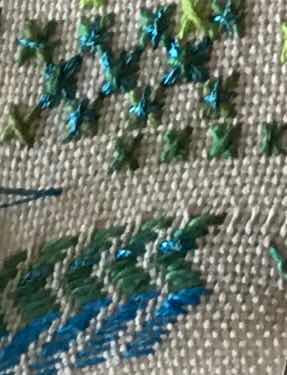

We began by sketching a curved shape which would become the void. I decided to use my initial. I was working on very open weave Lugana, about 25 count. From the threads I had brought along, chose a green perle 5, a stranded electric blue, a matching stranded metallic and a gold poly metallic.

I worked a tiny sample in a corner of the fabric. I was pleased to go against the Blue and green should never be seen without a colour in between mantra of my childhood!
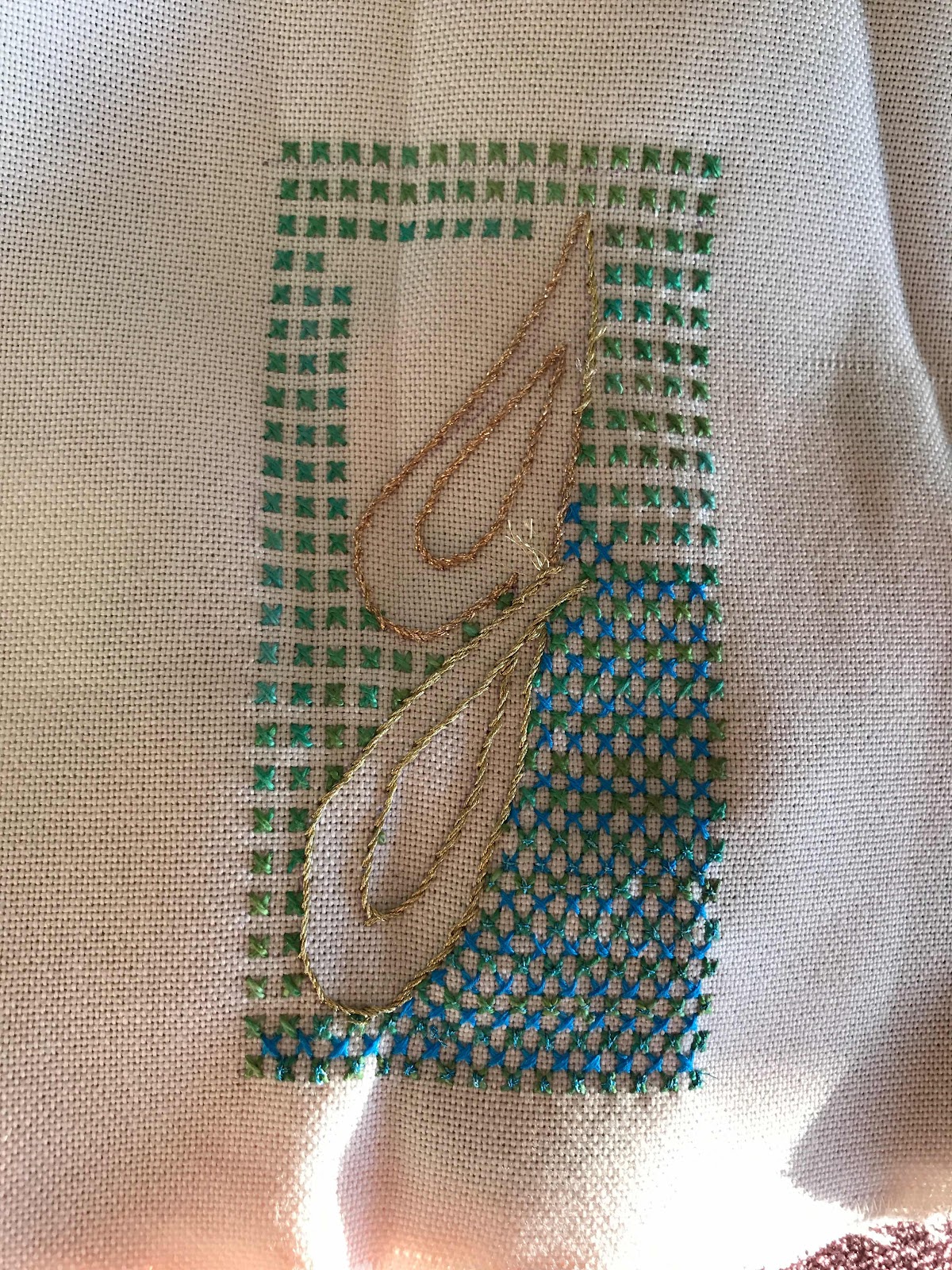


I outlined my initial in the gold,  then began to fill in the background using one of the stitch samples Carol had provided.
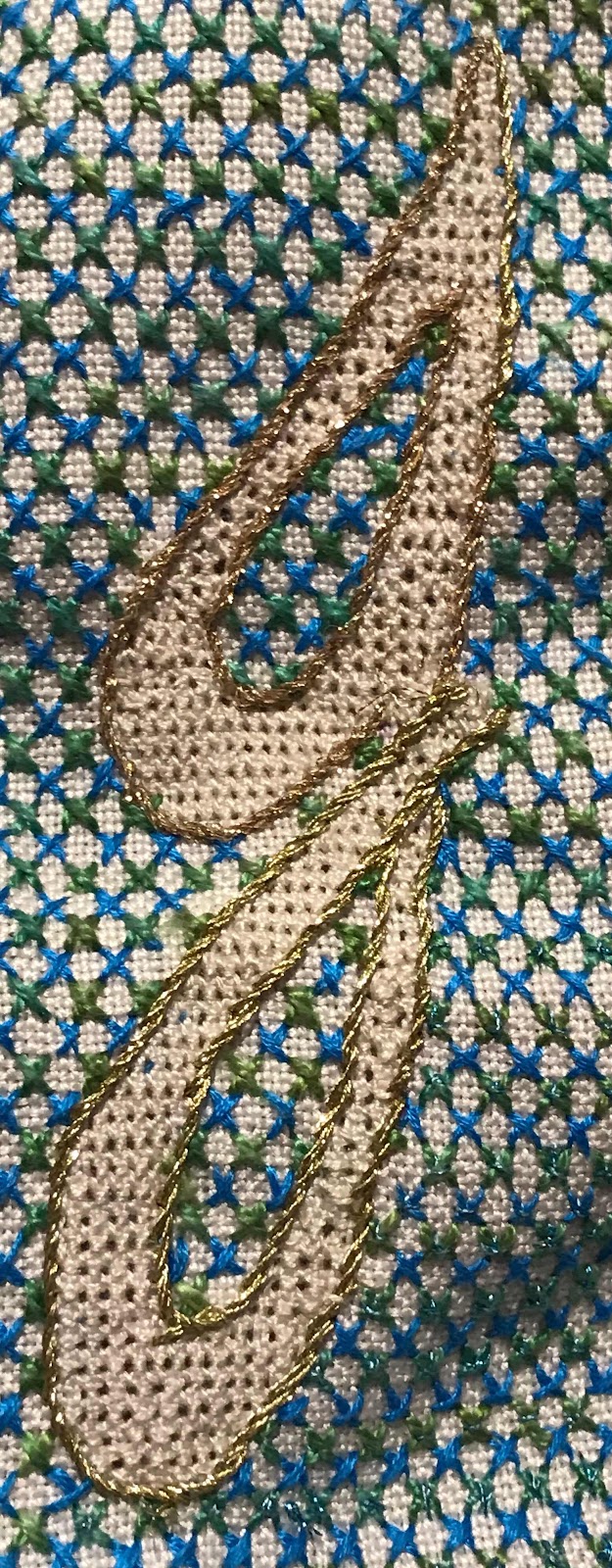

It was a great workshop. Everyone rose to the challenge of making it work without Carol. It was bad enough that she was sick - we owed it to her to use what she'd provided to manage our own learning. Mary did an amazing job of helping us as did the Course coordinators.
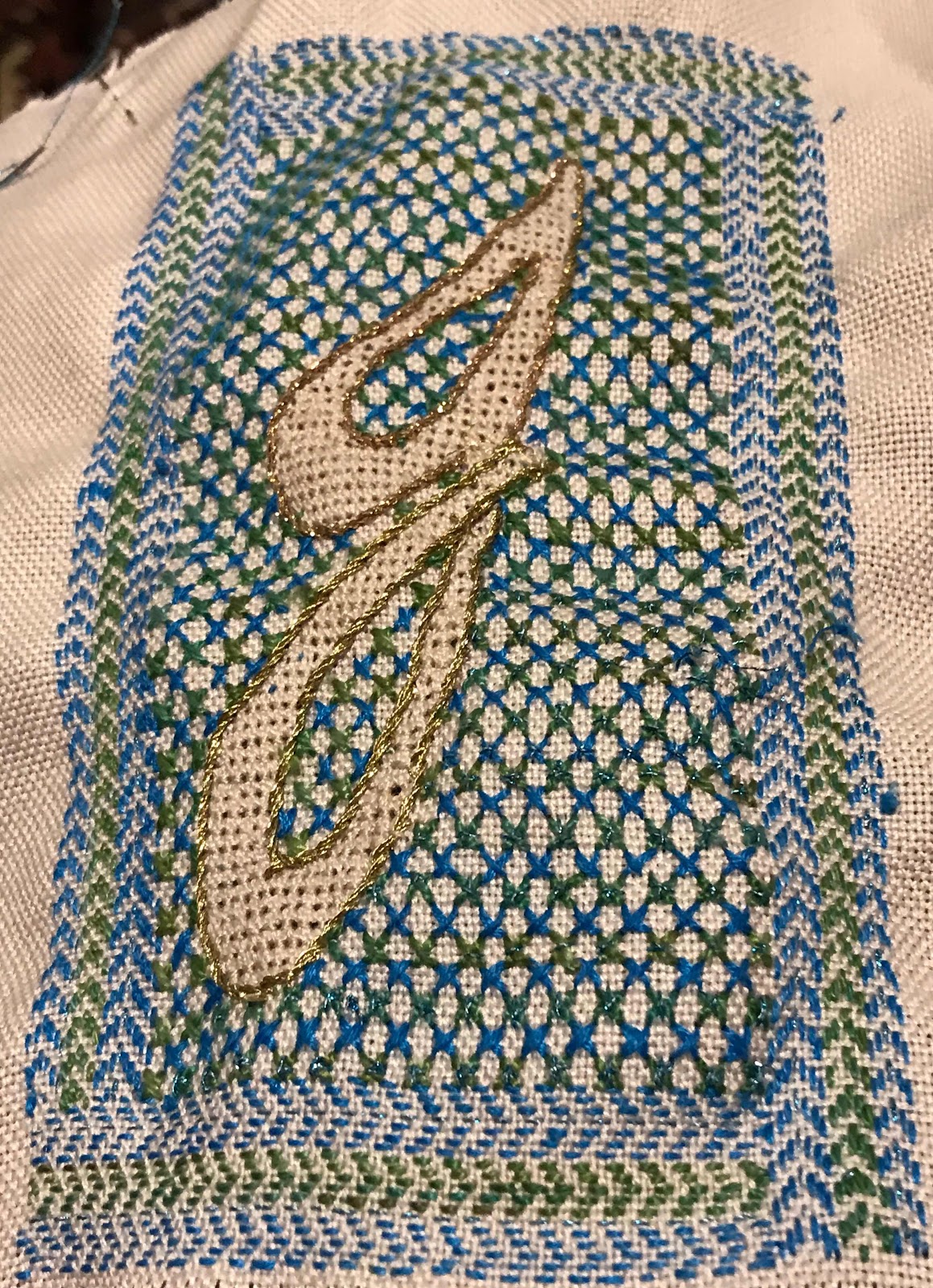
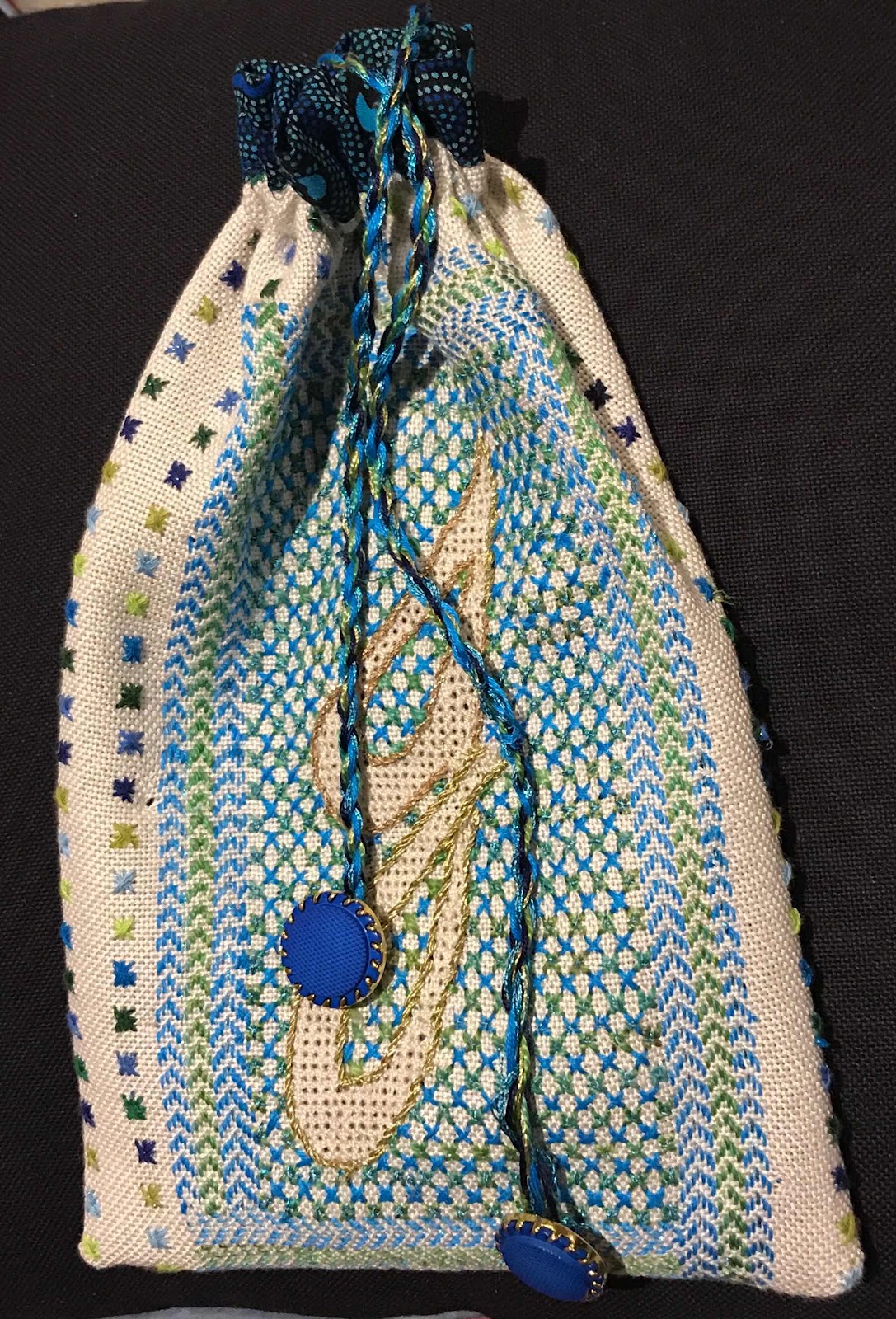
At home I filled the curved void with four-sided stitch. Around the first layer of background I put a border of running stitch arrow heads. There were challenges with tension. Most of these stitches are done by scooping rather than stabbing, which means holding in the hand rather than a hoop.
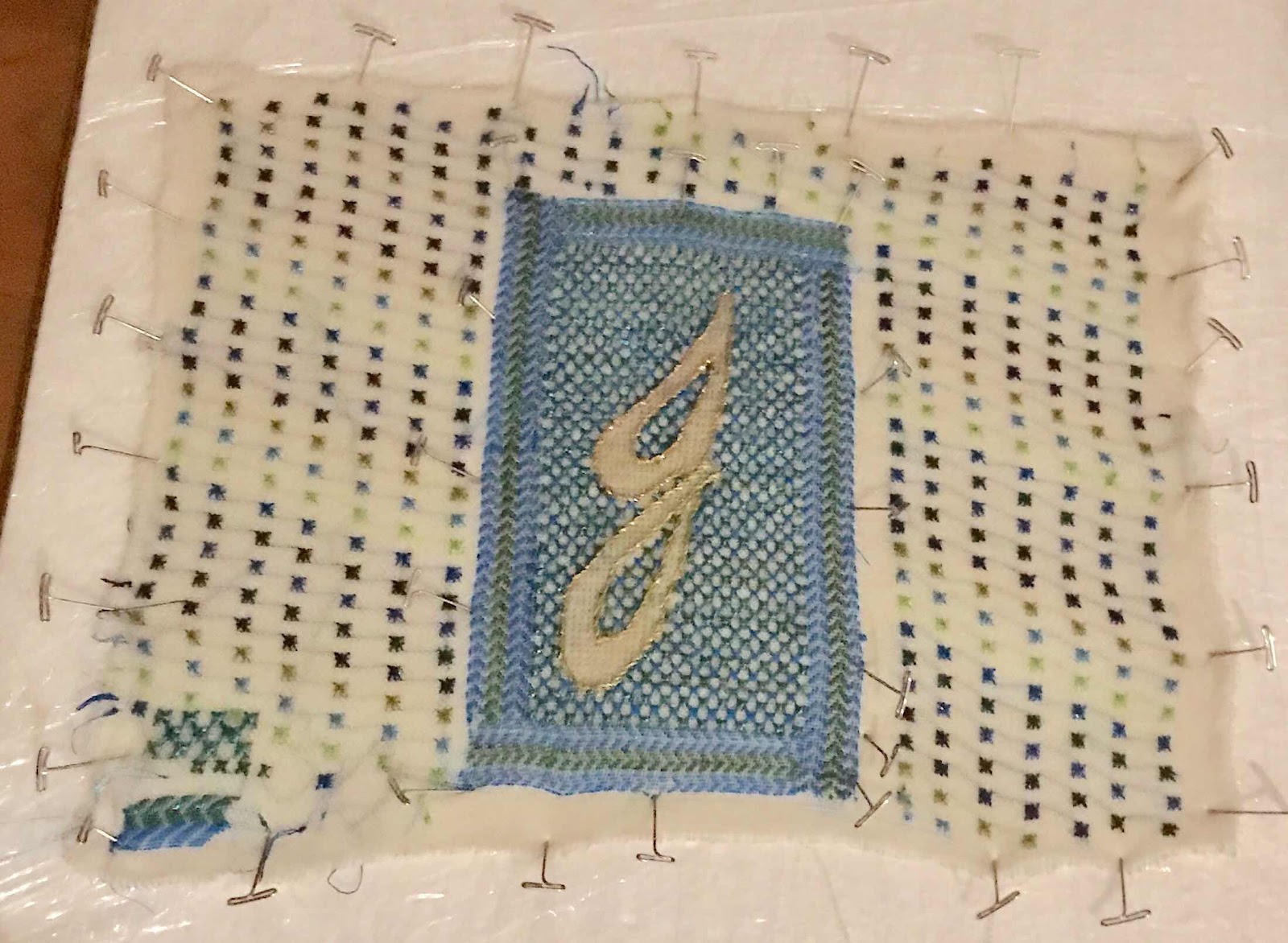


I had by now decided, of course, that I might as well use the whole piece of fabric to make a bag. I therefore worked another variety of the background stitches to cover the whole piece. For this I used some of my set of DMC Etoile thread - a soft stranded cotton with a touch of sparkle.

At this stage I blocked the piece to remove the bagginess created by the differing tensions.

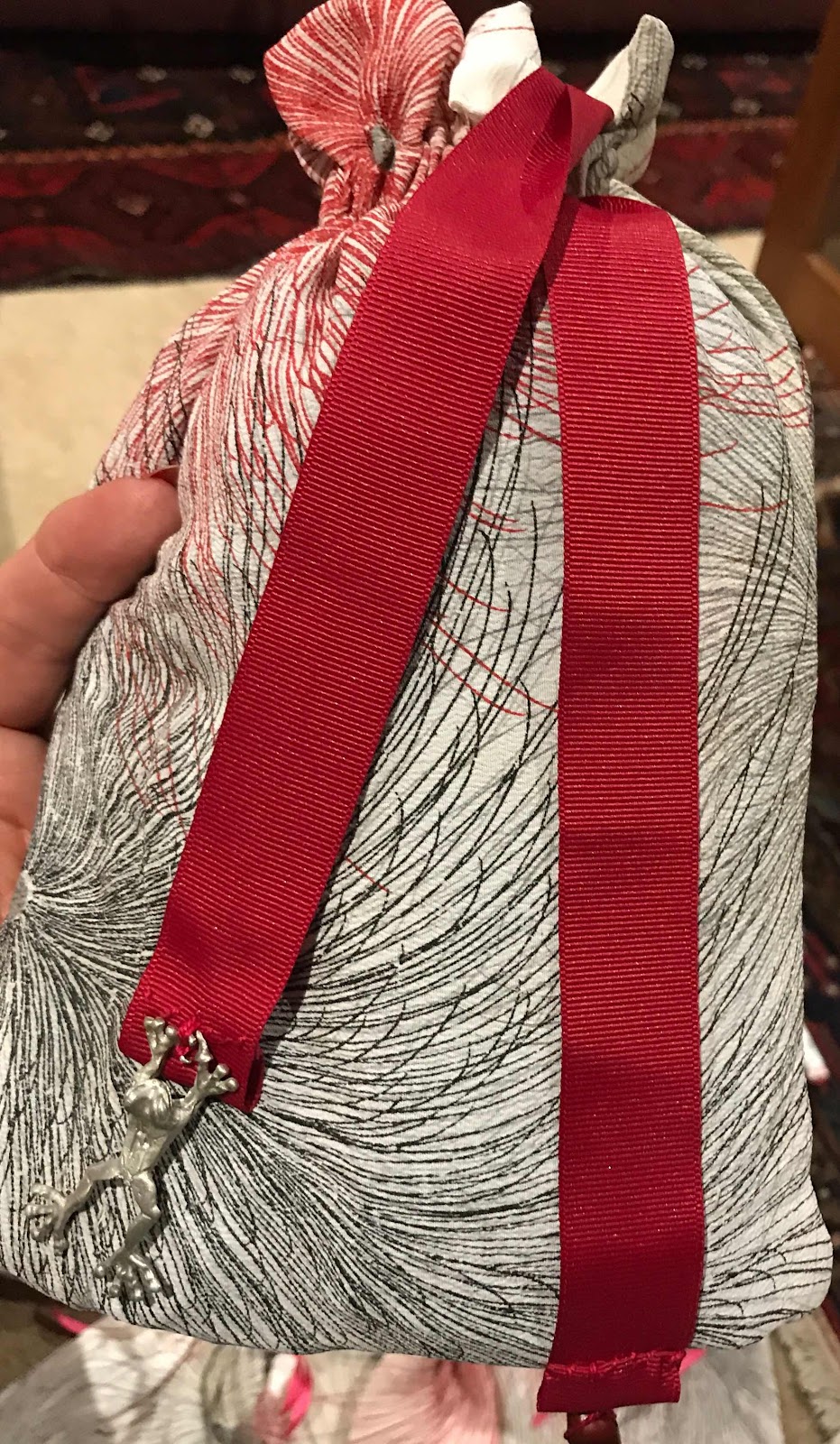
I folded the piece, stitched a back seam and the bottom.  I added a lining from some of the fabric I had left from my River Matters project . It's a mix of cultures, but the colours work well.
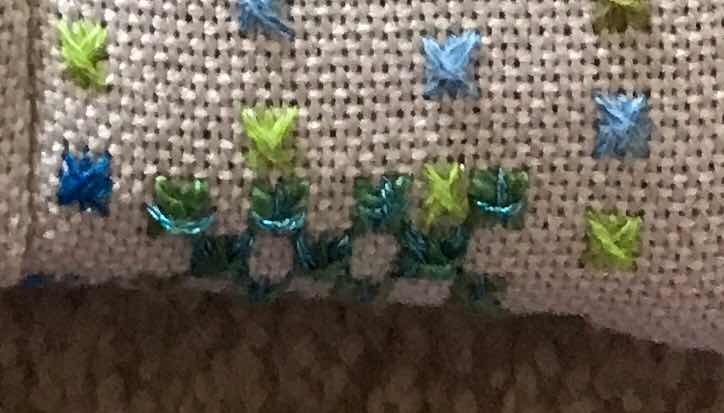
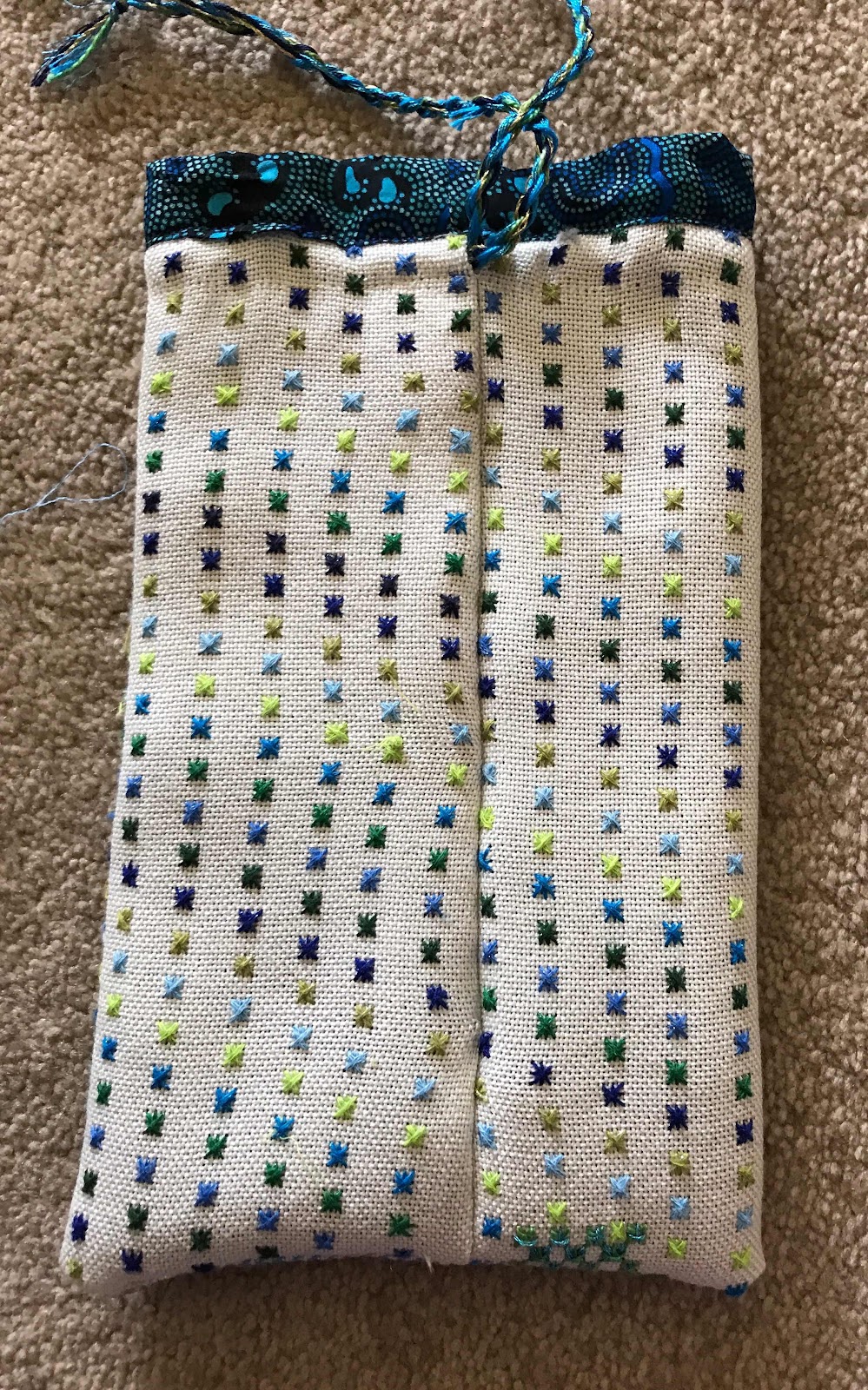
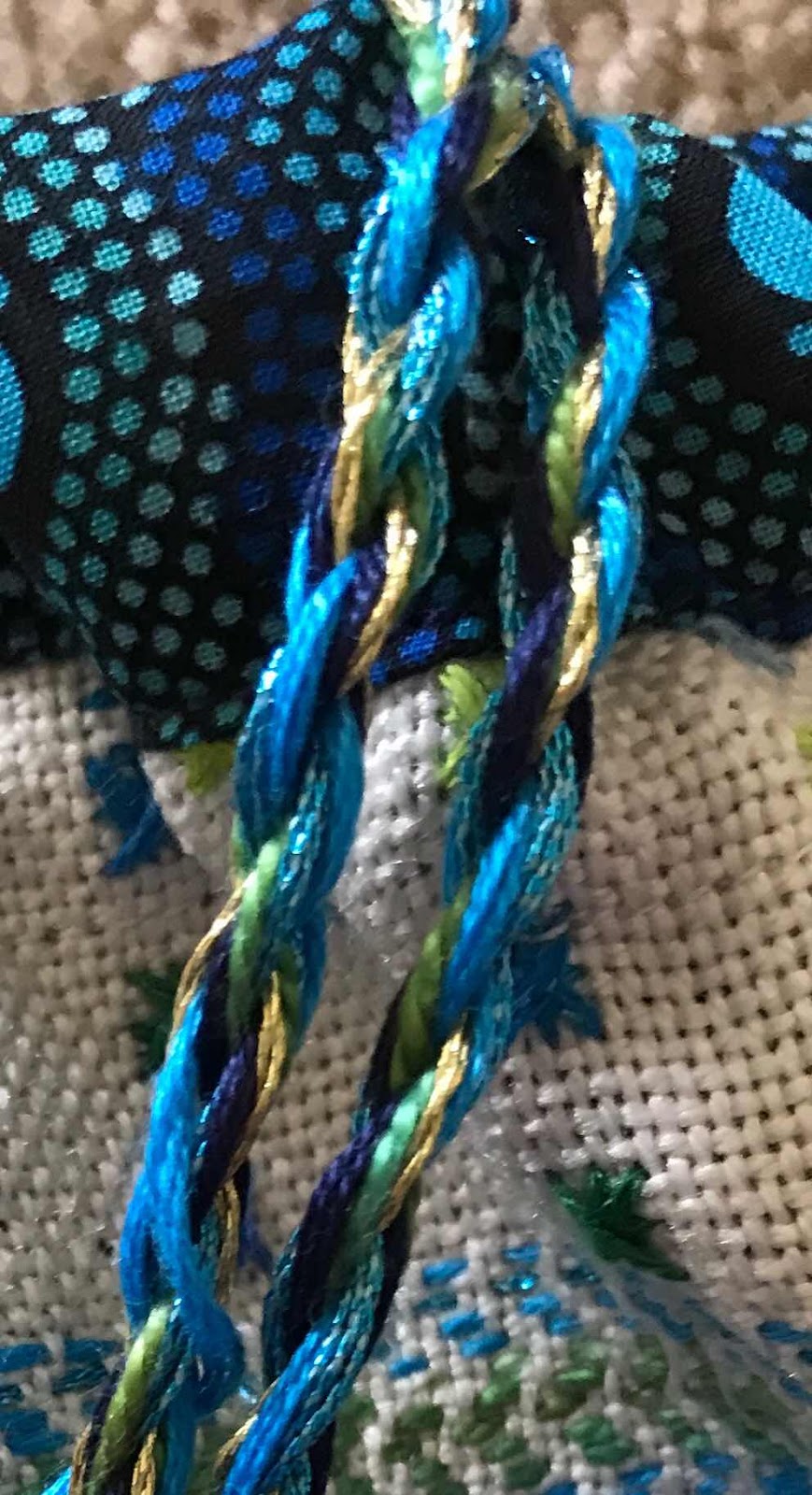
Notice that part of my initial sample stitches survives at the bottom seam. The twisted cord is made from strands of the basic threads used (without the Etoile).


As a final touch I added cord endings  from my button stash.

I'm not sure yet, what I will keep in this bag - but I'm very pleased with it and I'm sure something will turn up!


It is such a privilege to take part in these workshops. Thanks to all who made it possible.


Tuesday, January 21, 2020

Japanese bag therapy

This is, I notice, my 515th blog post. Seems apt that it should be published on 21/01/20.

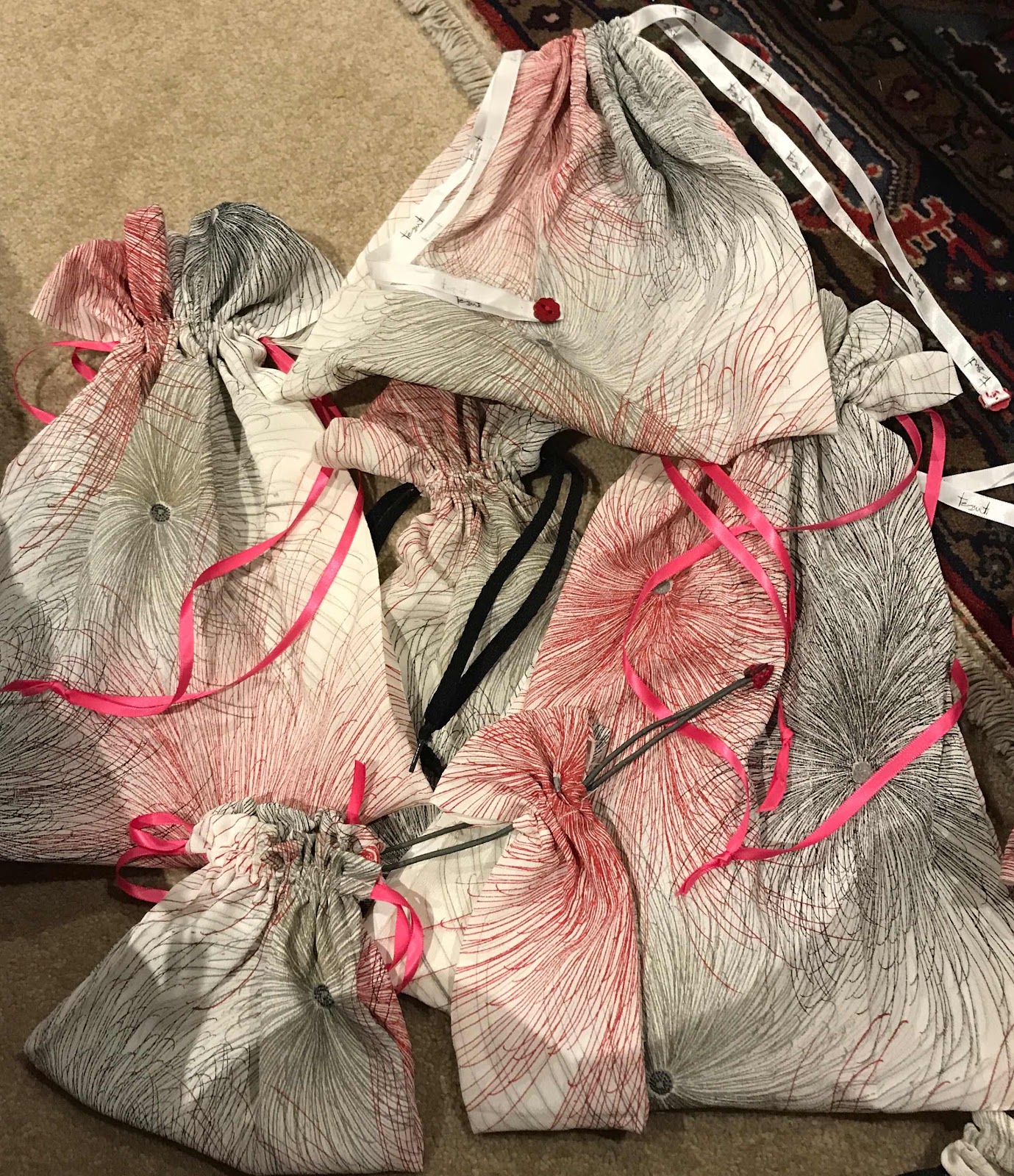
Christmas made a serious dint in my supply of the large drawstring bags I use in place of wrapping paper. I still had a good supply of small bags but decided I needed to make more medium and large bags. My whole family uses and recycles these bags so I like to keep the supply going - and the making of them is, for me, enjoyable, even therapeutic.

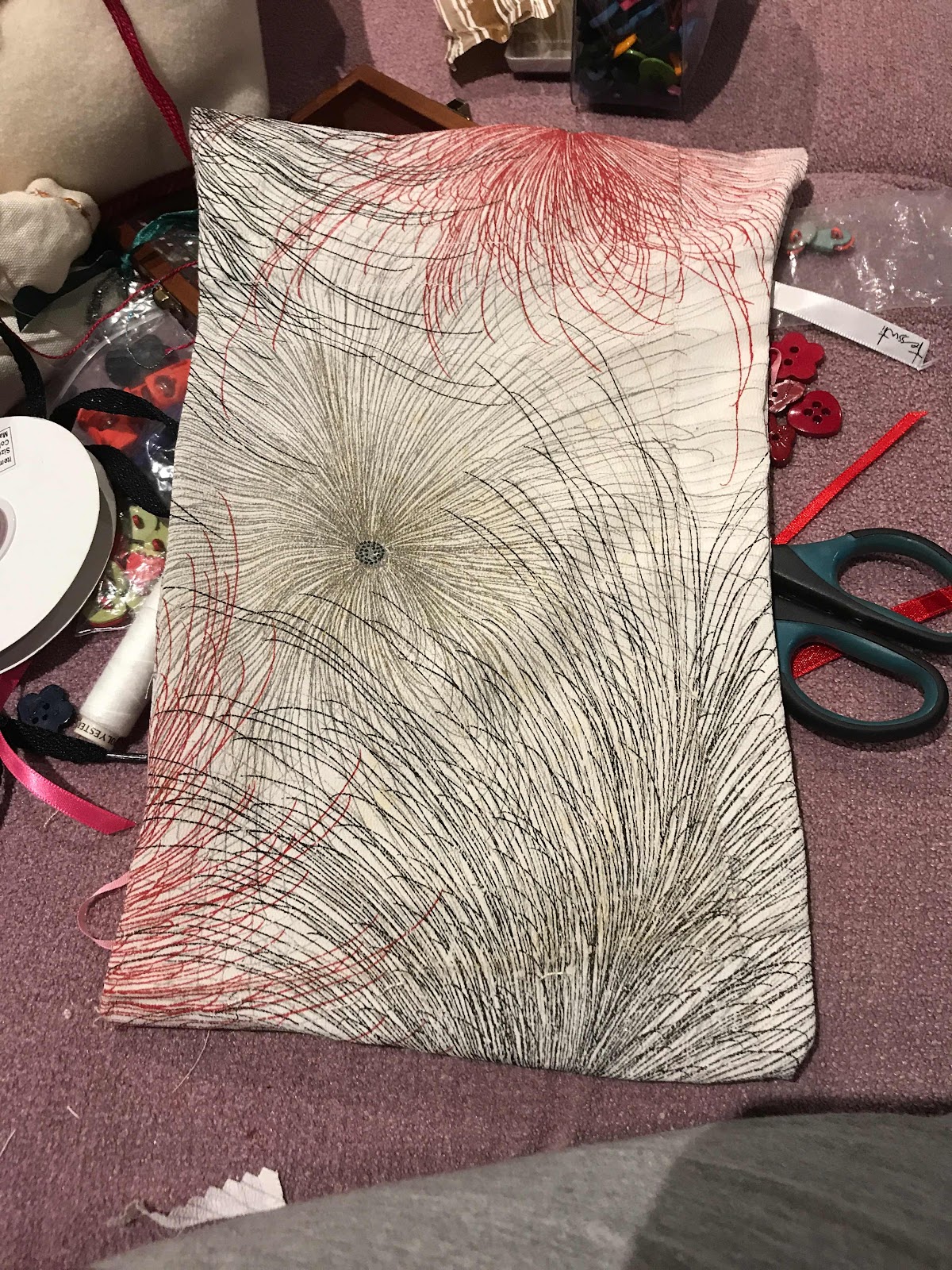
In the past I have purchased vintage sari and kimono pieces for these bags. This time I unpicked a kimono jacket given to me by my daughter. It took a bit of unpicking as it turned out to be made from a huge length of obi-width fabric, folded and tacked ingeniously - as kimonos usually are. Regretably, I didn't take photos of the unpicking and ingenious folds.


The jacket was fully lined. In some cases I used the lining as a lining for a bag. In other cases I made a bag of the lining and a bag of the outer layer.

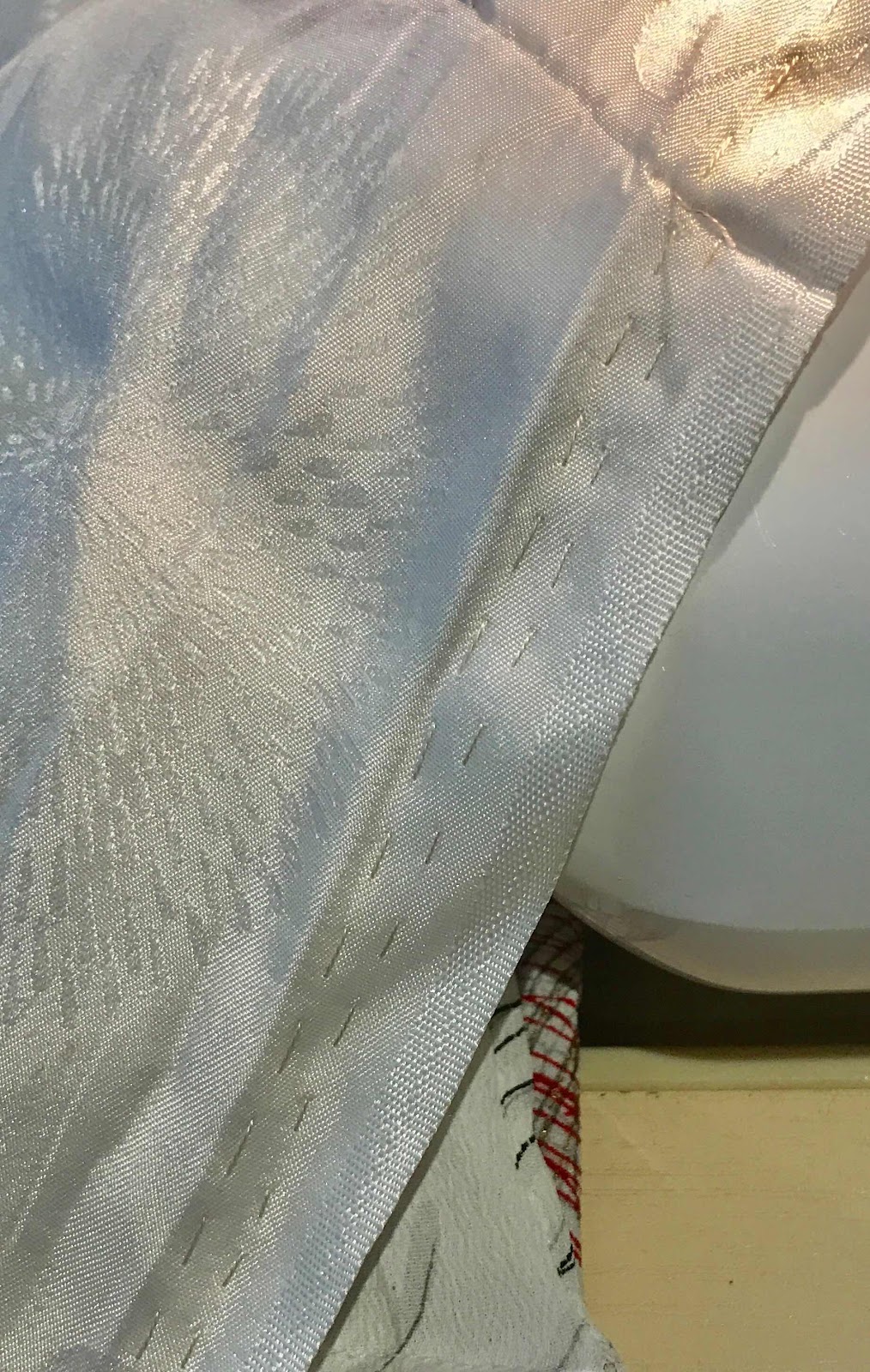
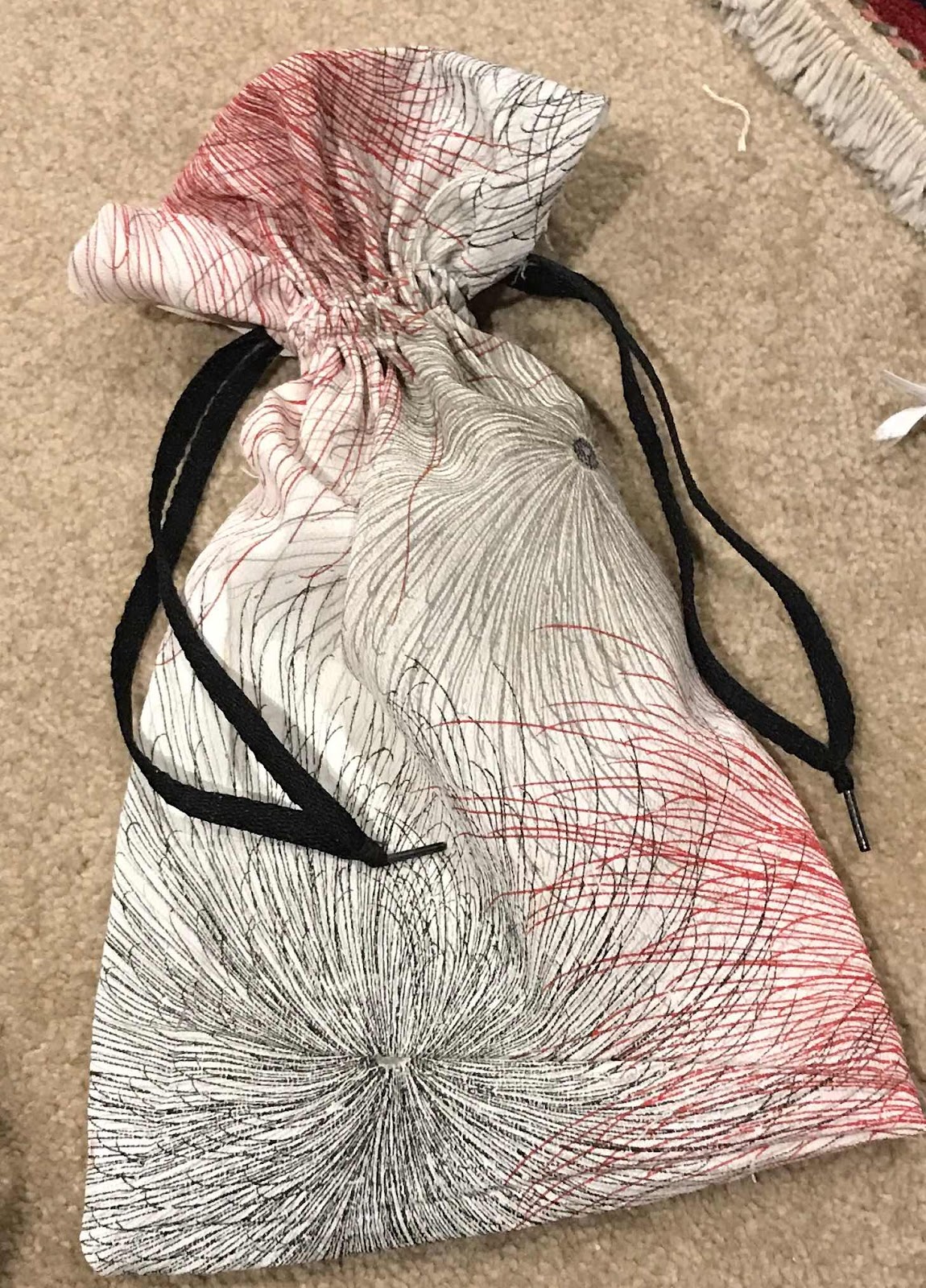
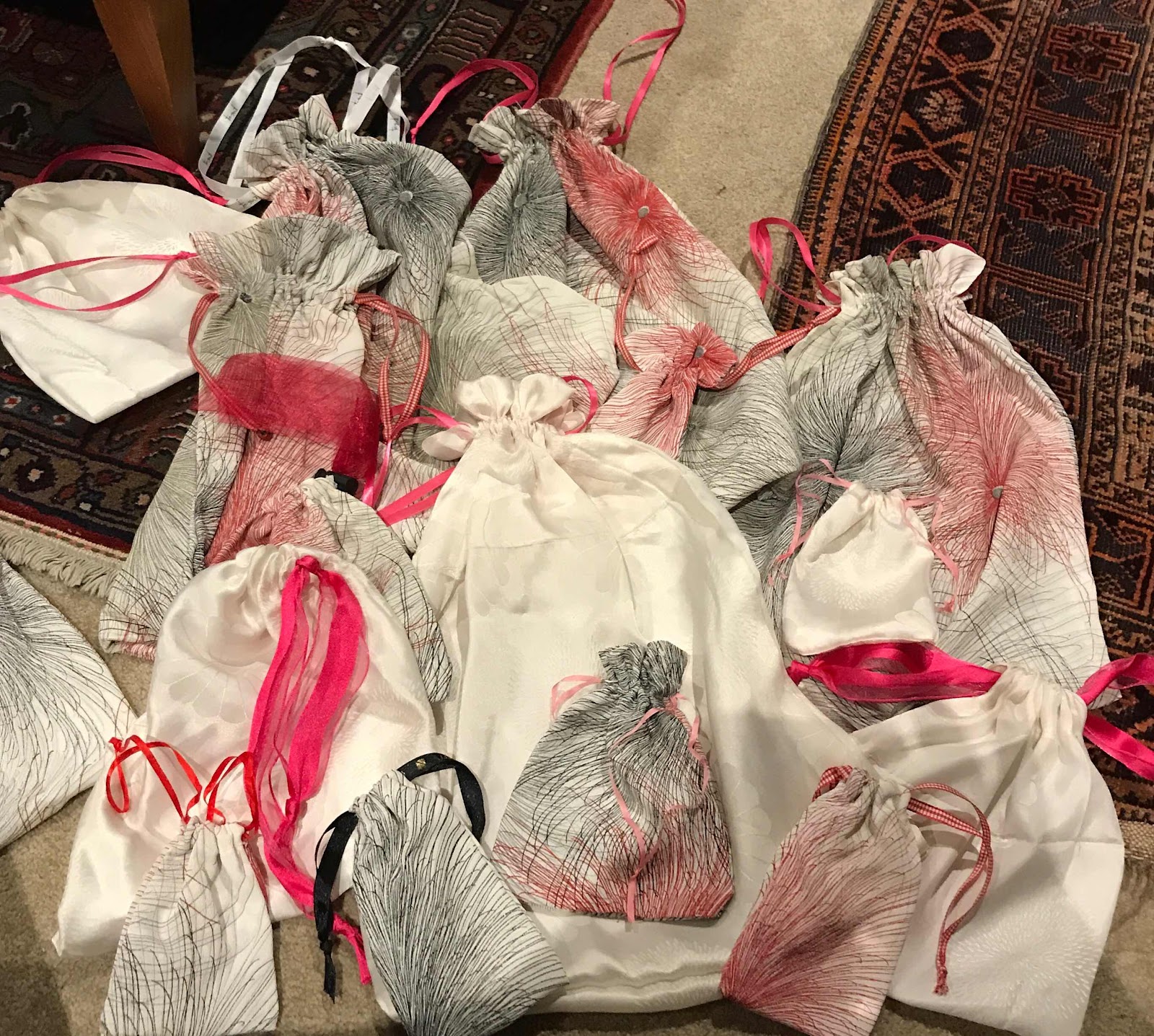
It made 23 bags of very varied size, from very small to fairly large. I like to let the fabric dictate the shape and size. Flaws and holes get incorporated. I kept as much of the original hand-stitching as I could. Much of it was stitched using two rows of running stitch.


After stitching the bags, I spent a relaxing evening finding matching ribbon or drawstrings of various cords, such as shoelaces.  A further hour or so was spent finding stoppers for the cords, using the remains of old earrings, buttons or, in some cases, knots.


I could have done with some more red ribbon, but made do with the strong pink I had at hand.


A very satisfactory result for a few hours work.

I really love recycling!

Friday, January 17, 2020

Chicken scratch apron


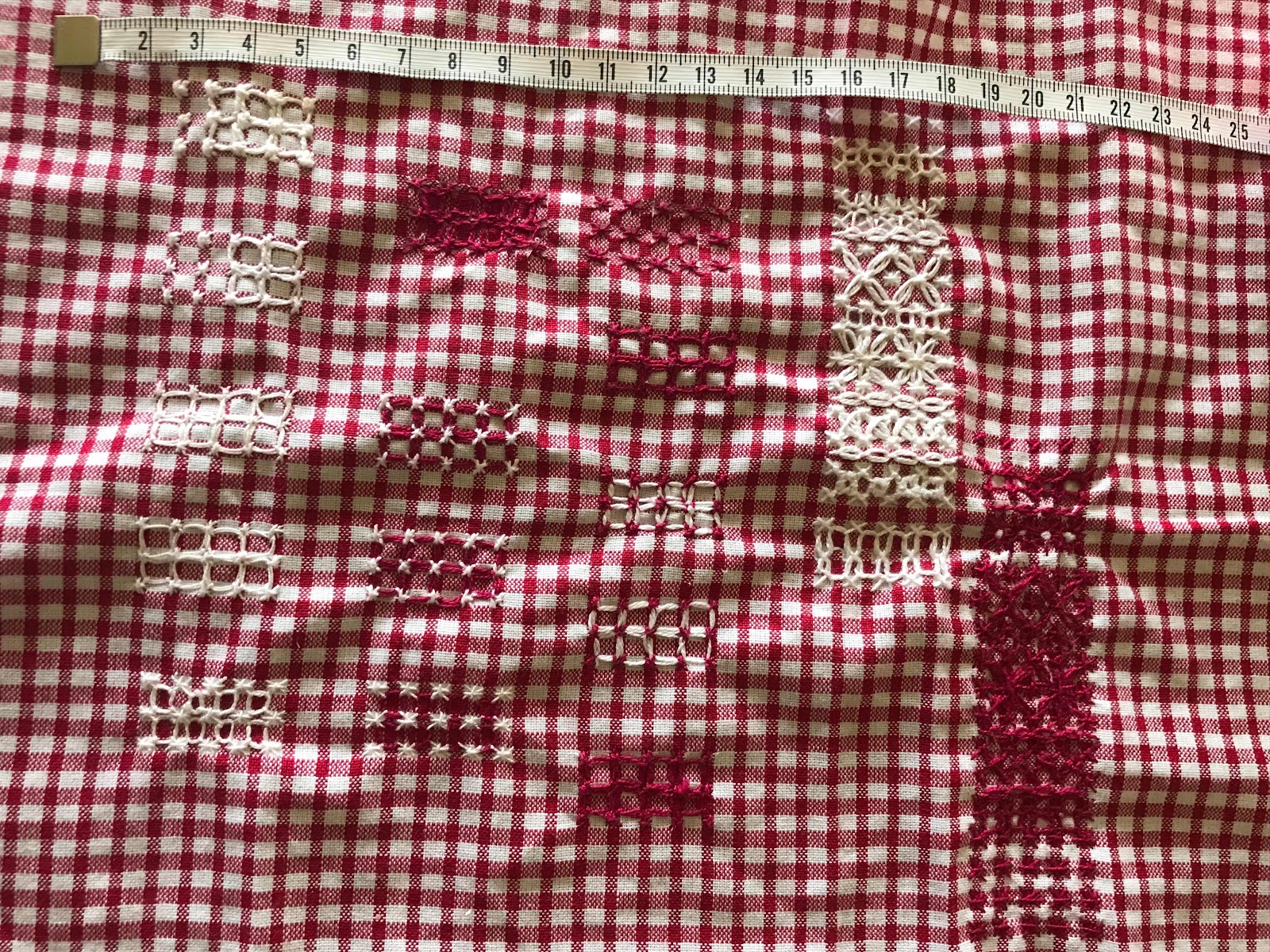
A year or so ago I did a workshop at the Embroiderers' Guild on Chicken Scratch, or Depression lace. We worked a little sampler, mine on a piece of small squared gingham that I happened to have left over from something.

I really loved the result. It was fascinating to see the different effects of using the red or the cream thread, and  from stitching on either the red or cream squares.

Others at the workshop had some striking fabrics they had bought from Trish's fabric shop in Adelaide. I visited after the class and bought three pieces with the intention of making aprons.

I also went hunting for patterns for cover-all aprons in the Japanese style. In the end I bought two aprons online to use as templates - cheaper and easier than patterns!
The time has never been quite right, but this Christmas, when I bought my eldest granddaughter a recipe book for Christmas, I thought it would be good to make an apron to go with it. I chose this piece pf fabric - a bold check rather than a gingham.

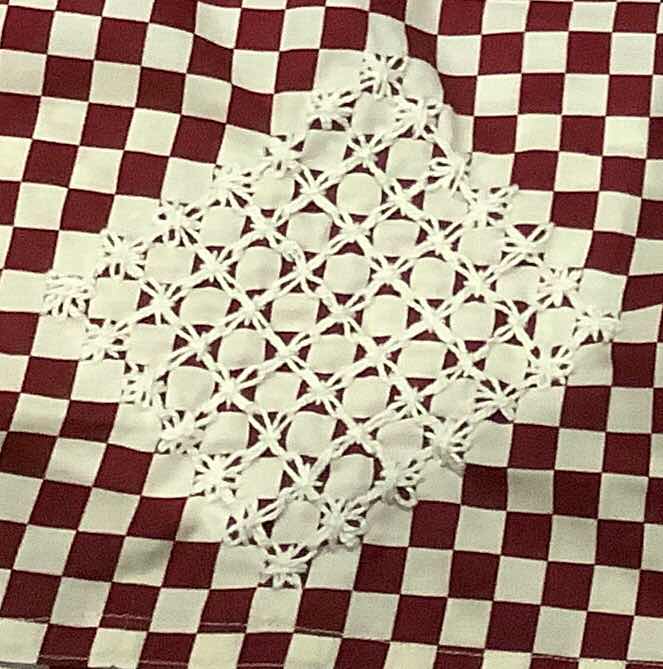
Because the squares were about half an inch, I needed quite a heavy thread to get coverage, and settled on this crochet cotton. It needed quite a large needle, but worked well.

I had bought a metre of the 140cm wide fabric. The length gave me the drop, less a strip for the cross-over straps,  and the width enabled me to cut the wrap-around apron without side seams. Using the pieces I cut out from the arm holes for pockets, I just had enough to patch together some bias strips to edge the curves.

I began the embroidery with the pockets, using detached chain crosses and edging it with double crosses.


Along the bottom I worked simple crosses on the red with cream thread. I really love playing with the different effects.


I kept referring back to my sampler.


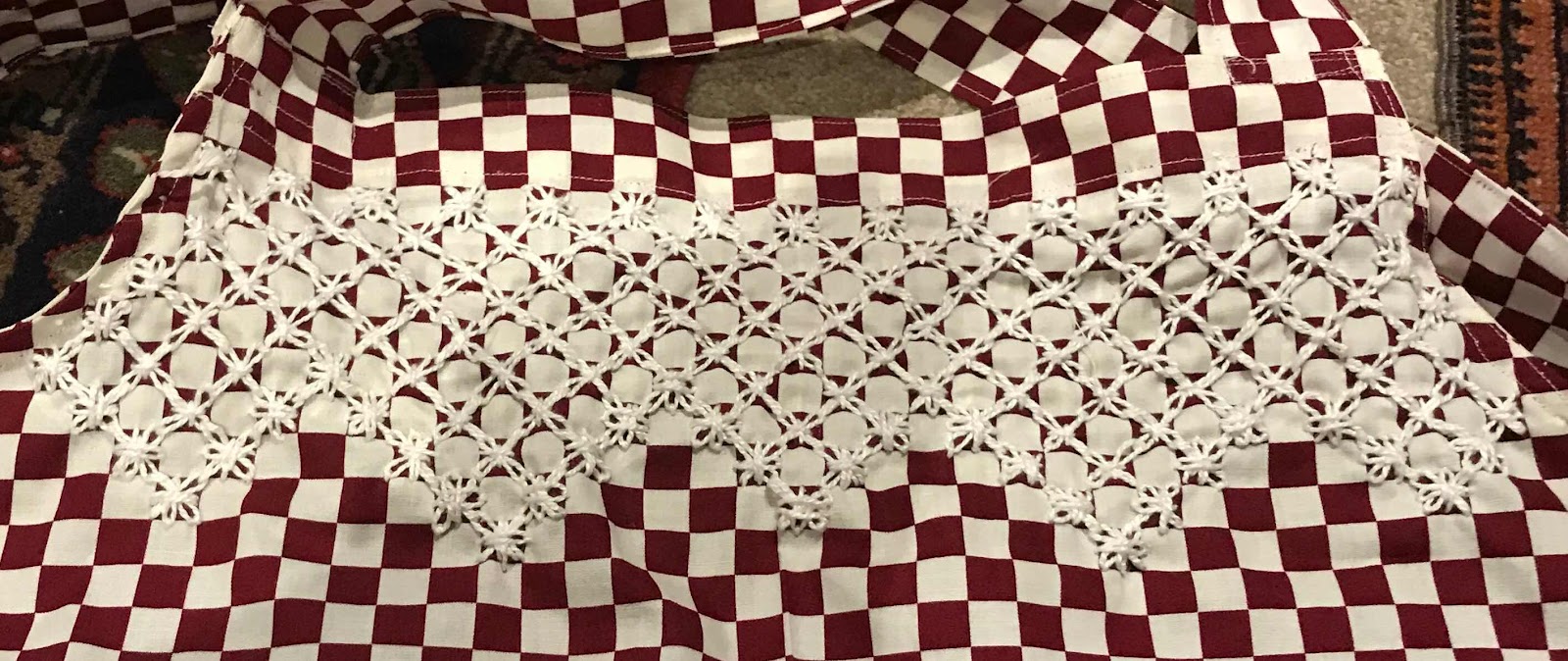
The yolk presented the greatest challenge. I had a couple of adaptations before I was happy. It needed quite dense fill to achieve the lacy look.
I didn't have a model to photograph the finished piece, but I was delighted with it. It is sturdy, but looks quite delicate.


It made a good present to accompany the recipe book.

Having taken the plunge I made up the other two pieces I bought after the workshop. That's, however, for another post or two!


Wednesday, January 8, 2020

Hand towel

 I like to make Christmas presents for friends. The trick is to make something they want, not simply something I like to make. One friend, who likes hand-made gifts, grew up in India. She has recently moved to a new home in Adelaide, so I thought I would embroider her a hand-towel, with Indian motifs.

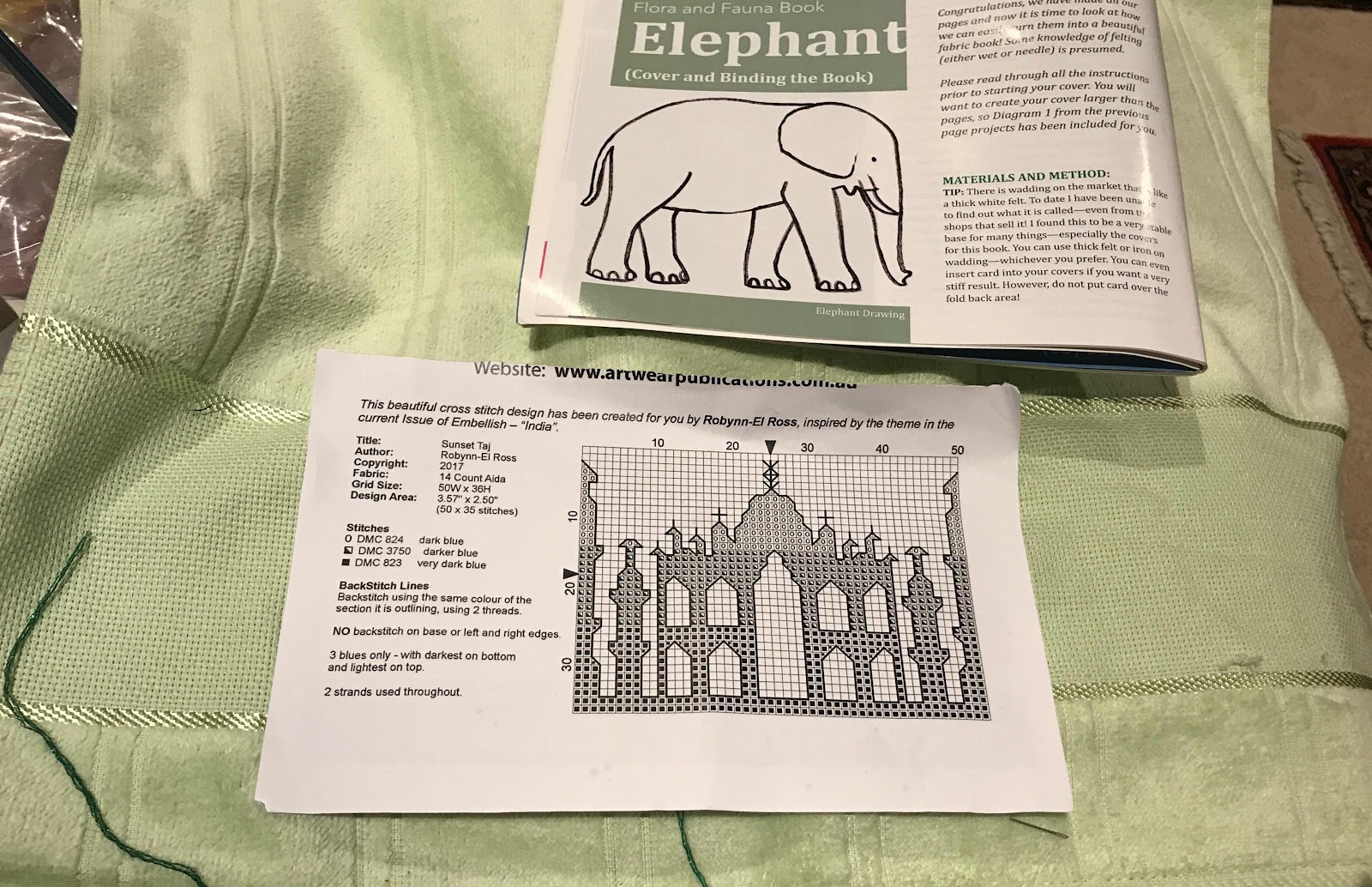
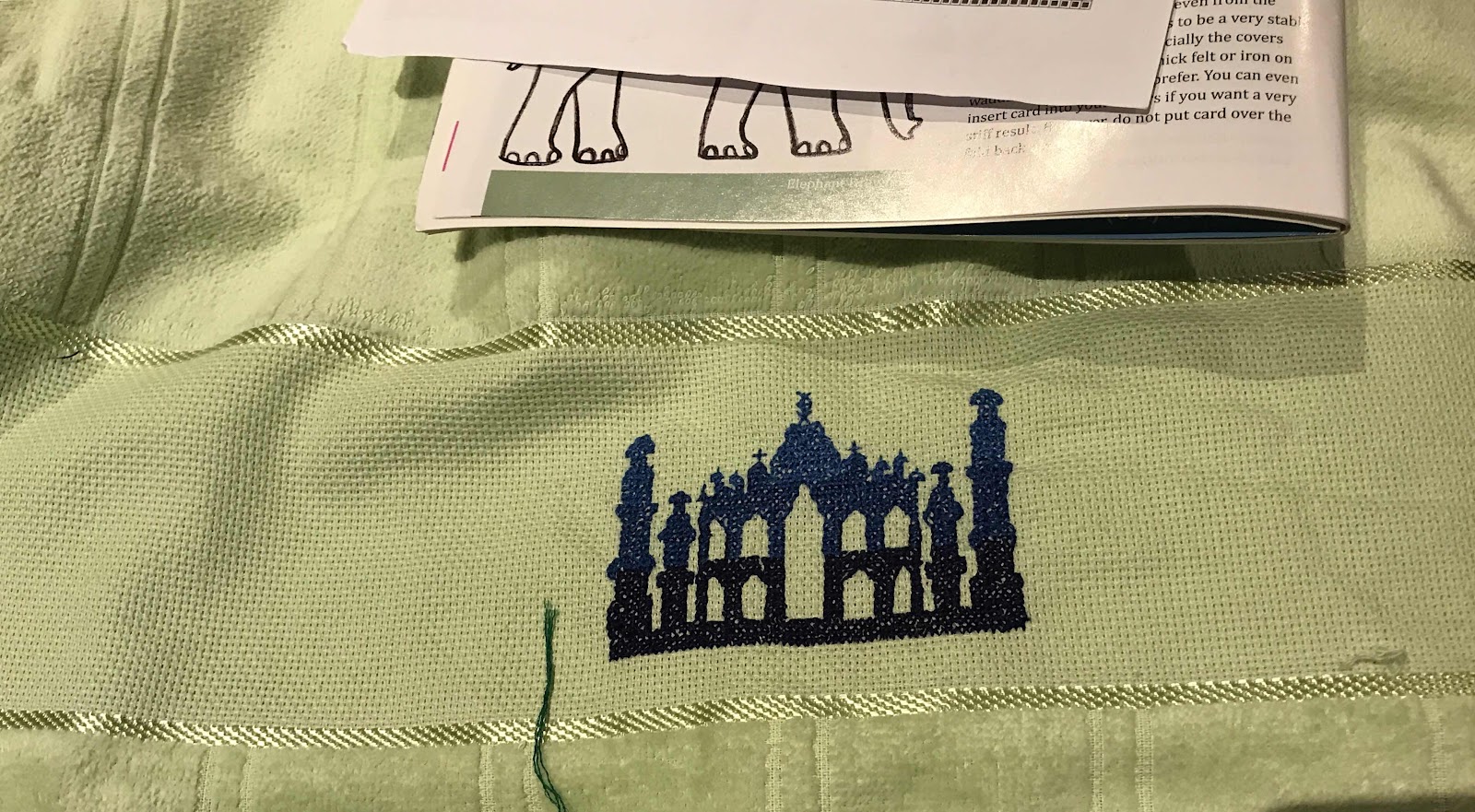
A bit to my own surprise, I found a cross-stitch design of 'Sunset Taj" that I had kept from a magazine, so began with that.

'Sunset' meant in three shades of blue, making it far more like night than sunset. However, I stuck with the blue but definitely night, It worked well, but looked too small on its own on the towel. I tried other Indian motifs, like elephants, but the scale was badly wrong.

After looking at dozens of photos of the Taj Mahal, I decided to embroider a version of the trees that line the approach to the Taj.

The trees are very dark green, and highly sculpted, although not uniform.

To this I added (but, alas, did not photograph) a crescent moon. As I finished it, I decided it was a mad idea. Who, after all, ever sees the Taj by moonlight?

My friend was delighted. One of her earliest memories, she told me, is of being taken, as a child of 7 years, through a gate, to see the Taj Mahal by moonlight - an image she has kept all her life!  Blew my mind!

Tuesday, December 31, 2019

Greek Museum of Adelaide Exhibition


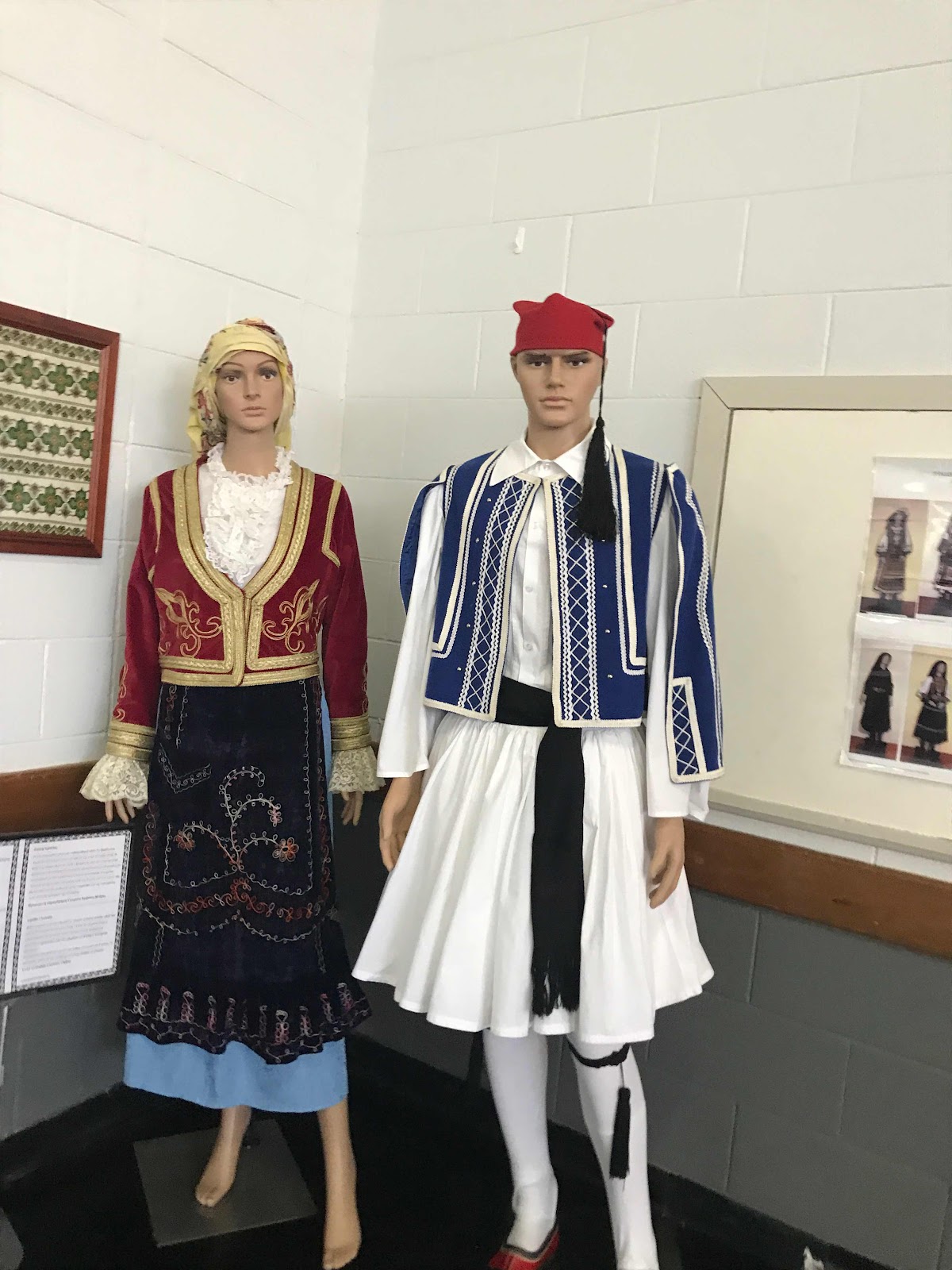
I spend an extraordinary hour or so this morning at an exhibition at the Flambouron Hall, 18 Fulton St Glenelg, guided by Chrysoula Melissinaki, president of the Greek Museum of Adelaide Inc. Chrysoula has lived in Australia for eight years and is passionate about collecting, preserving, displaying and cataloguing art and craft items belonging to the Greek-Australian community in Adelaide.


Most items have been donated by members of the Greek-Australian community. A few come from Museums in Greece or are on loan.


The association hires halls for exhibitions and stores the collection at other times in boxes in Chrysoula's home.

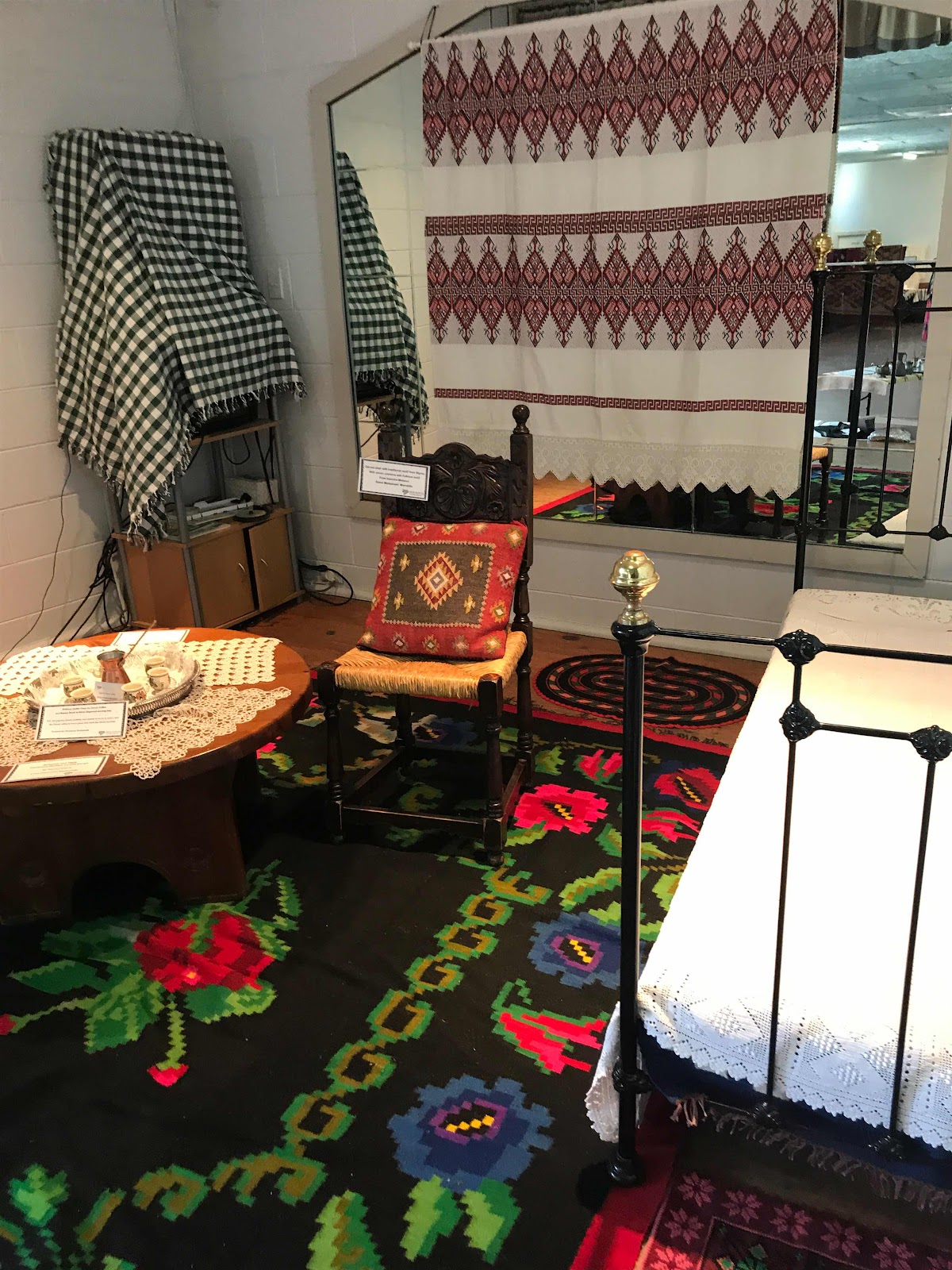
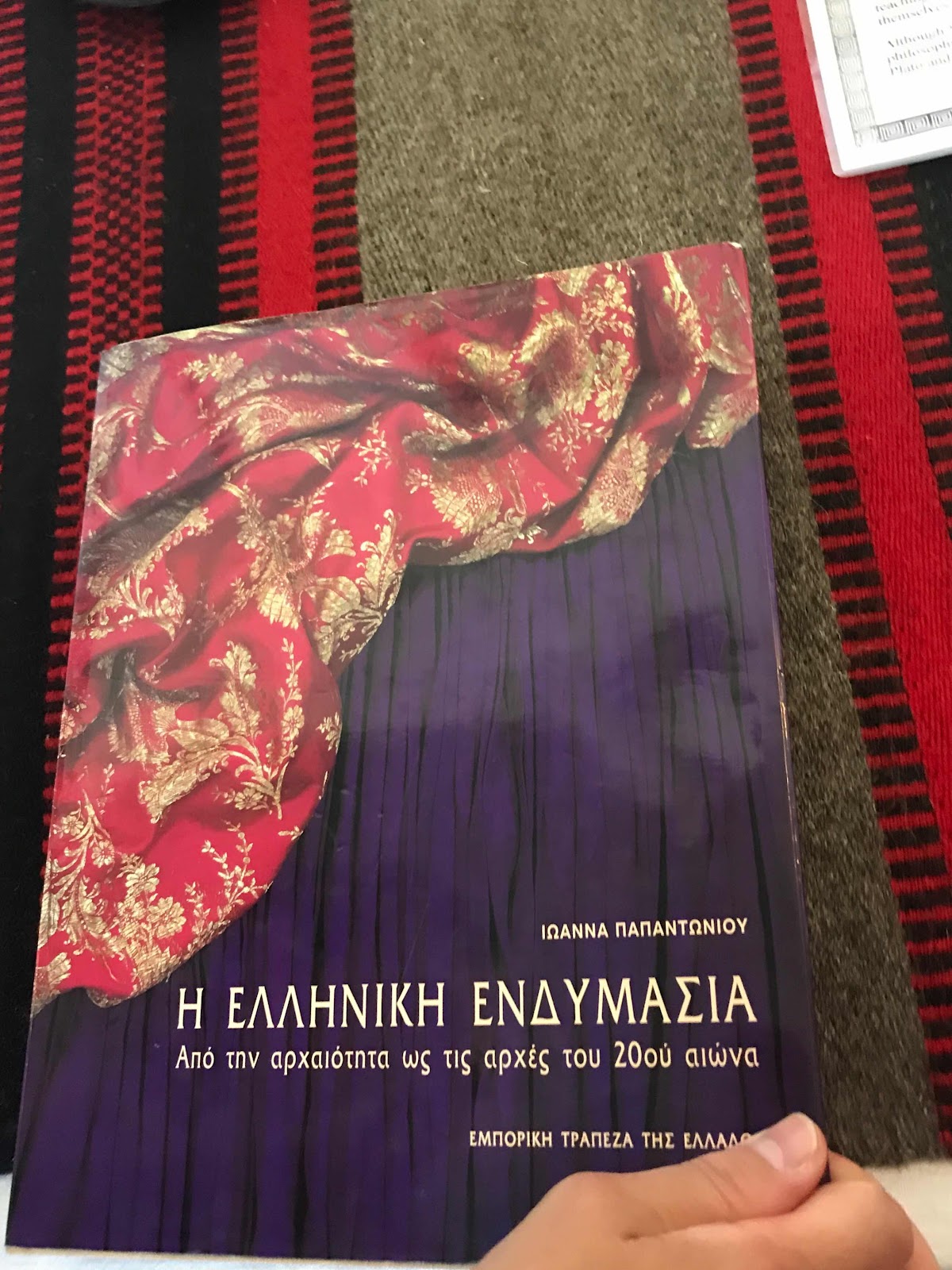
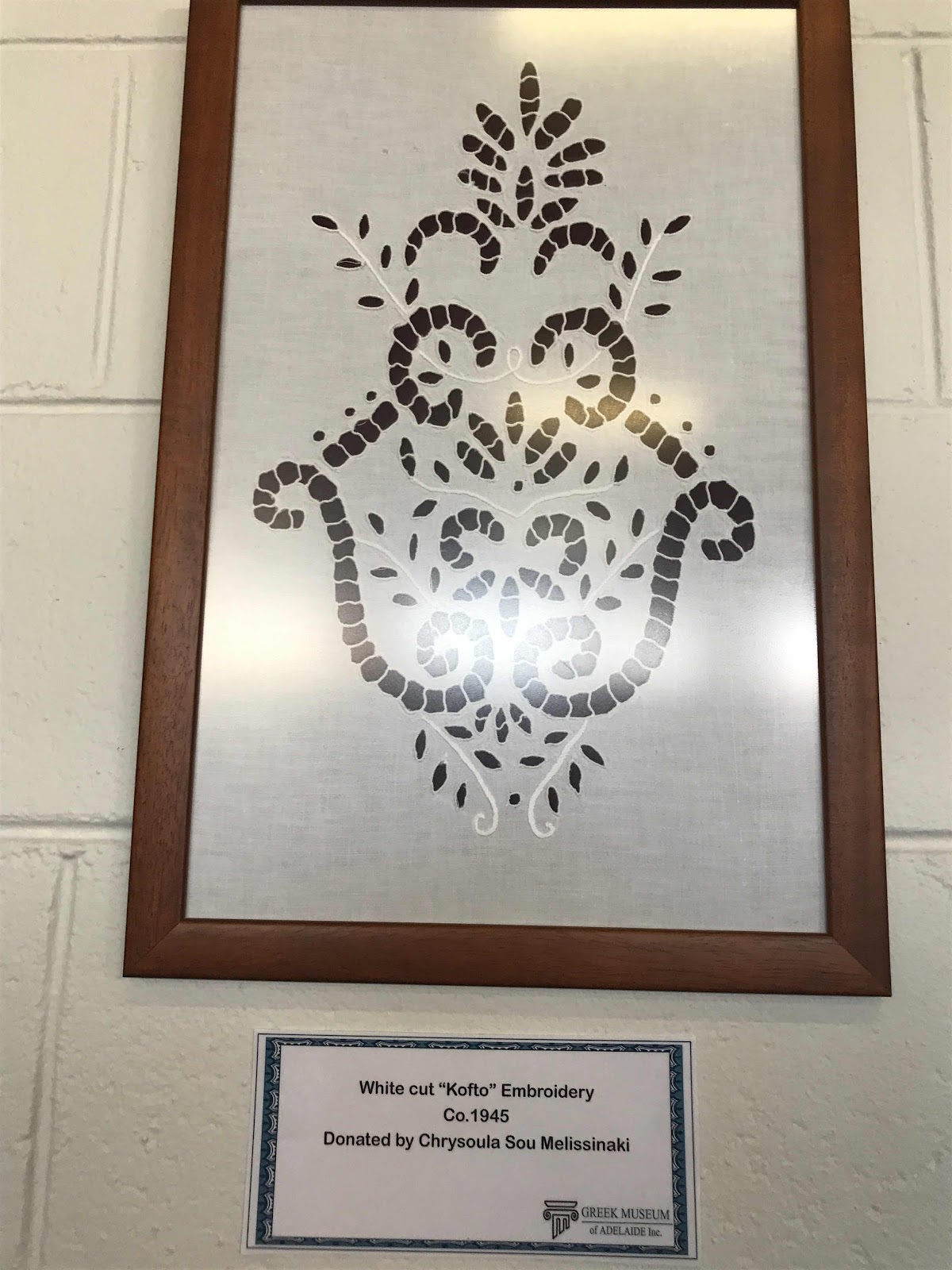
They hope to create a permanent home for the collection. I was mightily impressed. Items were beautifully displayed - indeed curated, with ample descriptions in both Greek and English. Chrysoula has found videos of various elements of the exhibitions and these can be viewed on screens. Also available are books that provide further information.

I was able to take photos, and given permission to use them on social media. Chrysoula took me through the whole exhibition and gave me background on the items.  The exhibition deserves more detailed cover. I am, however, anxious to publish and distribute this tonight, so that friends and Guild members in Adelaide might be able to get to the see it before it closes on Saturday around lunchtime. It will be closed on New Year's Day, but open from 10am -5.30pm on Thursday 2 January and Friday 3 January and 10 am- around 1.30pm on Saturday 4 January.


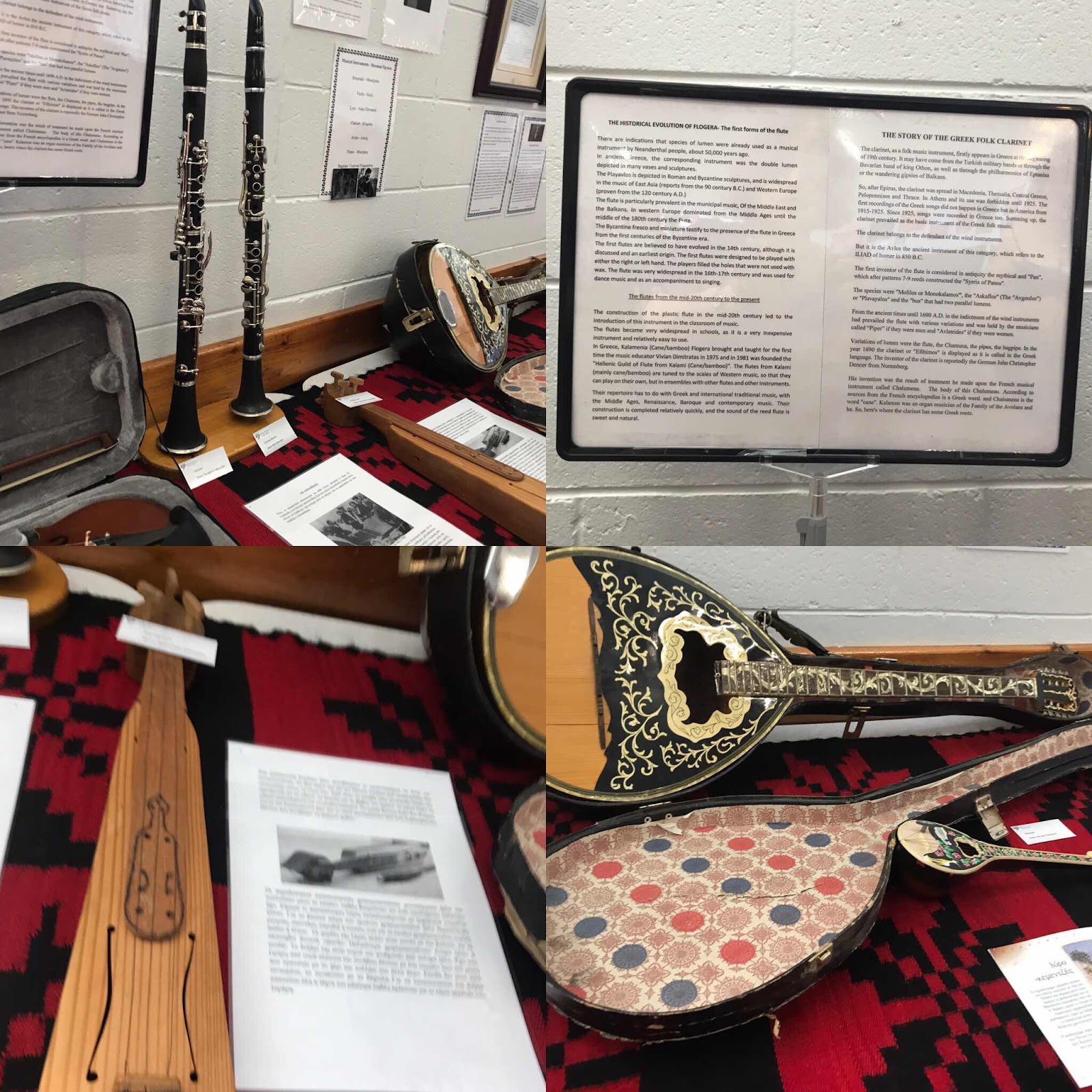
The exhibition covers a wide range of handcrafts, including musical instruments, pressed metal, lamps and a fine collection of old irons.


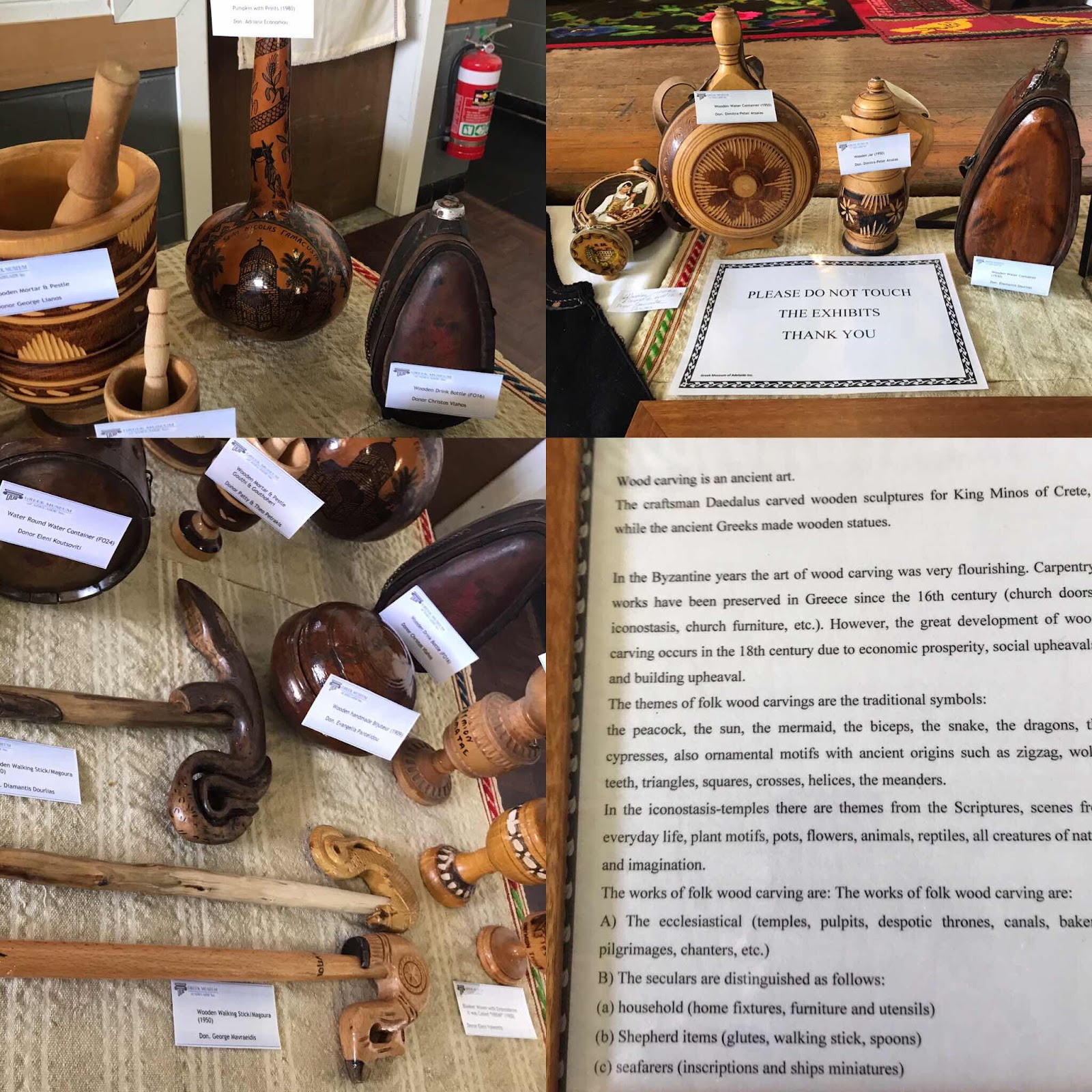
There are beautifully crafted wood items.


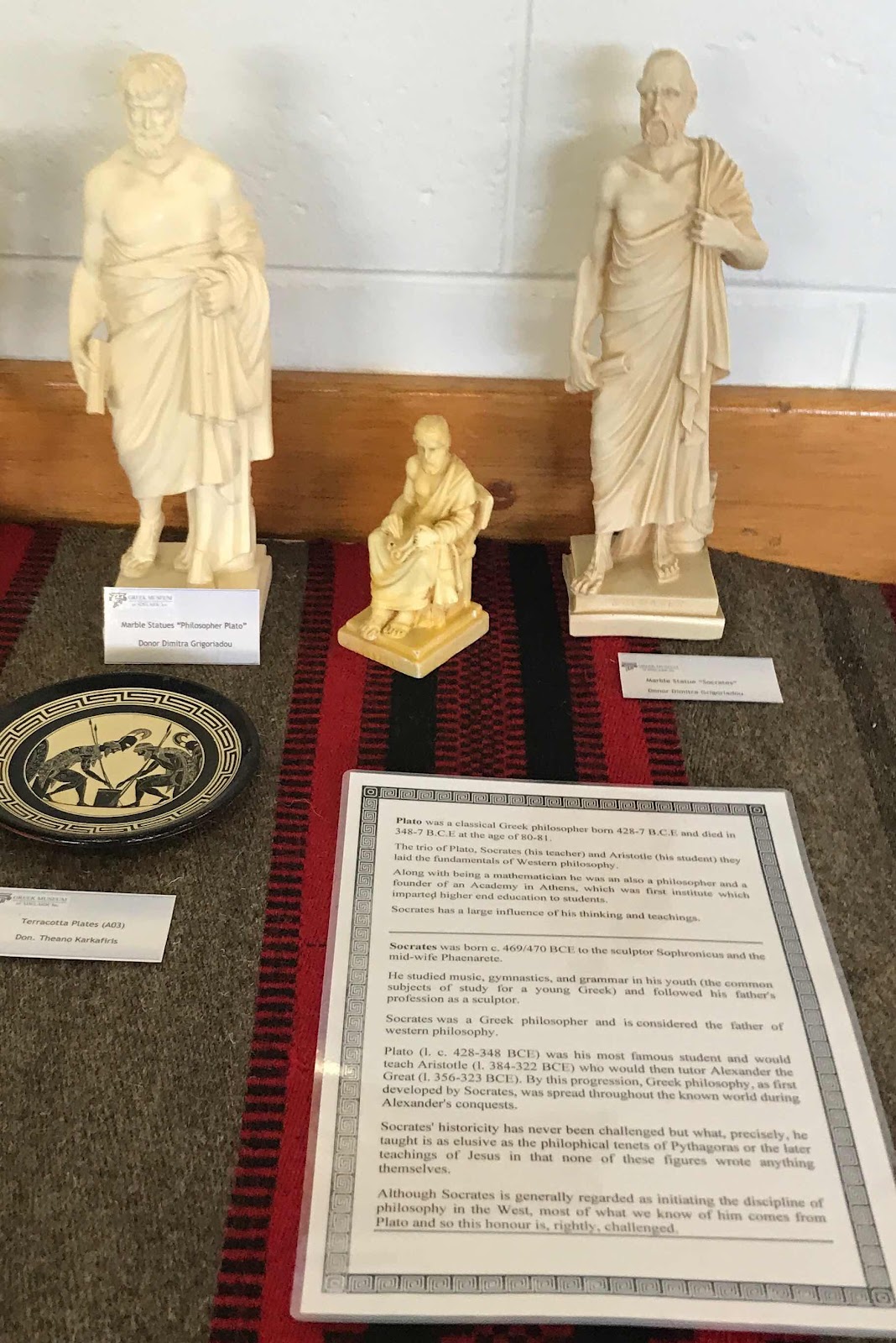
The importance of Plato and Socrates to Greek culture is acknowledged in many homes, and in the exhibition.


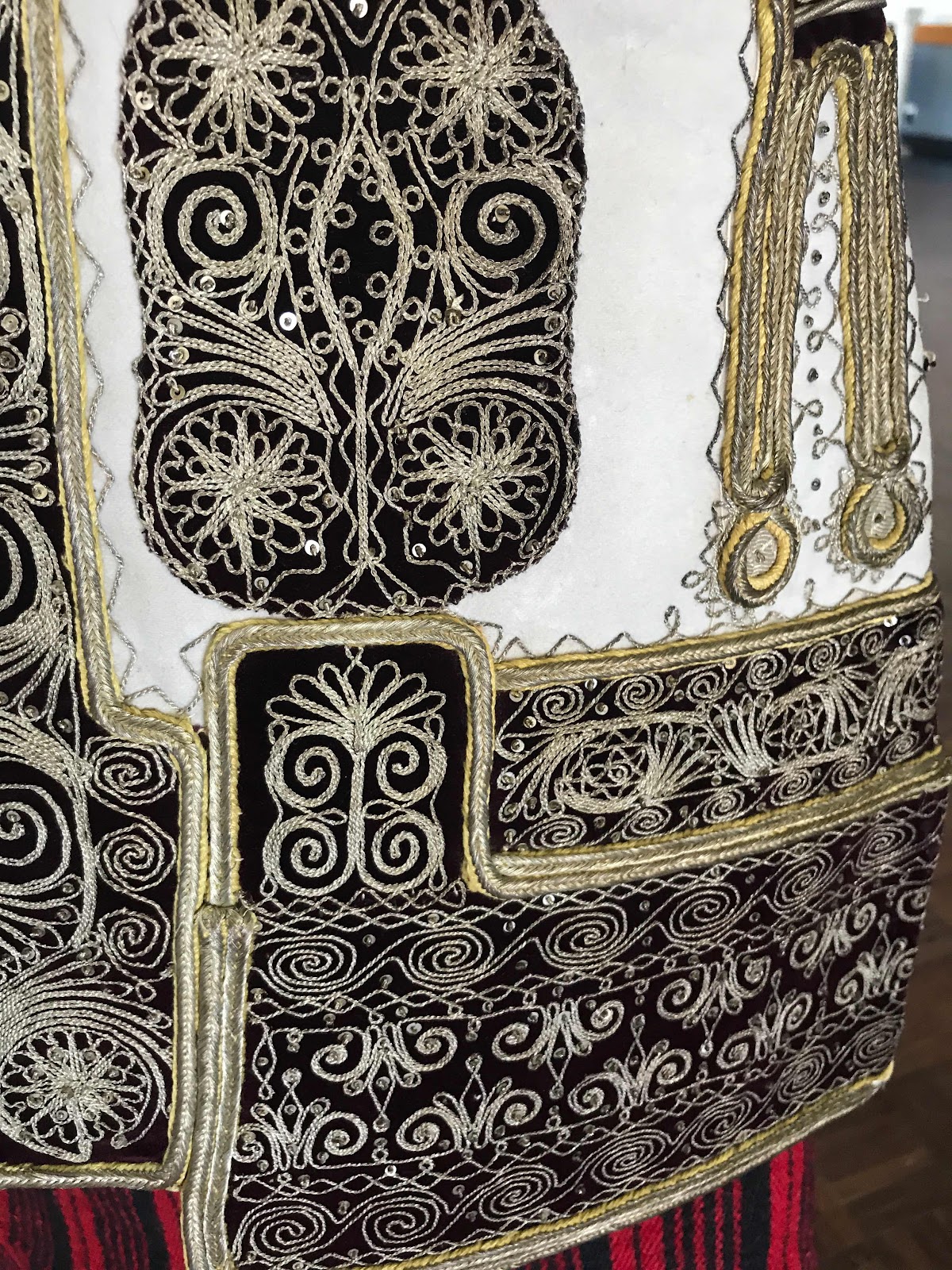
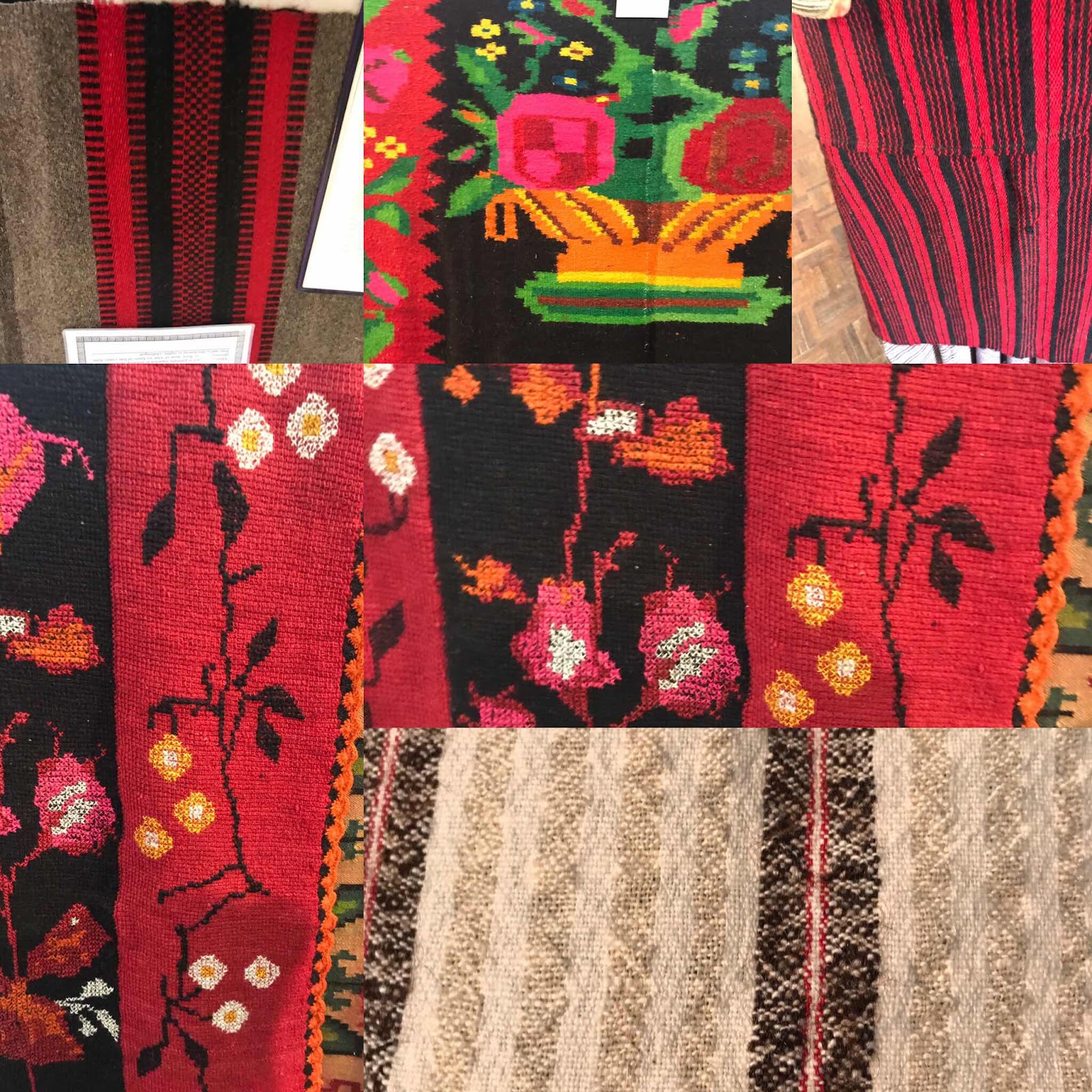
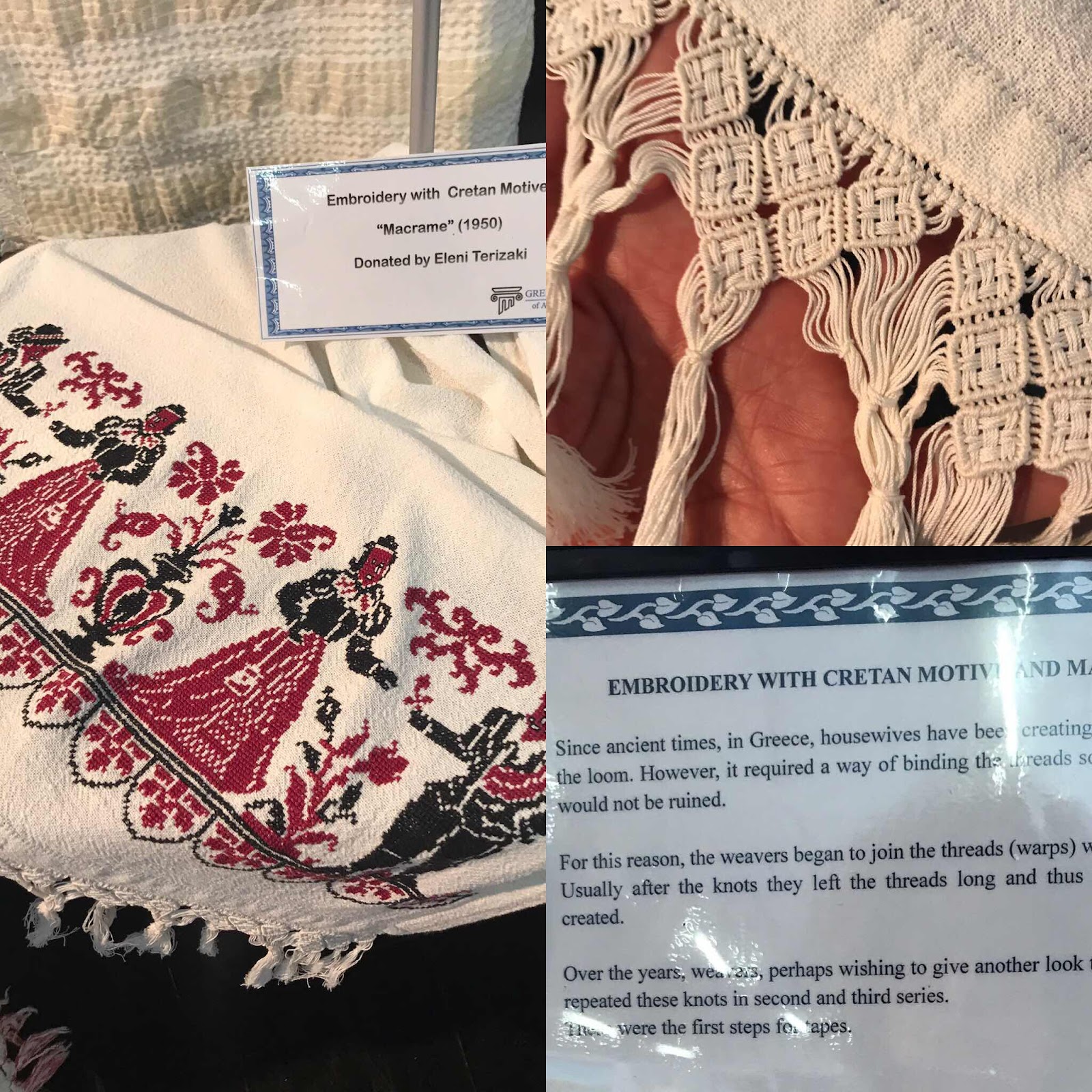
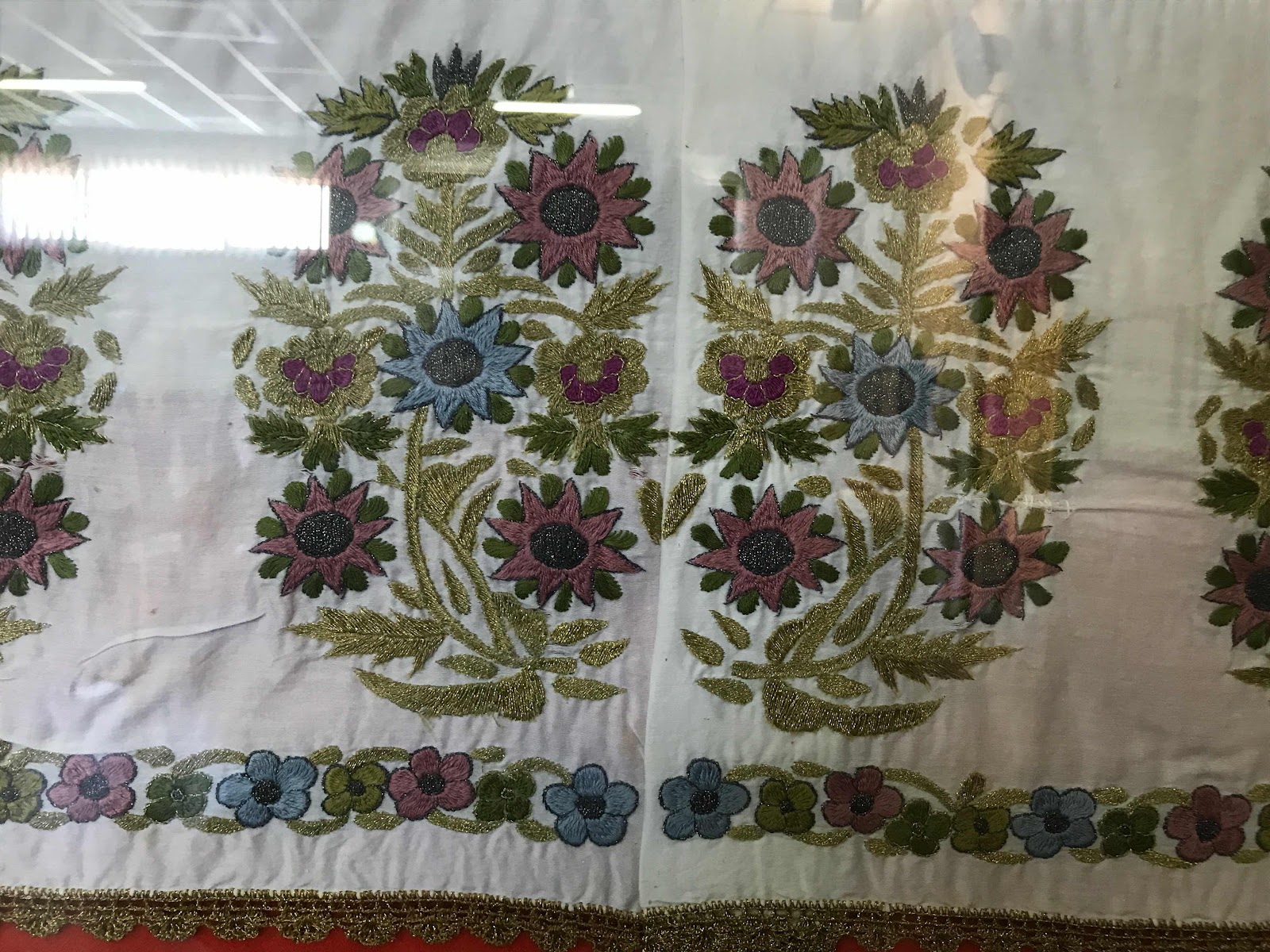
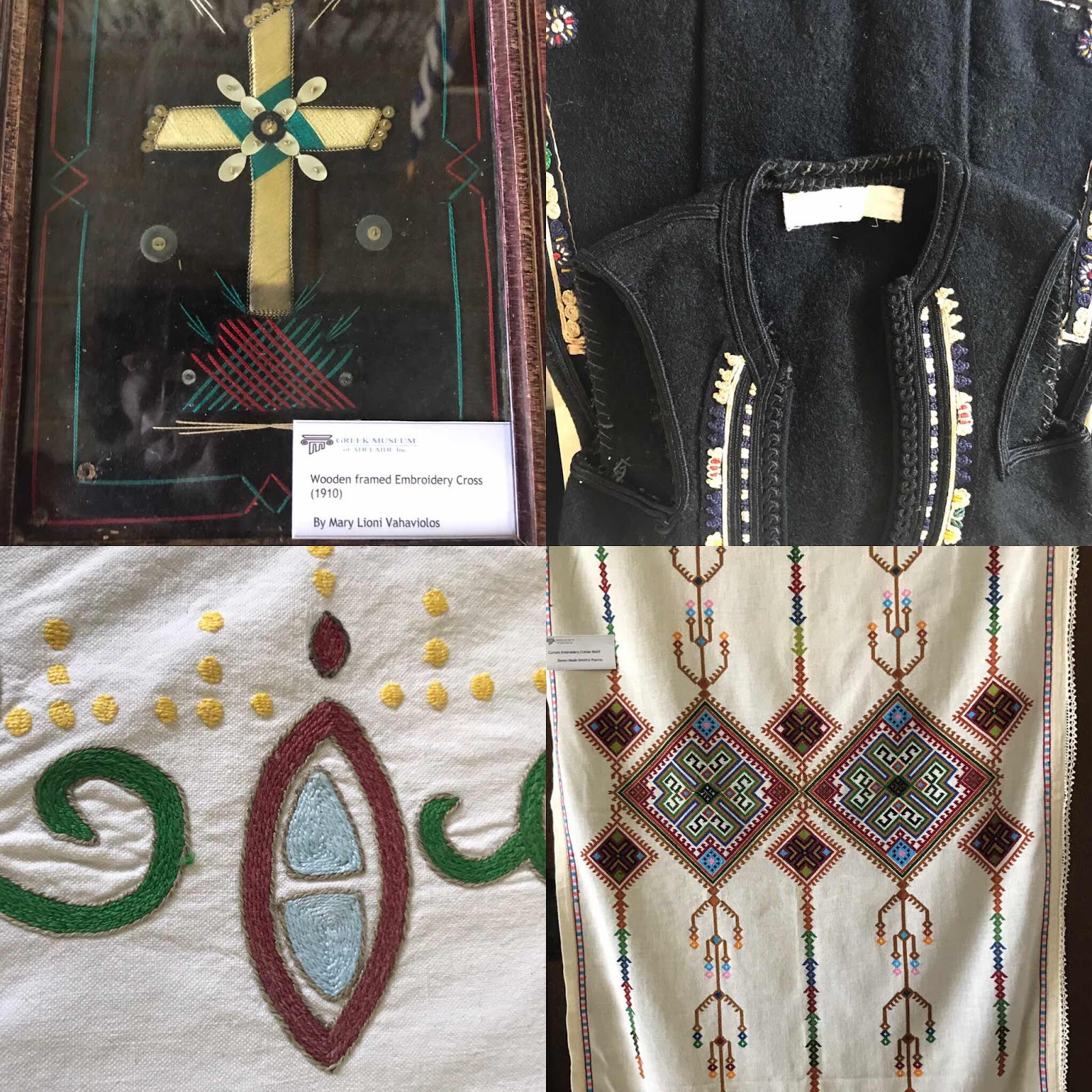
It is, however, the textiles that took my breath away.


There are many examples of historic and vintage weavings, many arriving with migrant families. The two on the left were made by Chrysoula's grandmother.

Many examples are behind glass - great for viewing but not so good for amateur photography.


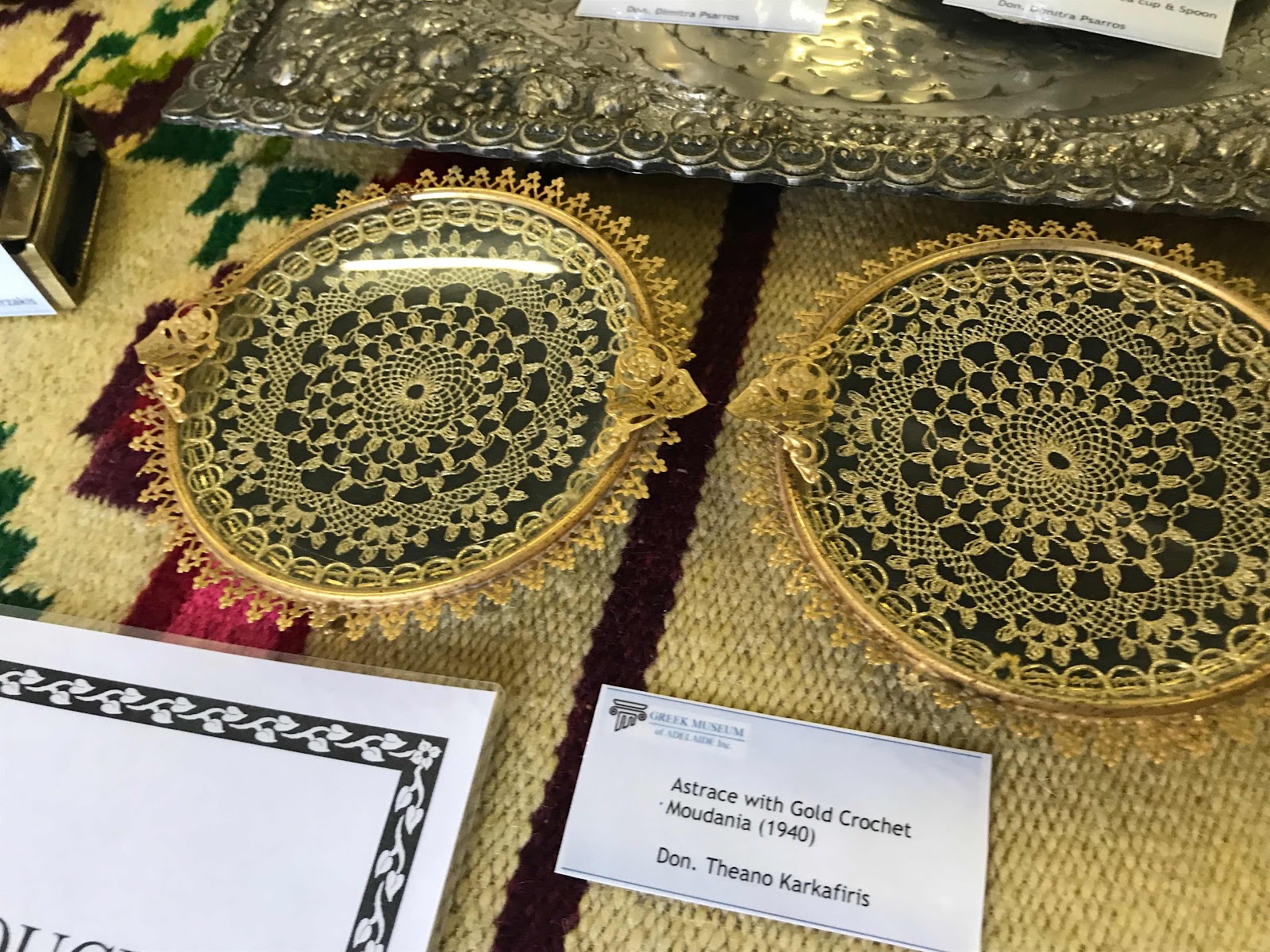
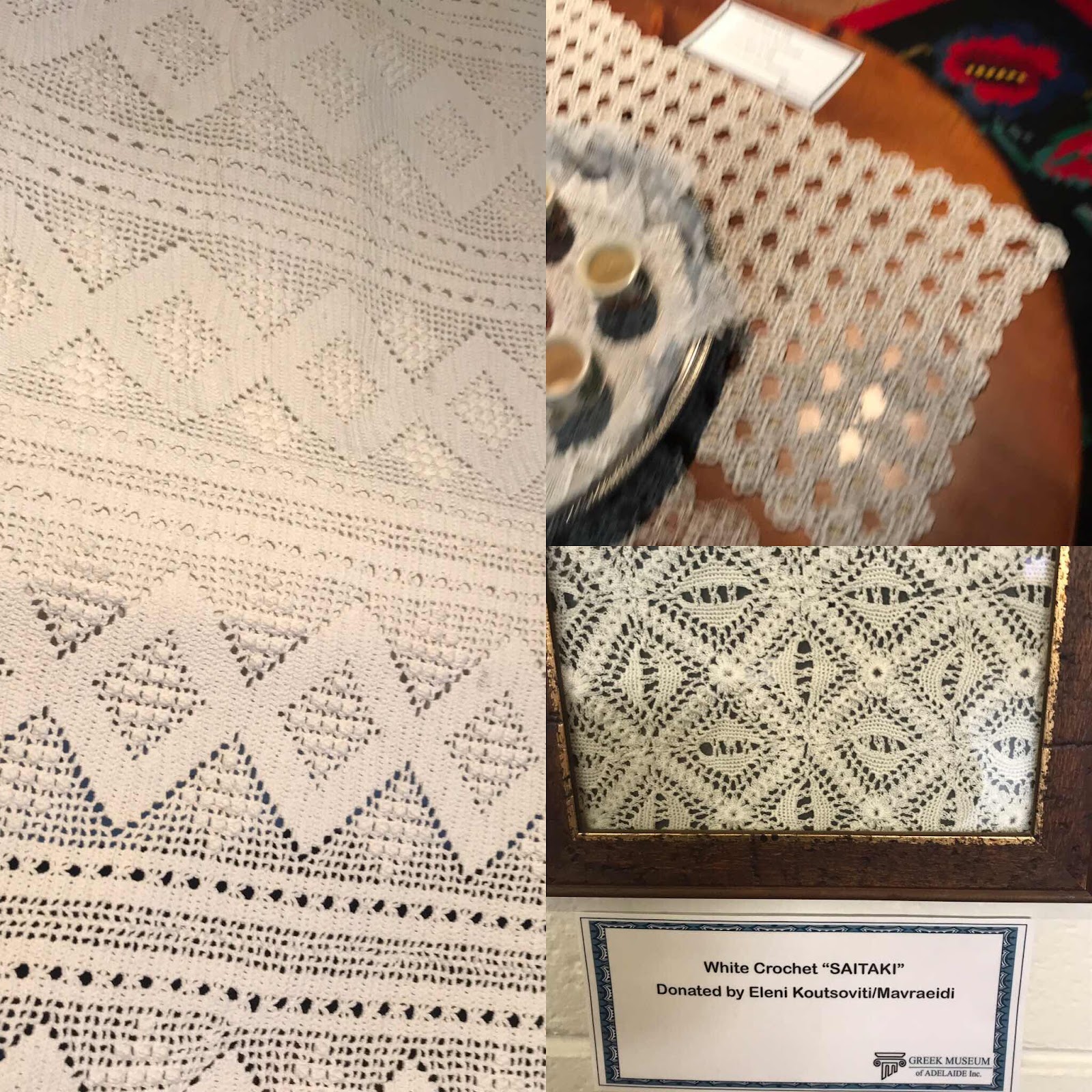
This is just a tiny sample of the crochet on display - from spider-web fineness to heavy bedspread quality.


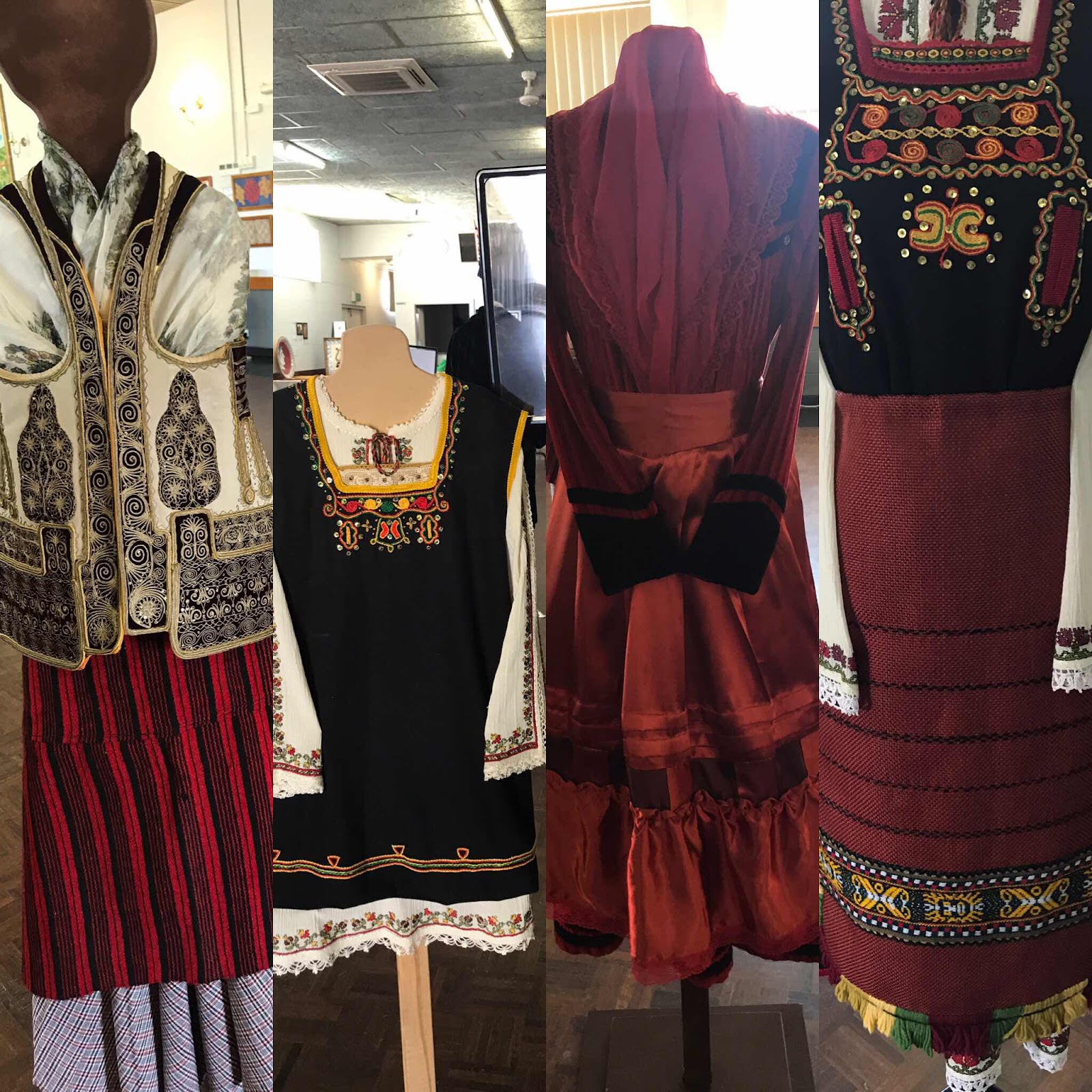
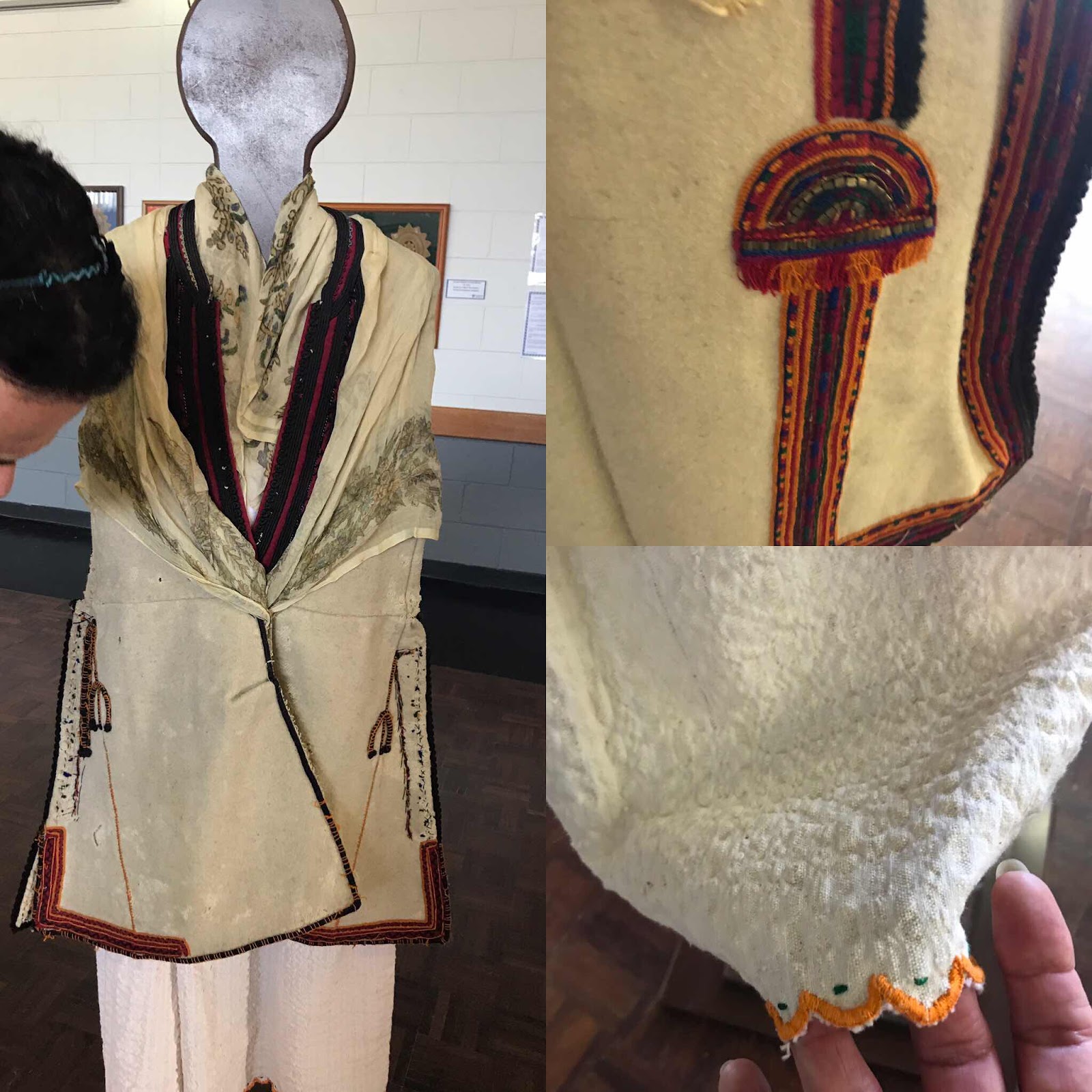
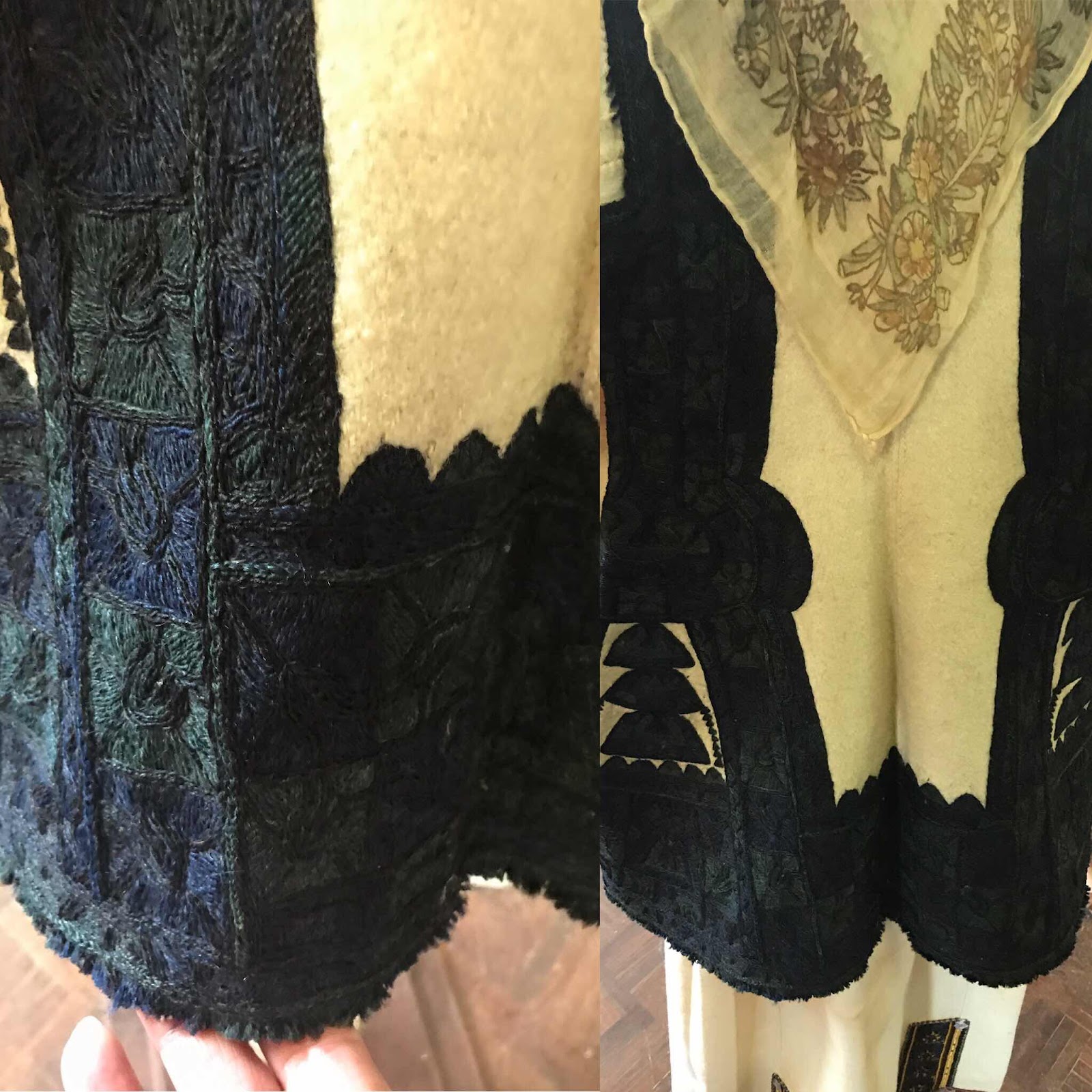
Similarly, the costumes vary from skin, to heavy wool to fine silk.


I loved the Cretan work, and the examples from Skyros.


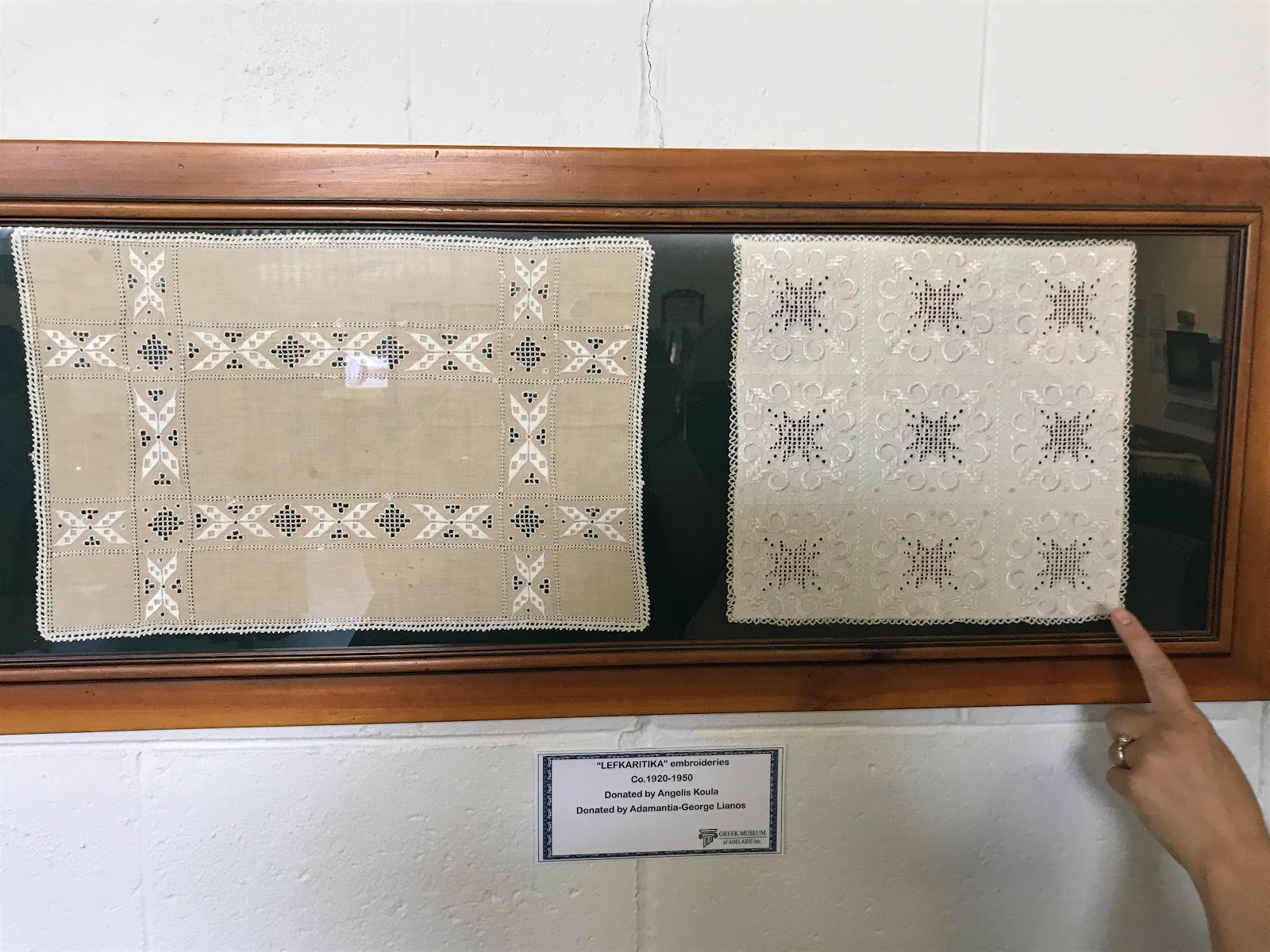
Some fine cutwork, and Lefkaritika, one (left) hand-stitched and one machine.


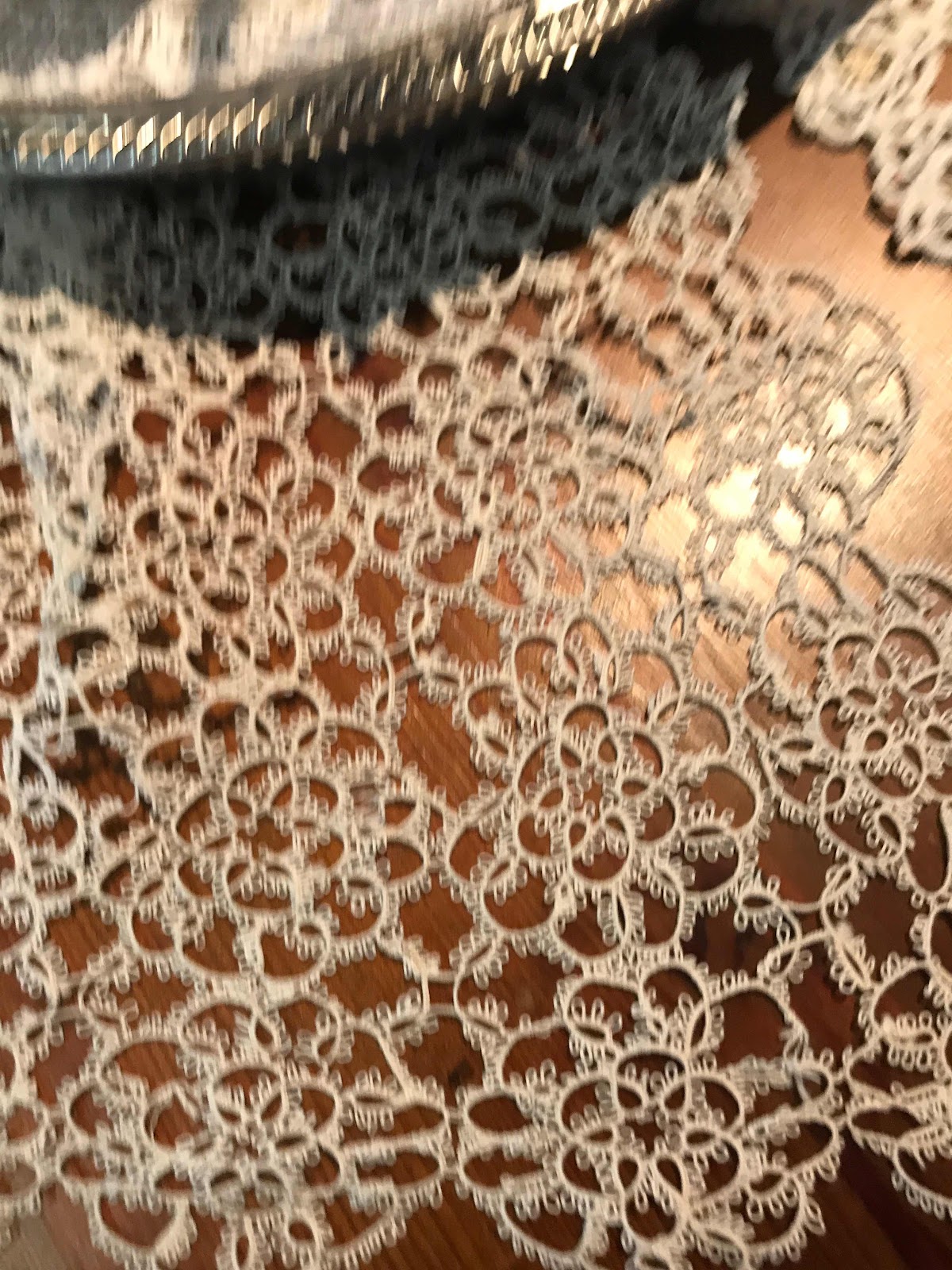
Tatting


I have tried to capture the scope and depth of this exhibition.  If you have a chance to see it, don't miss out. It is a remarkable achievement for a non-profit community group. It is a huge commitment of time, effort and shared knowledge. I do hope this develops into a full-fledged museum - and that other groups take inspiration from it. 


This is Adelaide's heritage.
Thank you Chrysoula and your Museum volunteers.

Saturday, December 28, 2019

Christmas sacks

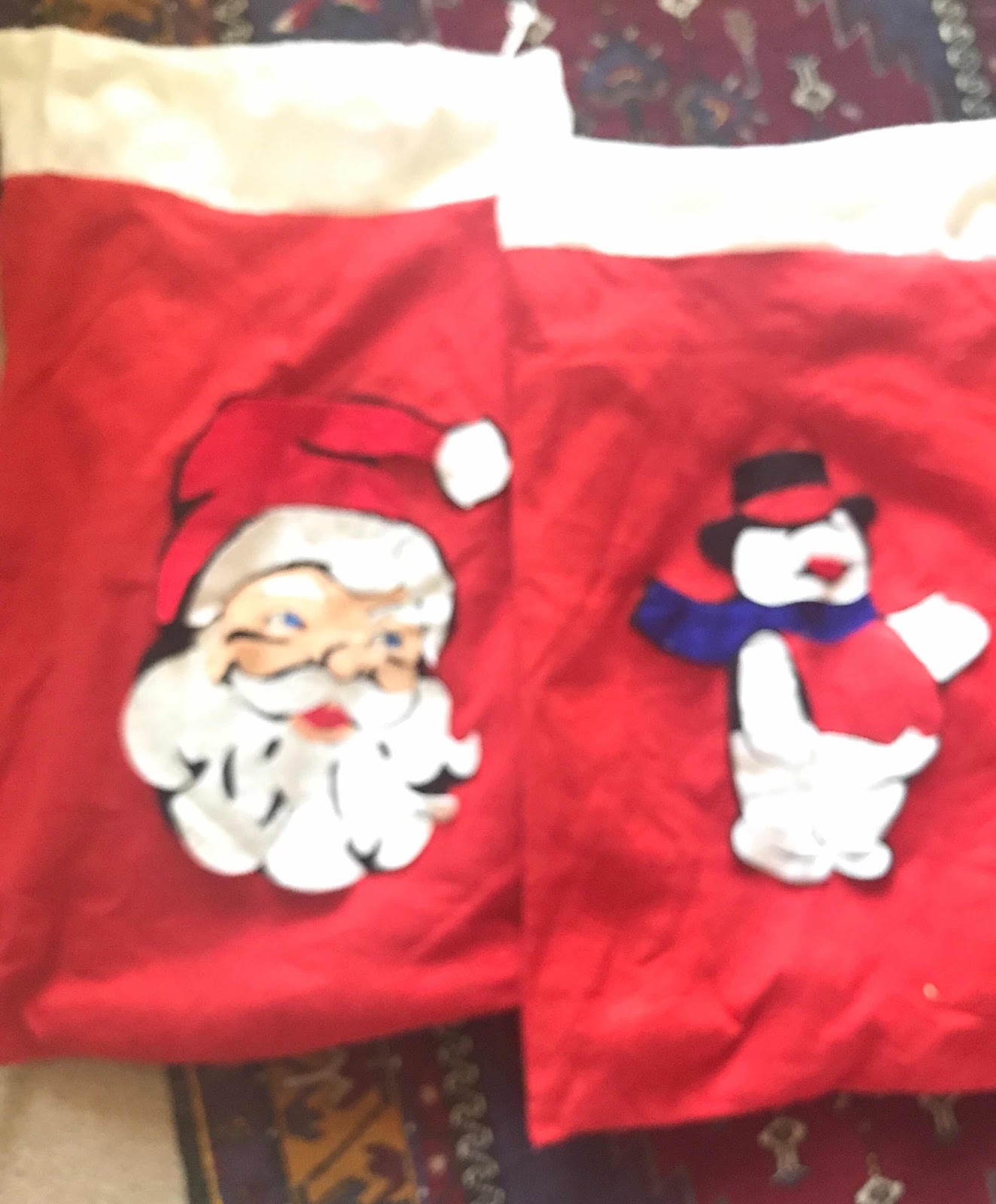
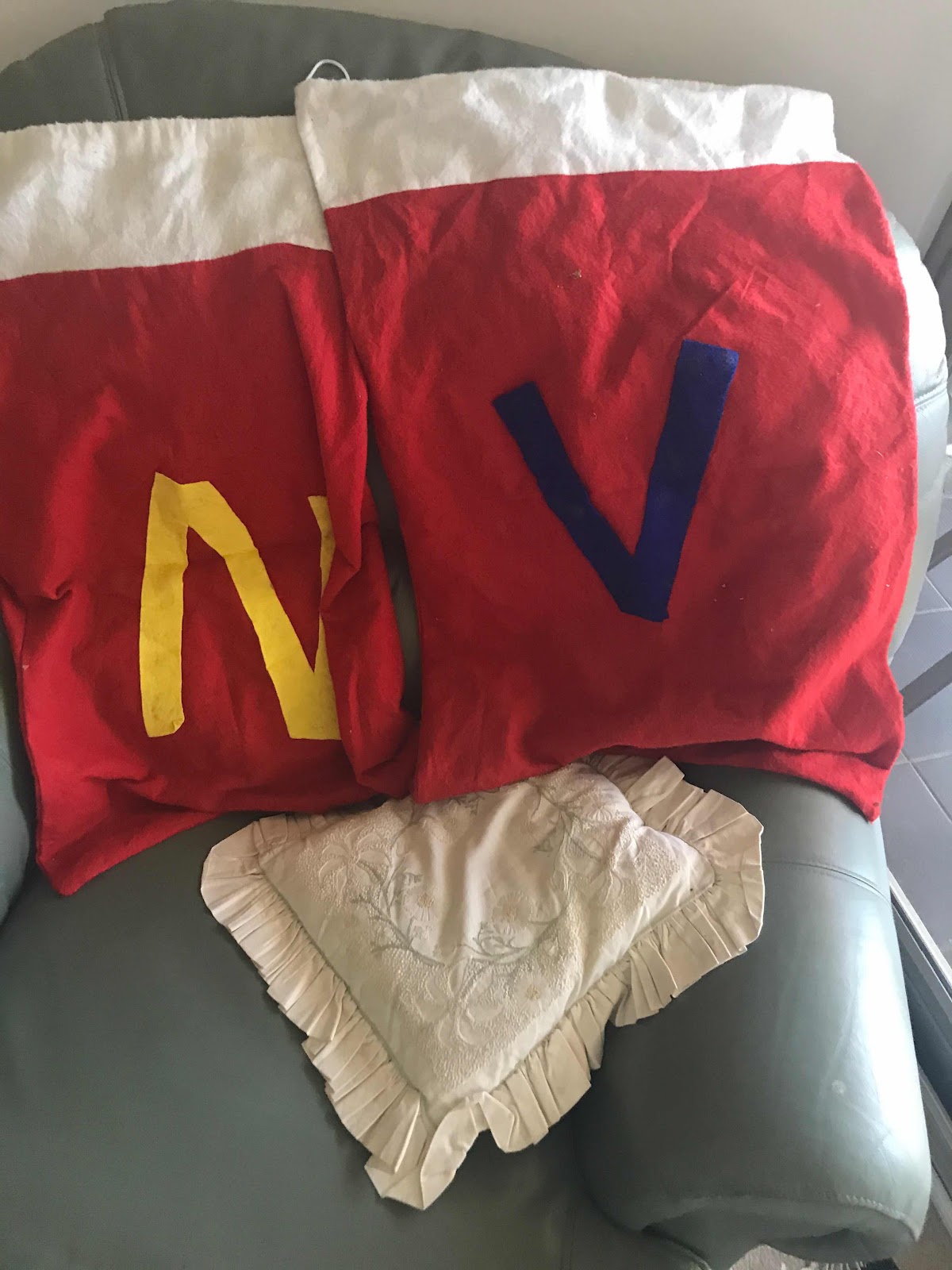
I think it was my grandson's first Christmas - fourteen years ago, that my late husband and I bought two Santa Sacks in which to place our Christmas presents for our two grandchildren. We bought them at Cheap as Chips. They were made of red felt, with a Christmas motif on one side - and much bigger than the children. I appliqued the initial of their first name on the front.

When their twin sisters were born two years later, we managed to get two more, with different motifs, and again, attached an initial to the other side. We  used these every year for Christmas presents for the children, and I have continued this in the five Christmases since my husband died.

The sacks, however, are a bit ragged and tattered. Some years they have been opened in the garden, acquiring a few burrs and prickles. I have never dared to wash them, lest they felt further. They are also very large - more suited to bulky presents for young children than adolescents. The children, nevertheless, have become very attached to them.

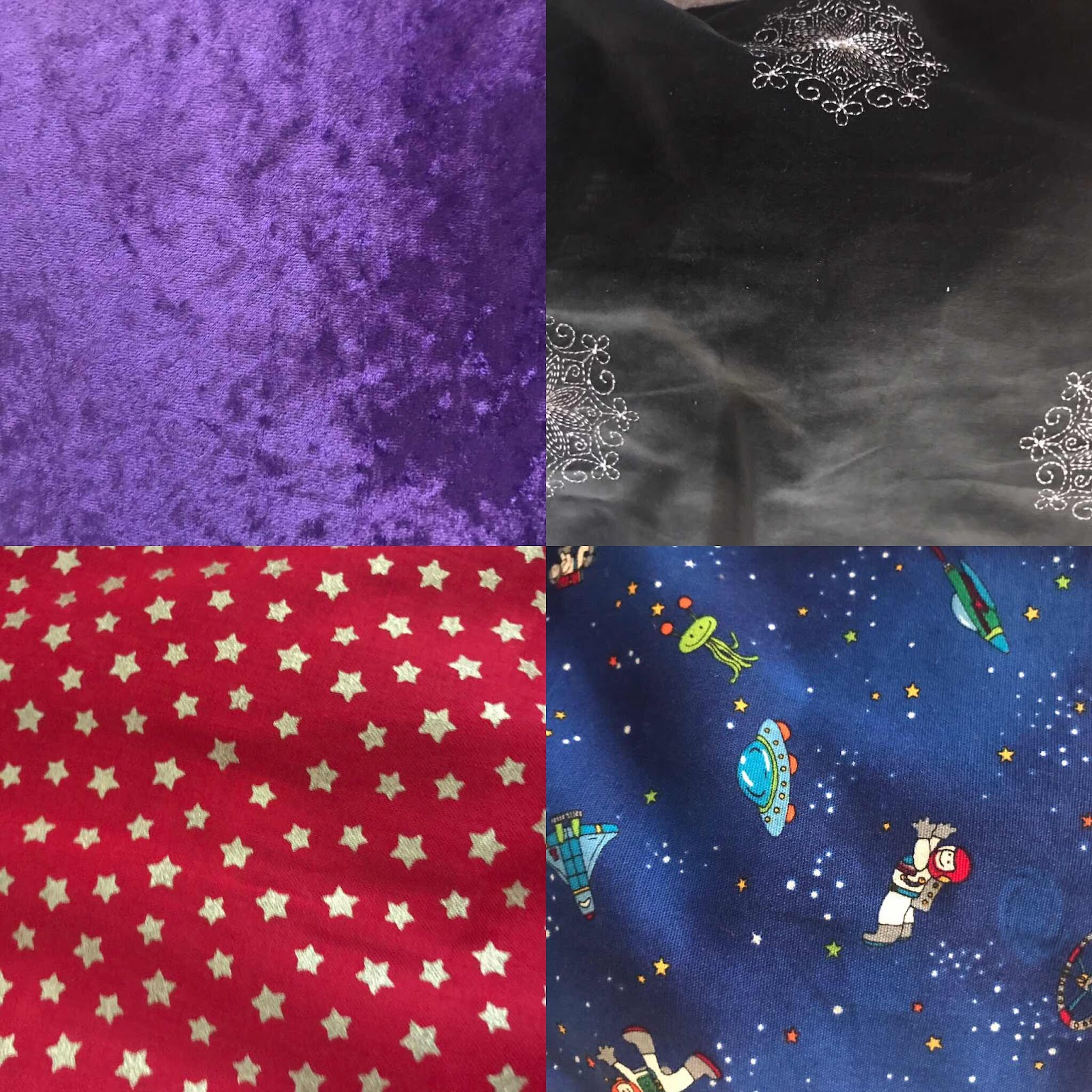
A few days before Christmas I got the bright idea that perhaps I could make new replacement bags. I fell asleep planning a visit to Spotlight for some Christmas fabric. In the morning I decided I should first check my stash, since I was sure it contained at least one piece of Christmas fabric. Half an hour later, there was fabric all over the floor and I was sorting it into piles so I would be better able to use all my discoveries.


I found one piece of designated Christmas fabric and several pieces that would, as my mother used to say, pass with a push.

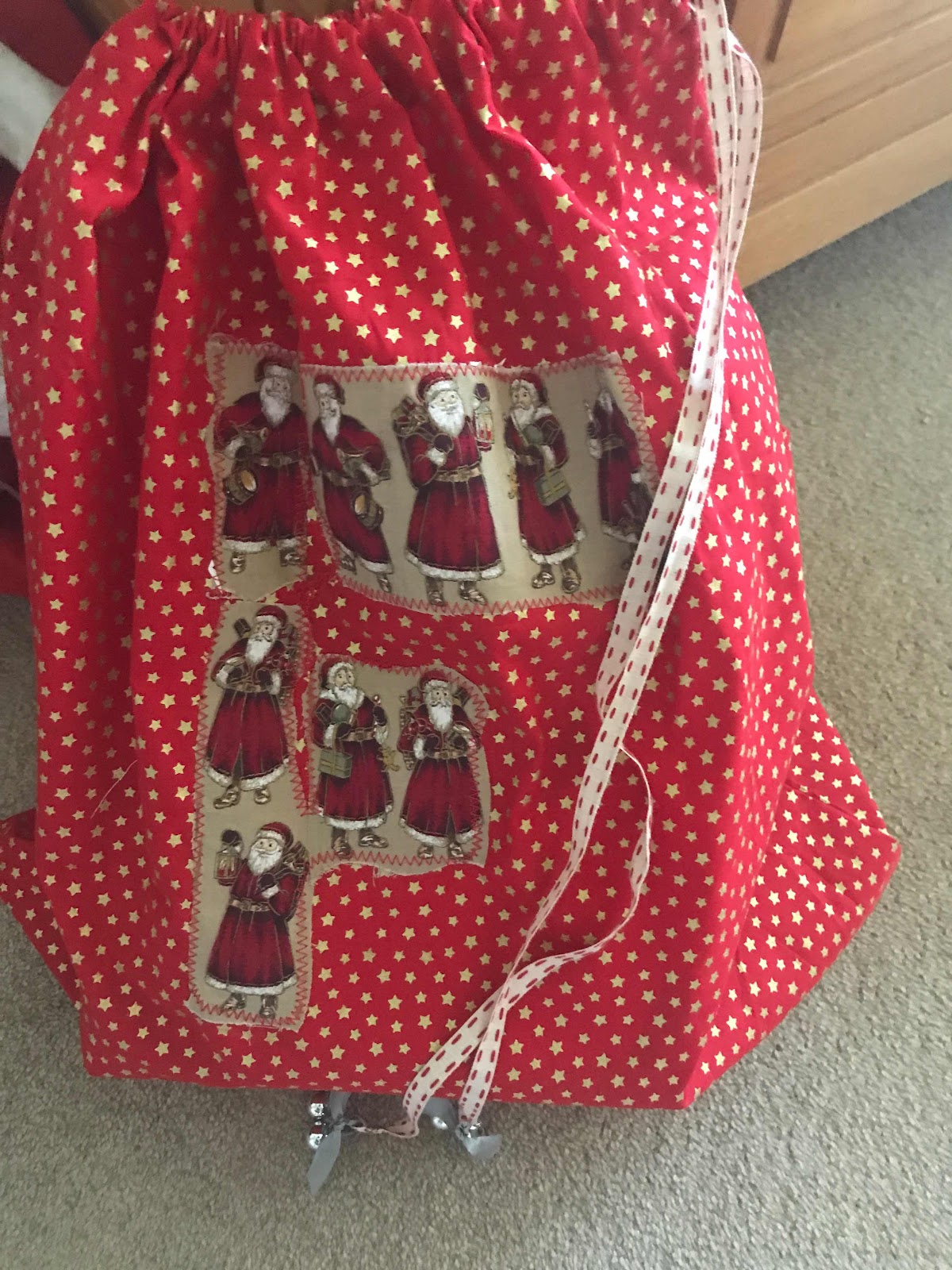
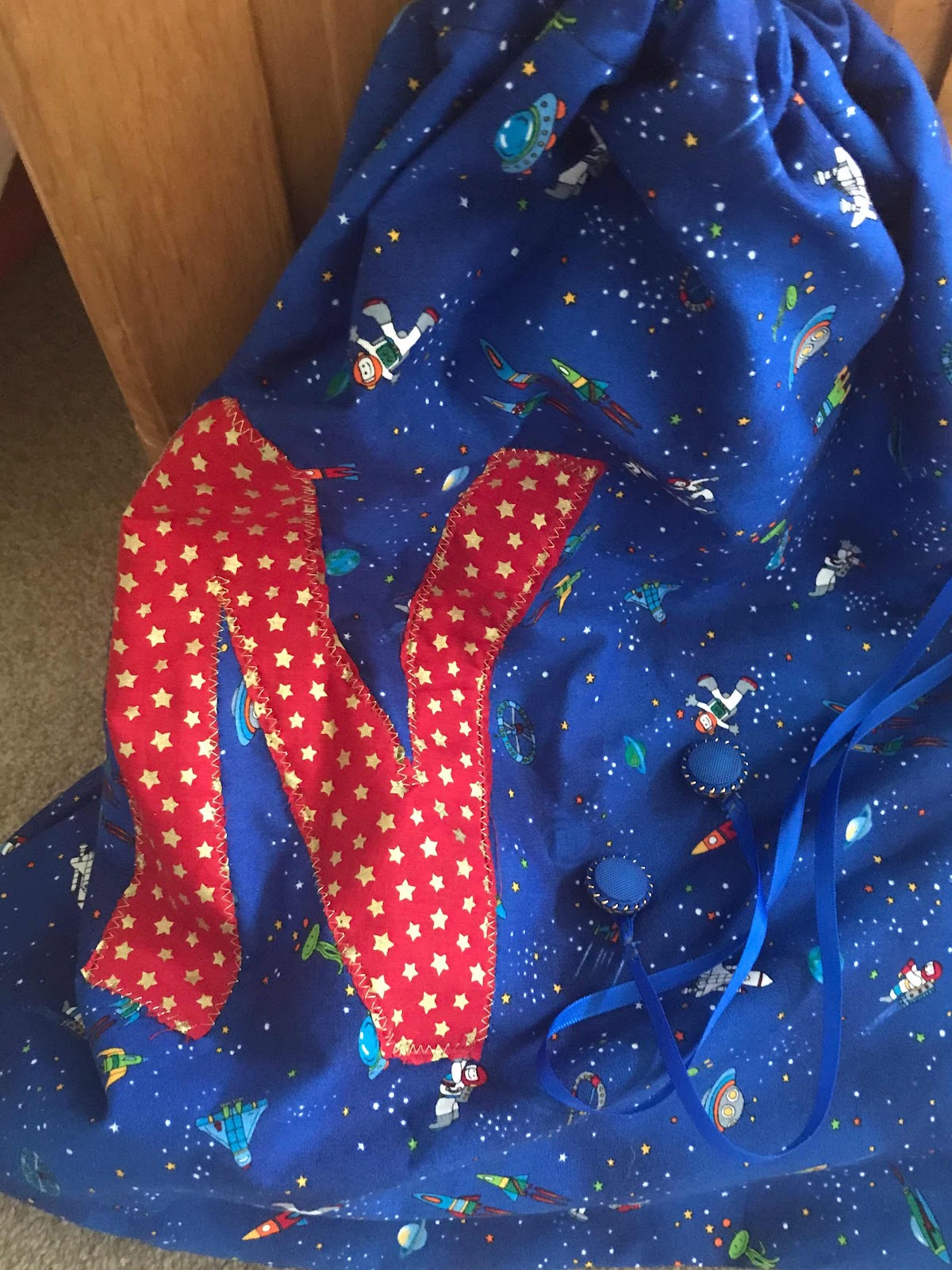
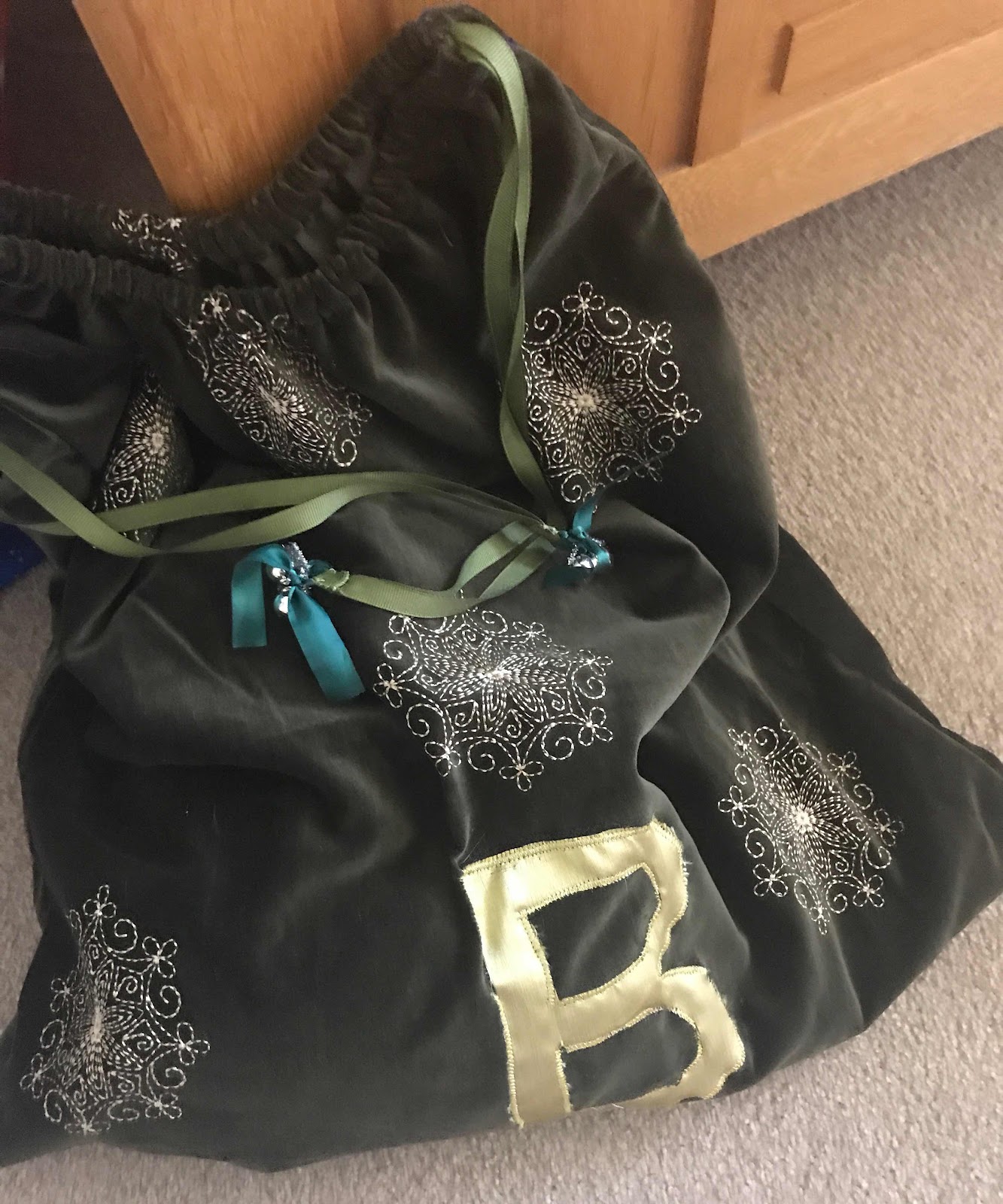
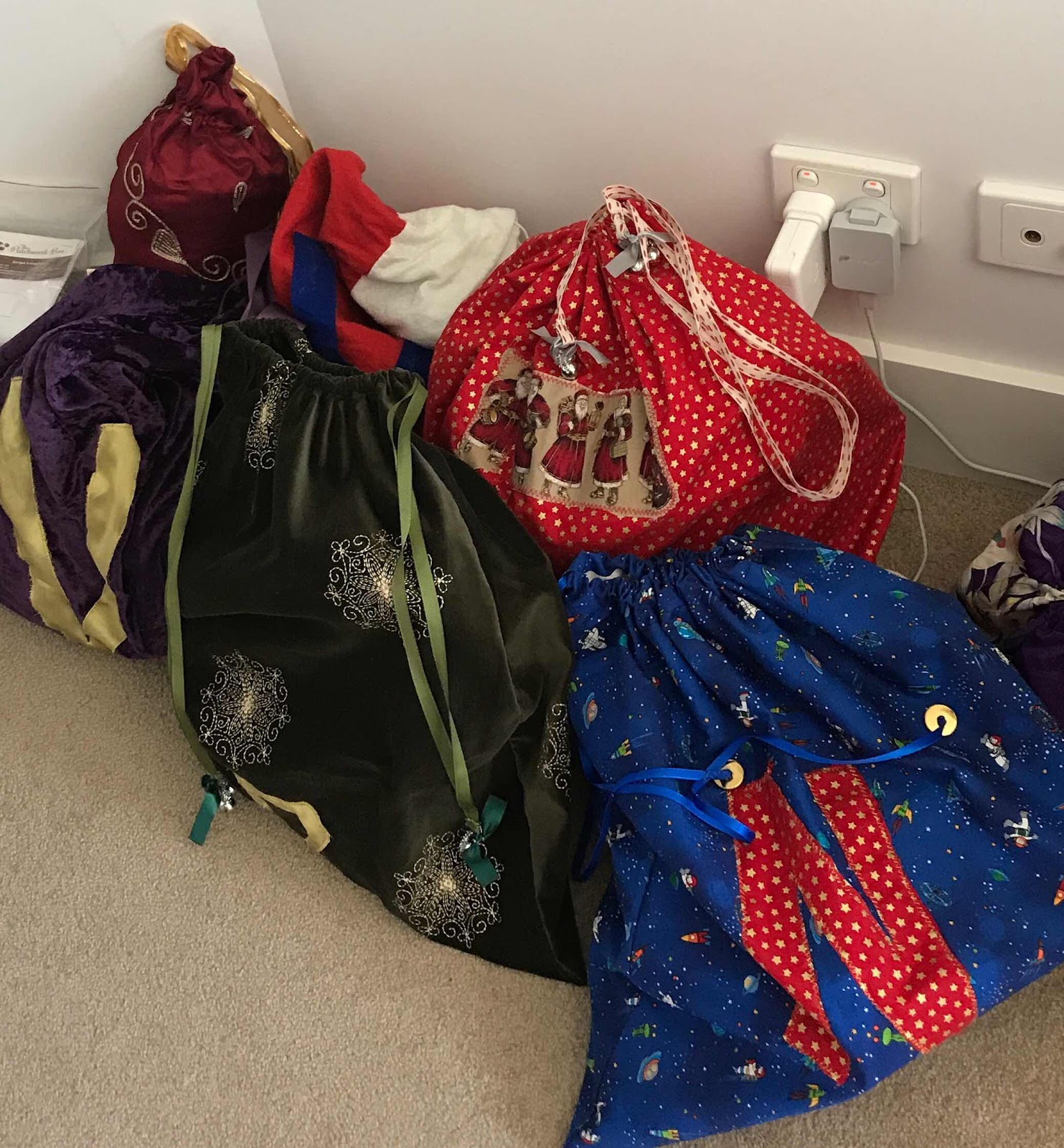
Abandoning the plan to shop for fabric (or anything else, like food) I cut out fabric, stitched  bags, found ribbon, variety of matching buttons, bells and toggles.

By 1.30pm when I needed to be at a friend's place for an afternoon of stitching, I set off with four bags, a safety pin, needle, thread and an assortment of ribbons and fixings. As my friend cut out squares for her next quilt, I finished off my sacks.


They are smaller than the original Santa Sacks, but still fairly large. I needed to convince the recipients that change was a good thing. The older two were willing to give it a try. The younger two were reluctant. I didn't want to push it, so suggested I place the new sacks inside the old ones.

So on Christmas Day I set off (no, not to St. Ives) with two felt Santa Sacks. Each sack contained two ( no, not cats) new sacks and a drawstring bag for each of the adults. When I arrived at my daughter's place for lunch, I unpacked the older children's new sacks and the adults' bags, leaving the younger children's new bags inside the old Santa Sacks. Everyone was happy.

Everything in the sacks (or bags) was of course, in its own drawstring bag, mostly from the supply I made last year - no wrapping paper for me! These bags get recycled many times, which pleases me no end.
I haven't asked whether the younger children are happy to transition next year. Maybe I will keep a couple of the old felt sacks to transport the new sacks and their cargo of bags - a bit like a turducken. Maybe a Sansackag.