Search This Blog

Showing posts with label felt. Show all posts

Sunday, April 5, 2026

Small Easter gifts


In early March, Morris and Sons advertised a range of Corinne Lapiere kits for Easter gifts. I liked the look of them and figured I could just about make them before Easter, if they arrived in good time. 

I ordered them on 11th March and they arrived on the 16th. I set to work straight away, beginning with the rabbit inside a carrot, which is absurd. I thought my health-conscious grandson might enjoy it (he did!)
It was a lot of fun to stitch, but did require a bit of fiddling.

I chose the beehive next because it had more embroidery. It also had 15 tiny felt leaves to attach. I’m glad I ignored the instruction to cut everything out of the felt before starting. There’s no way I could have managed not to lose some of them. It was also easier to embroider the main body before cutting out, holding the whole felt sheet in your hand, rather than a piece less than 3” square.

Instructions  were only for embroidery on one side, but I added to the back as well
After that I tackled the chicken.


This was  embroidered on both sides. Again, I embroidered it before cutting out the pieces. This was nicely varied. Construction requires patience, pins and a little dexterity.
Then came rabbits. The instructions were for making one in each of three felt colours. Apart from facial features they were not embroidered. I decided they could do with a little embroidery. I had by now decided to give these to the girls. It was clear I could get at least two, and possibly three, from each felt colour. I thought I should embroider each one with a different motif.


On the first one, I chose a native red daisy


then some sprigs of wattle.


then wisteria.

After adding a bottlebrush to one side of the next one, I hesitated to repeat it on the other side. It seemed not only unnecessary, but somehow to detract from the first one.

The same applied to the lemon tree.  One is enough.

These are all quite small, about 2" without the ears.
                                                          

My favourite of the kits, however, turned out to be the last, the Star-Gazing Hare. I had to look up the mythology.  The Star Gazing Hare was the companion of the goddess Eostre, from whom we get Easter. It became a talisman for renewal, Spring, beginnings, fertility. 

She carries a star and a telescope and gazes at the sky.  The body stitching, rounds and rounds of running stitch, was a bit repetitive, but it's a charming figure with a most interesting story. 
 
I found this basket in the Frewville supermarket. It was just the thing for transporting these gifts. 


I added bookmark tags to each figure with the recipient's name and put them in the basket, along with some Ukrainian Easter eggs and some nests. 

They were well received.

There's enough felt to make the best part of another set. 


I've also bought a few more Corinne Lapiere kits while Morrison's have them in stock. It's a luxury. As you can see, I really like them.


Sunday, June 29, 2025

Certificate Course Workshop:Sue Spargo Style Applique

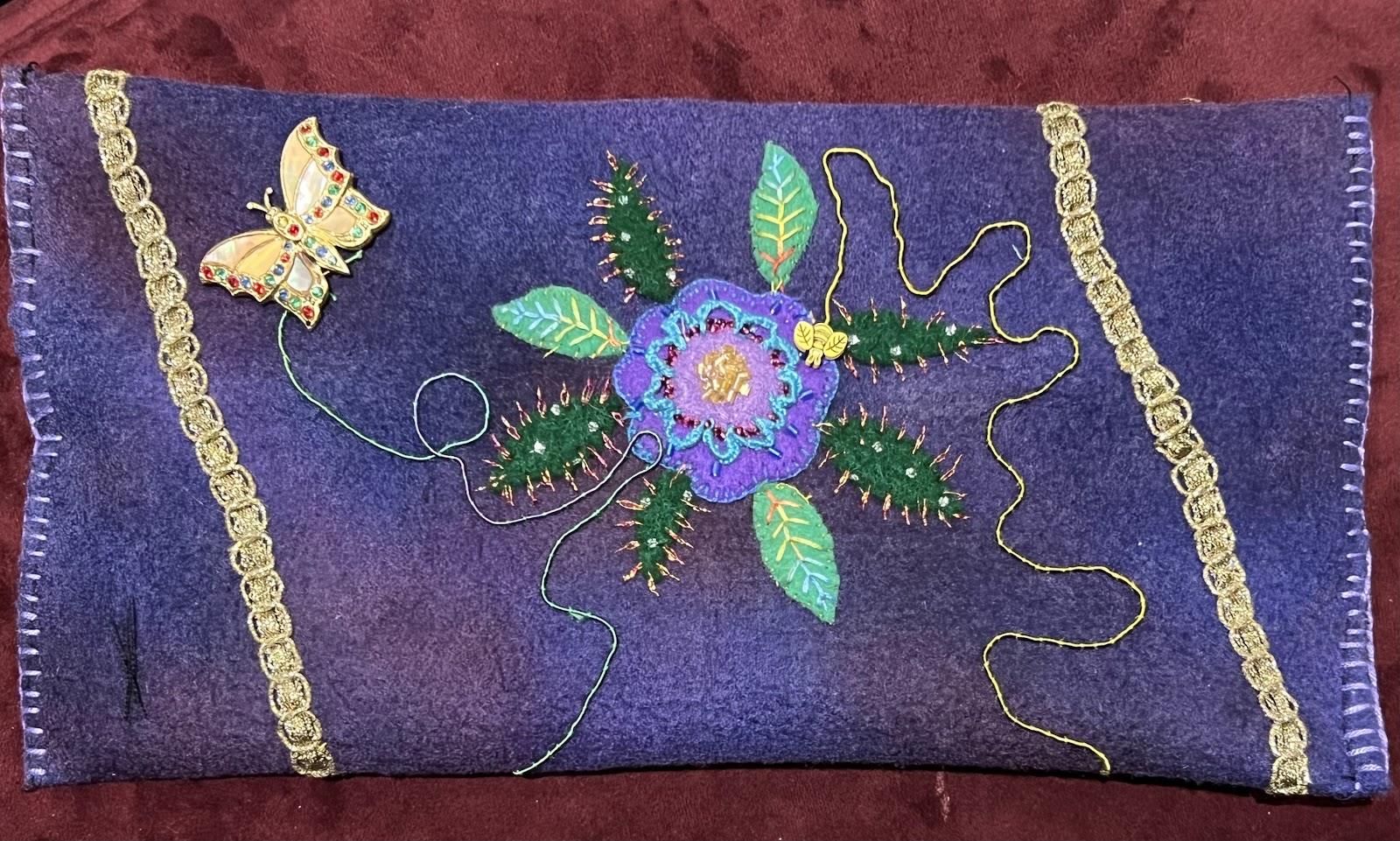
This month's Certificate workshop was taken by Christine Bishop and focused on a basic design from Sue Spargo's Creative Stitches 2nd Edition in the suggested form of a sampler and pincushion. I had a piece of hand-dyed fine wool felt in a lovely purple colourway, which I used as the background fabric. I took a range of felt pieces for the flower and leaves. I enlarged the outer flower a little .The original design had four leaves. I experimented with various colour green for leaves. 

I had a very small piece of felt with silver spots printed on it, which I thought might provide a lift. In the end, after consulting with others, I added another four leaves, five in the spotted dark green and three in a lighter colour. 
I found a fine metallic and used one strand of gold together with one strand of red for the single chain stitch edge on the dark leaf, and a variegated stranded cotton for the lighter leaves.

I had expected to use the same variegated thread for the buttonhole loops around the inner circle, but rejected it.  In the end I settled for a blue cotton, left over from Evil Eye embroideries. I added gold chip beads (also left from Evil Eye embroideries) to the centre.
When I chose the background felt I did so thinking it would be a shame to cut it for a pincushion, and it might be folded into a pouch. 

Christine gave us a bee button and I had identified a butterfly brooch from my tin of bits of bling. I decided to connect them to a flight path using gimp and the full length of the fabric.


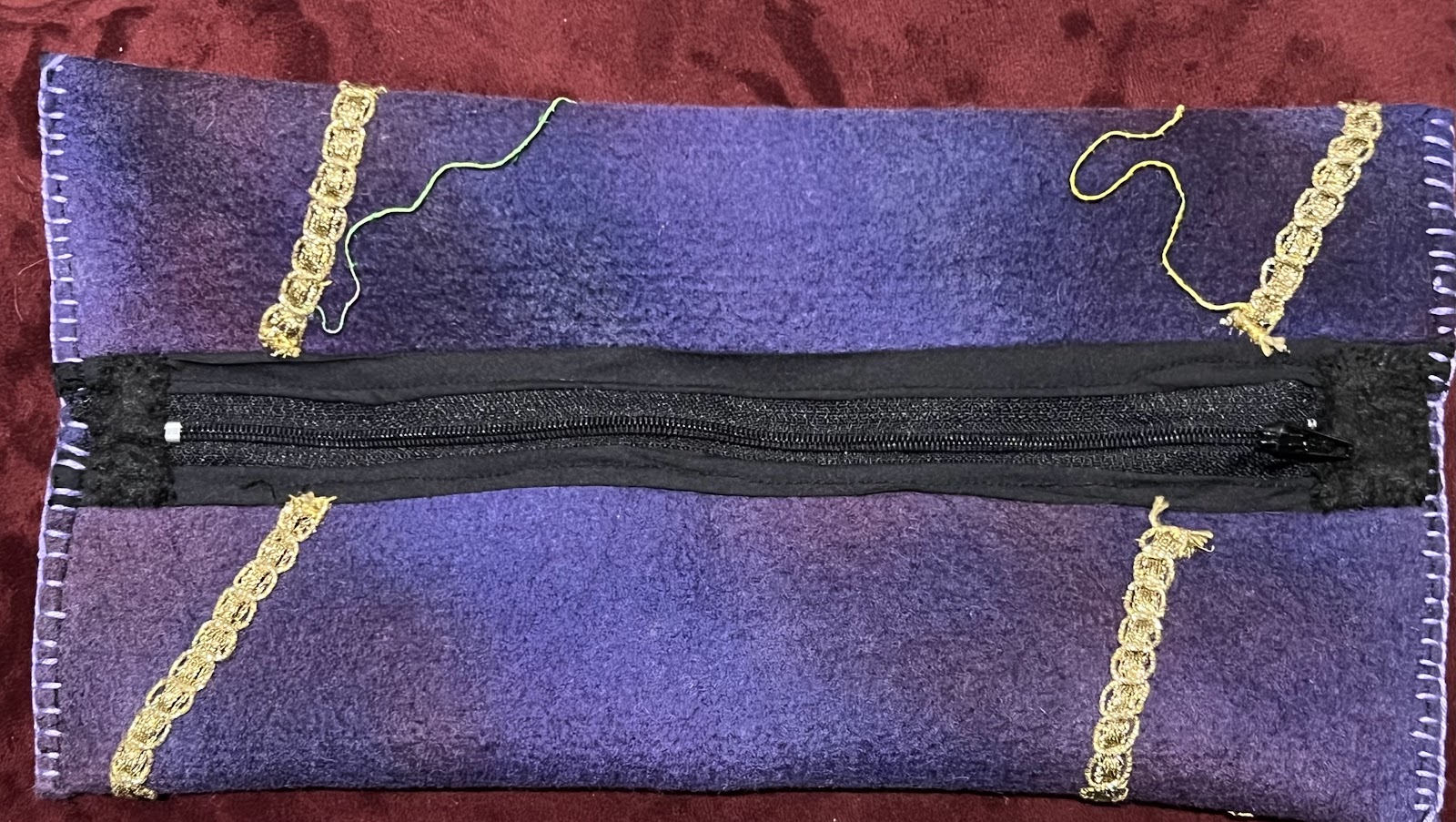
I folded it in half, stitched the edges down on the machine, and added a zip at the back, using bias binding between the zip and the felt in case the edge catches.


The side edges needed a finishing touch of blanket stitch in mauve. Finally, I added a couple of small felt squares to cover the end of the zip.


It looks nothing like the pincushion template, and I have more pouches than I can use, but I'm very pleased with this one. I have enjoyed two days of simply messing about with colours, fabric, threads, bling and ideas. And I really like the result.
Great workshop.

Tuesday, November 5, 2024

Floe, the happy penguin.

On the cover of Inspirations 123 , Floe, the Fairy Penguin captured me immediately.  I loved the concept, the embroidery, and the felt medium. I also have a friend who loves penguins. I bought the kit. Once my major knitting projects were completed I decided to treat myself to making it. 

Carolyn Stanton, the designer, has an Etsy shop, with lots of felt projects. This one, however is only available through Inspirations.

Cutting out was fairly straightforward. The instructions for transferring the design seemed to me unnecessarily complicated, so I copied the pattern markings by hand, using lead pencil on the white and chalk pencil on the black. I had, of course, to either work fast or keep renewing the pencil marks on felt, but a combination of both worked well.

There is a variety of threads, including several different wools and silks. Getting the right one for each stitch kept me focused.  (Would it matter? Not sure.)

The trickiest part was getting the curves right while stitching it together.  


Without a beak and flippers it took on a slightly sinister look which I could only pray would disappear when finished.

The stuffing, however, had to come first.  I decided against the recommended filling of either rice or oven-hardened beans. I figured the chance of a doorstop getting wet was too high, so bought a bag of stones from Bunnings. These went neatly into the base in the kit-included cotton bag. Filling the upper body to make it firm took a significant amount of wool fibre stuffing, but worked the required magic on the shape as I stitched over the back join (not in the recommended colour!)


I am delighted with the result. 


As I had hoped, the beak and flippers turned it immediately into a recognisable penguin. 

Floe emerged in all her splendour, with plenty of personality and anxious to get to her real home.

She didn't  fit into any of the standard Australia Post boxes, but I had one that had already travelled the world and packed her in using bits of bubblewrap, shredding, tissue and paper bags. She travelled overnight and reached her new home this morning.
She is already at home and welcome. My friend refuses to put her on the floor and she has found her new niche at eye level.

I really enjoyed the challenge, both stitching and construction. It isn't a project I would recommend to an embroidery beginner, unless in a class or group with help, but with a bit of experience it is a really satisfying project.
I'm glad I went with the Floe.

Saturday, August 3, 2019

The River Matters

This is an unusually long post - recording the work of several months to create my entry in the   Guild's SALA Exhibition, which opened tonight. SALA, the festival of South Australian Living Arts, is held in August.  Entries in SALA have to be original. The Guild Exhibition is on until 11 August.

The Guild theme is  'a celebration of water'. The organising committee has printed some  sea dragons, sea horses and water lilies on to fabric blocks which can be purchased,  embroidered and developed in original ways. I bought some, but then I had another idea.

A conversation with my brother drew my attention to lines in John Williamson's 1988 song It's a way of life


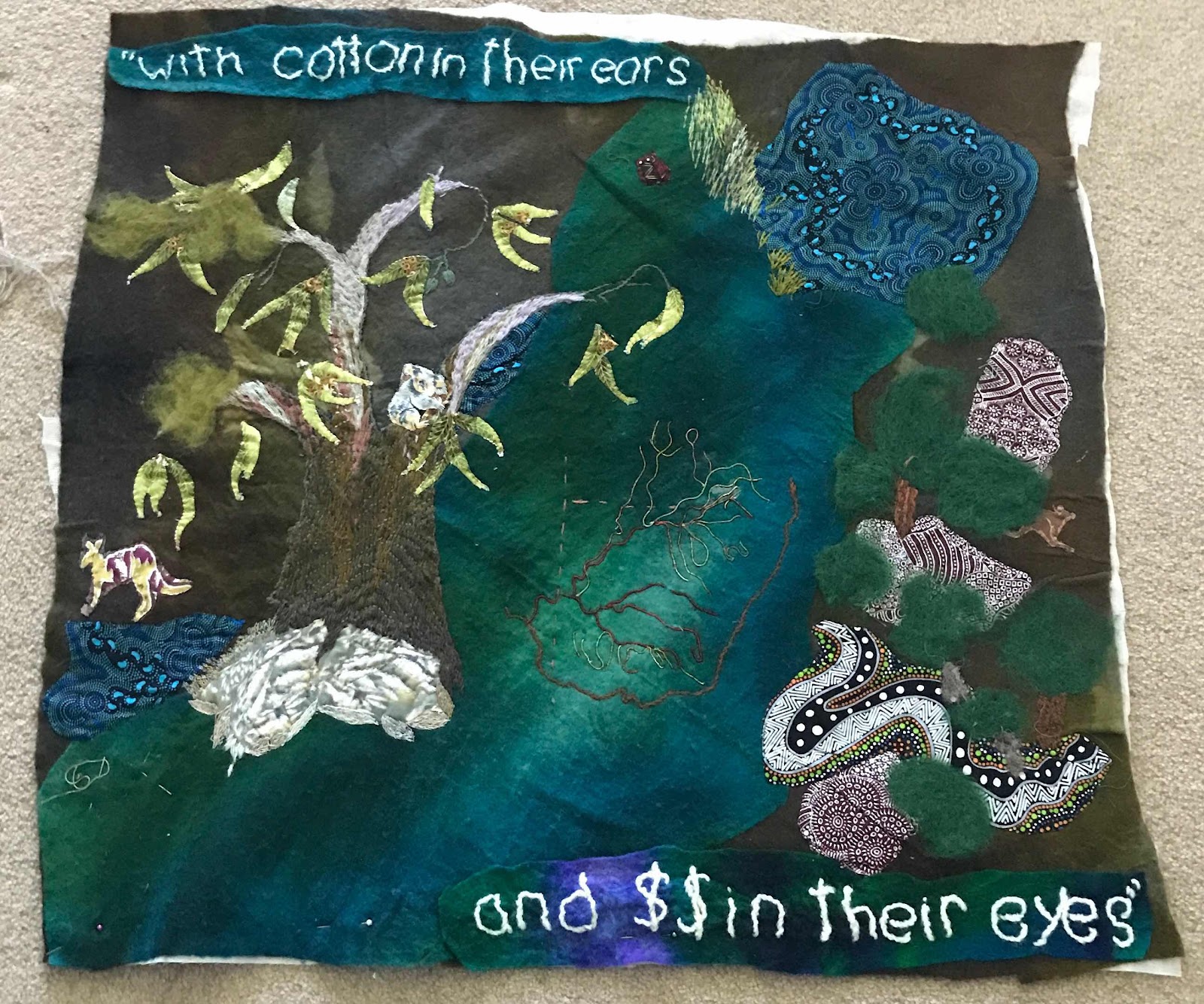
With cotton in their ears and dollars in their eyes
Their banker grins and our country dies.

Last SALA exhibition the Guild's theme was 'Aviarius'' and I made a quilt around the song When the red, red robin. When a friend at the Guild asked me if I was going to embroider a song again, I formed the idea of creating something using John Williamson's words, in the light of the water crisis in the Murray River basin. We surely need to celebrate the life-giving river system as we seek to restore it.


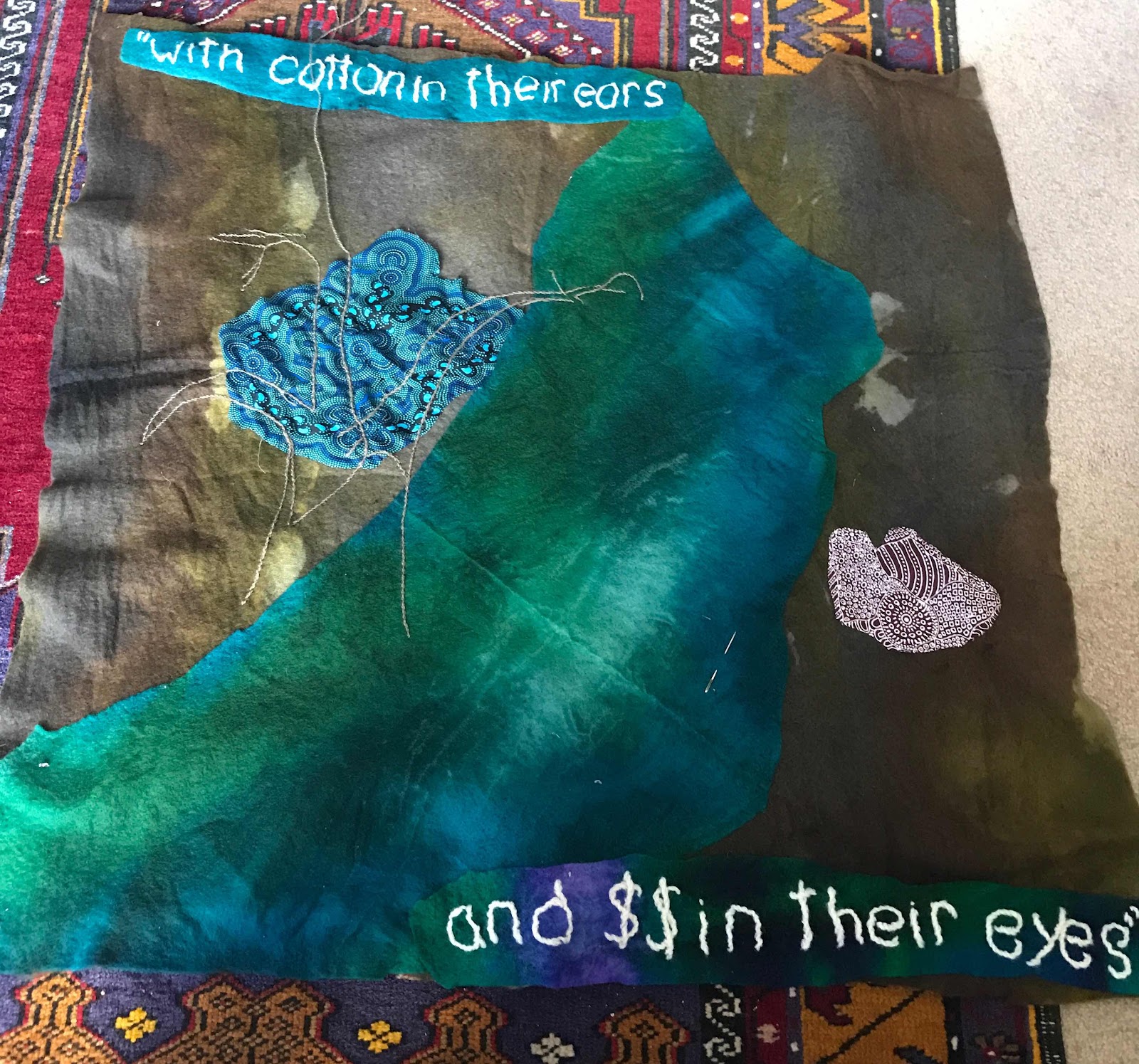
In my stash I had a couple of felt flimsies I had purchased from Dale Rollinson. They were not the right colour for a river project, but they had potential in size and texture, so I searched Dale's Thread Studio site and ordered four more. When they arrived, I selected 'ironbark' as my background and 'emerald' for the river. This is the river affected by blue-green algae. I set aside the others for the back.


I practiced Quaker stitch on the lettering, initially using Appleton's wool, which I doubled to get enough coverage.


I then switched to tapestry wool, which worked better.

It was hard to keep the lettering straight on the felt flimsies. The lines and letters I marked with chalk disappeared into the felt within minutes. Even when I tacked lines the felt shifted as I stitched. I don't, however, mind the crude look.
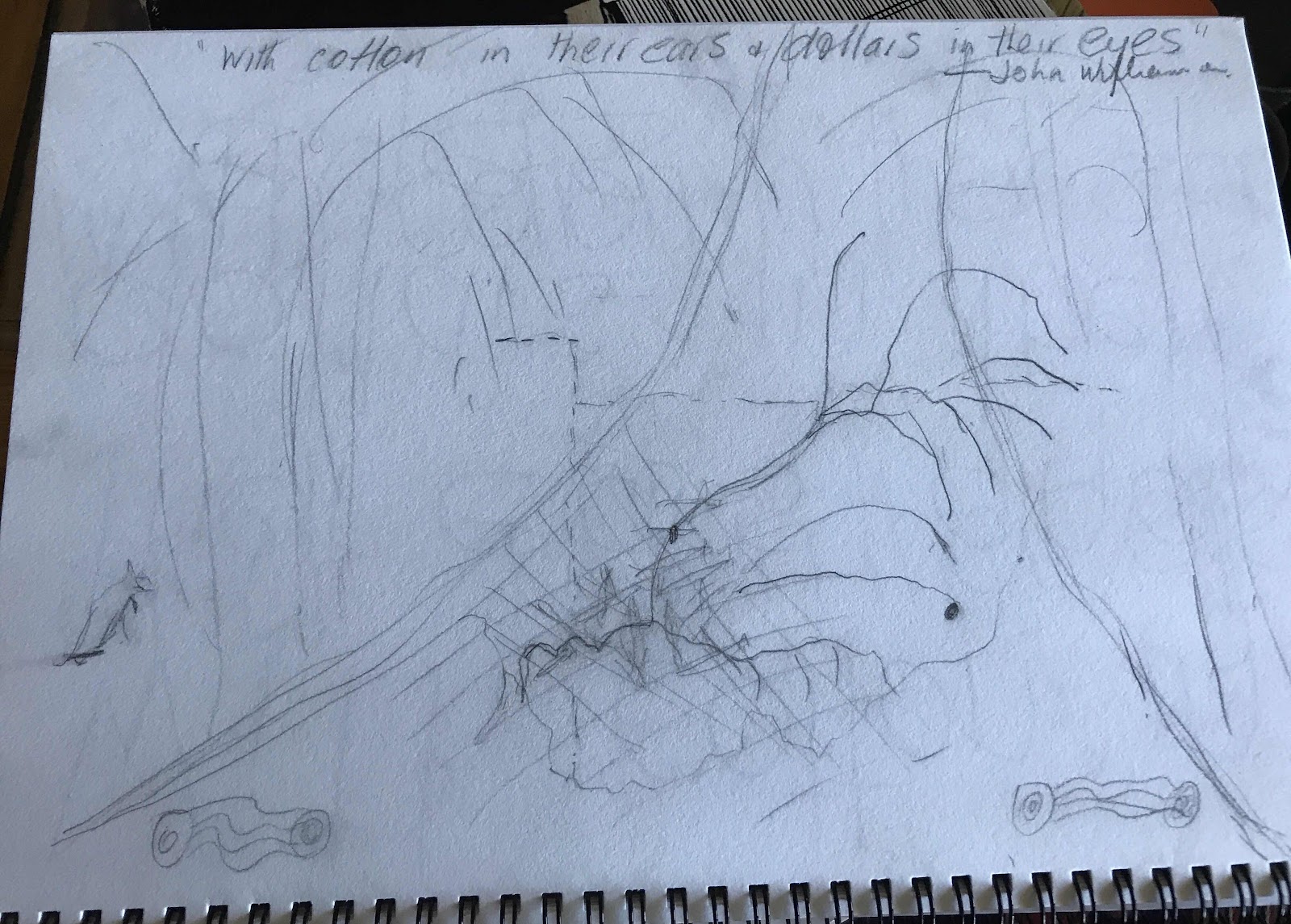
I looked at a lot of photographs of the Murray-Darling river system and made a rough sketch of my design.

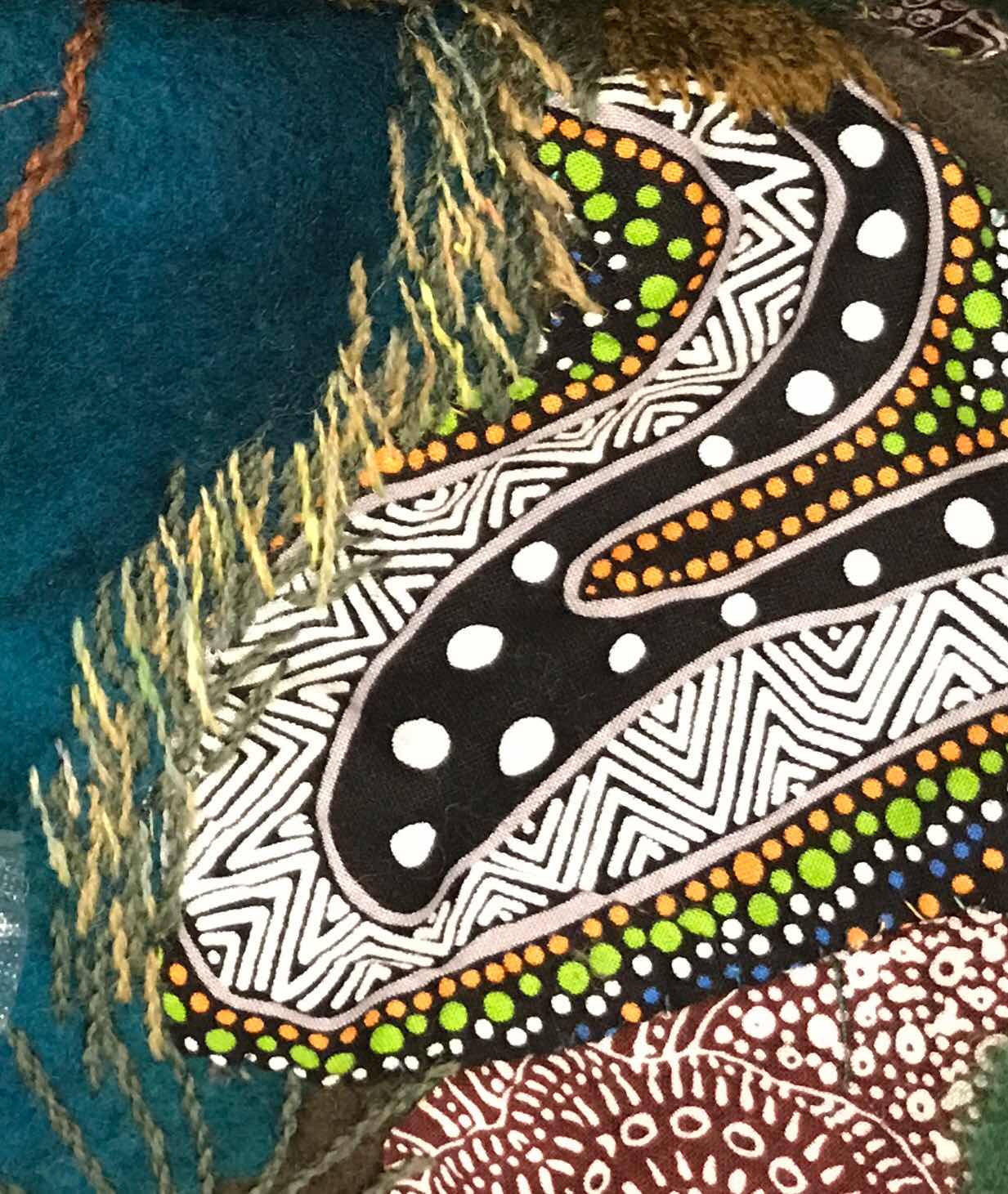
I wanted to show the connection of the river to land and life and the impact of the greedy use of water. I thought of using various Aboriginal words and symbols for water but decided I did not have the authority or permission to do this. Instead, I thought I could use Aboriginal fabric. I figured that this was commercial product, and therefore in the public domain, available for incorporation.

I also searched for Aboriginal designed fabric with water themes and ordered pieces called Baanbaan, On Walkabout, Waterhole brown, Possum land and water blue from Aboriginal Fabric Gallery in Alice Springs. They were immensely helpful, rushing fabric to me before Easter. I also bought Dancing Spirit Brown and Snake and Emu from the One Stop Fabric Shop.

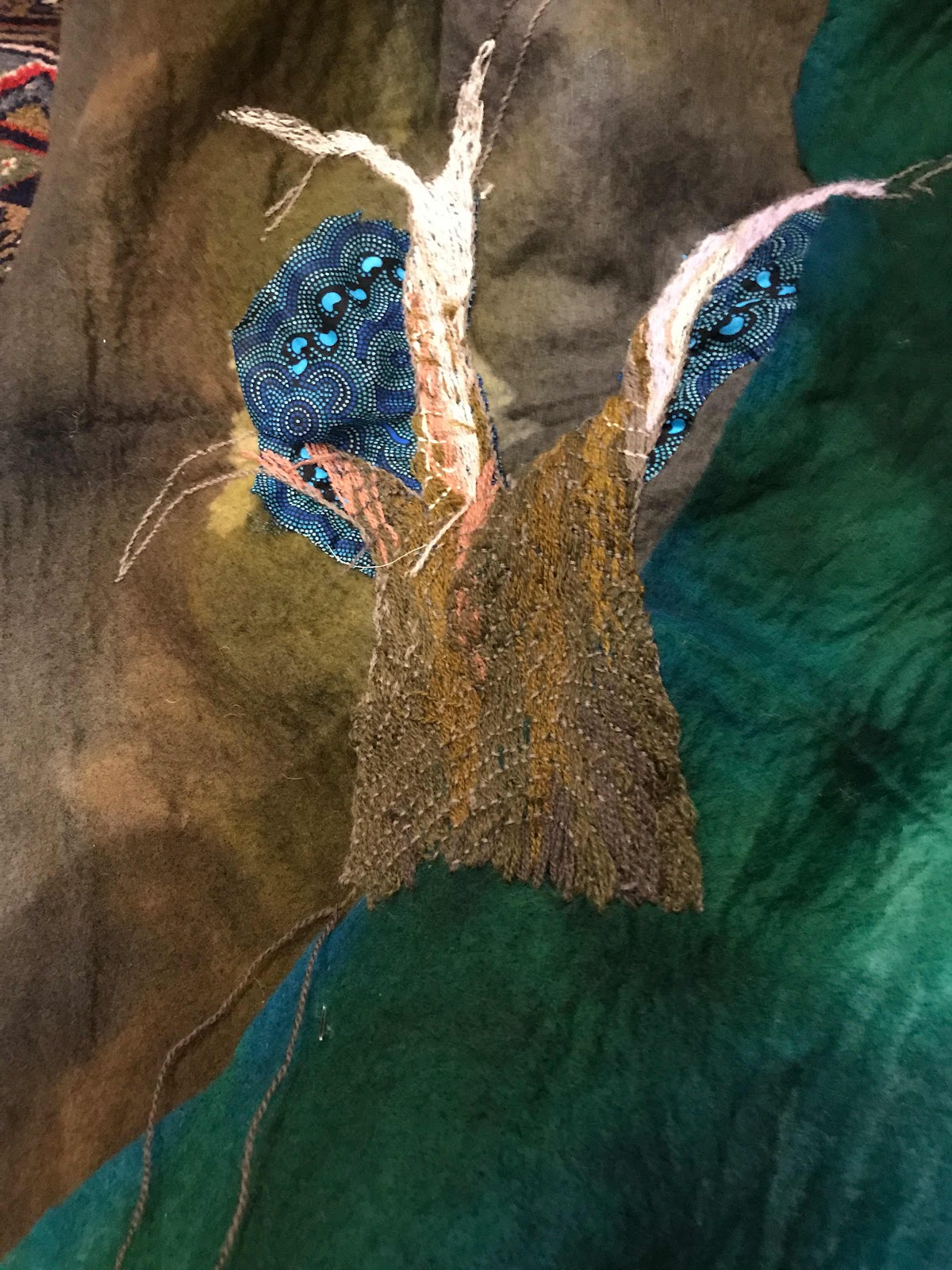
Over Easter I appliquéd, a few pieces of fabric to the flimsy and then embroidered a large tree overhanging the river.

I cut some gum leaves from another piece of fabric I found and appliquéd, them around the tree. It creates, I think, a good sense of a tree losing its leaves and beginning to die.


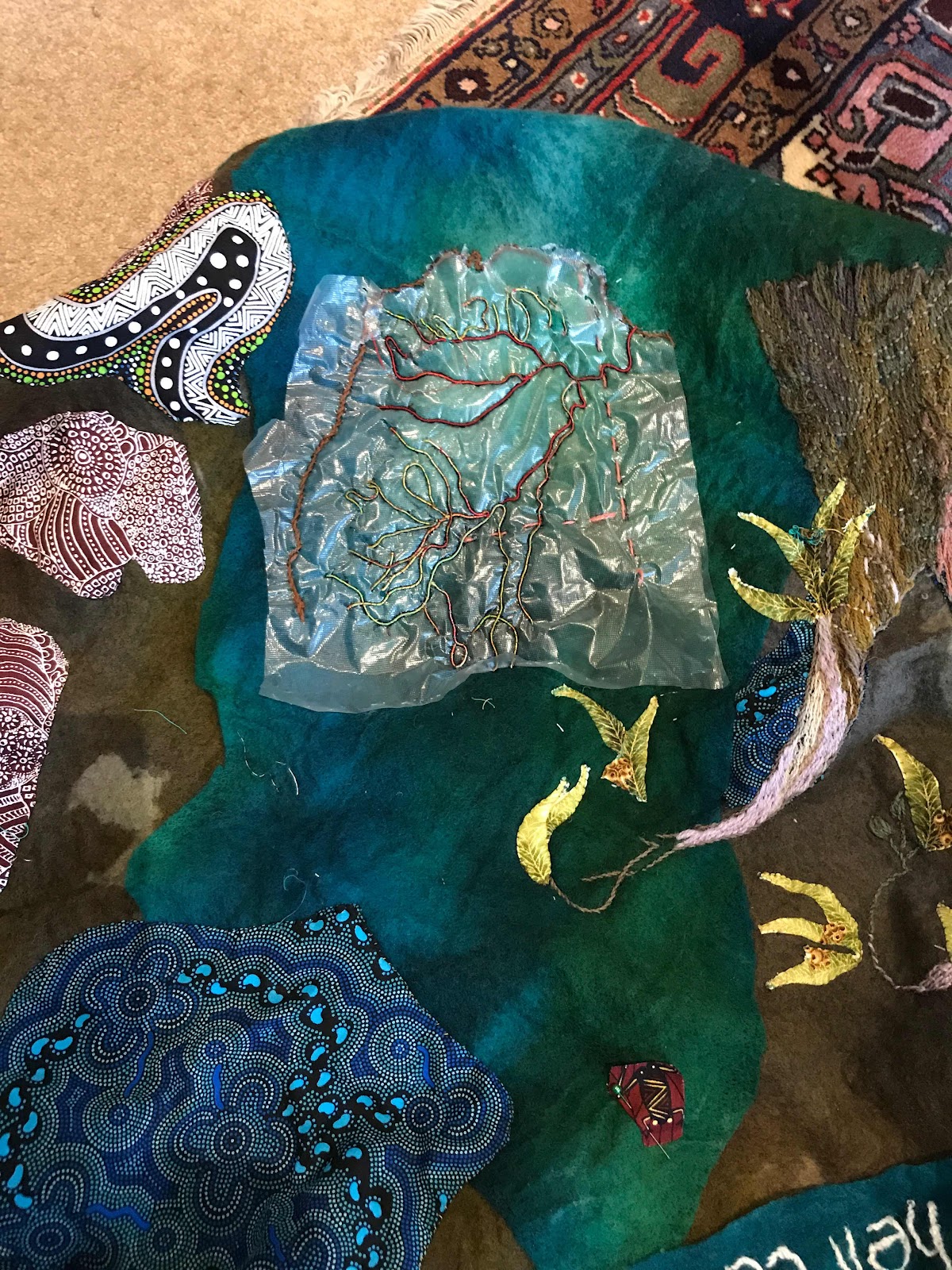
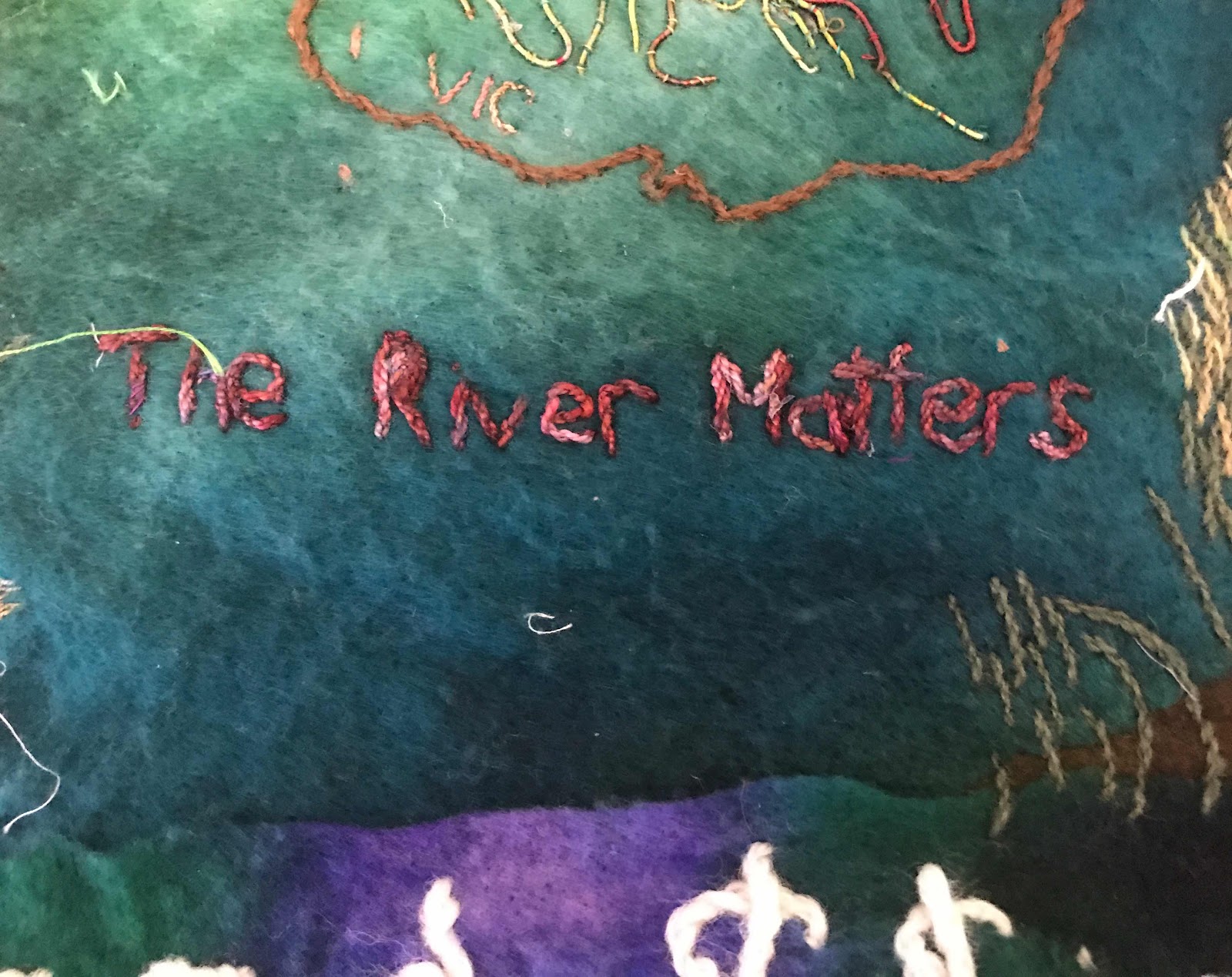
In the centre of the river felt I embroidered a map of the Murray-River basin, using gimp. The only way I could see to do this was using Solvi. The background is too soft and absorbent to use any marker. I don't much like stitching through a membrane but in this instance couldn't find another way.

I removed as much as the membrane as I could by tearing, rather than dampening the whole thing, as I wanted to wet as little as possible of the felt. It worked, but did need a bit of stitch repair afterwards.

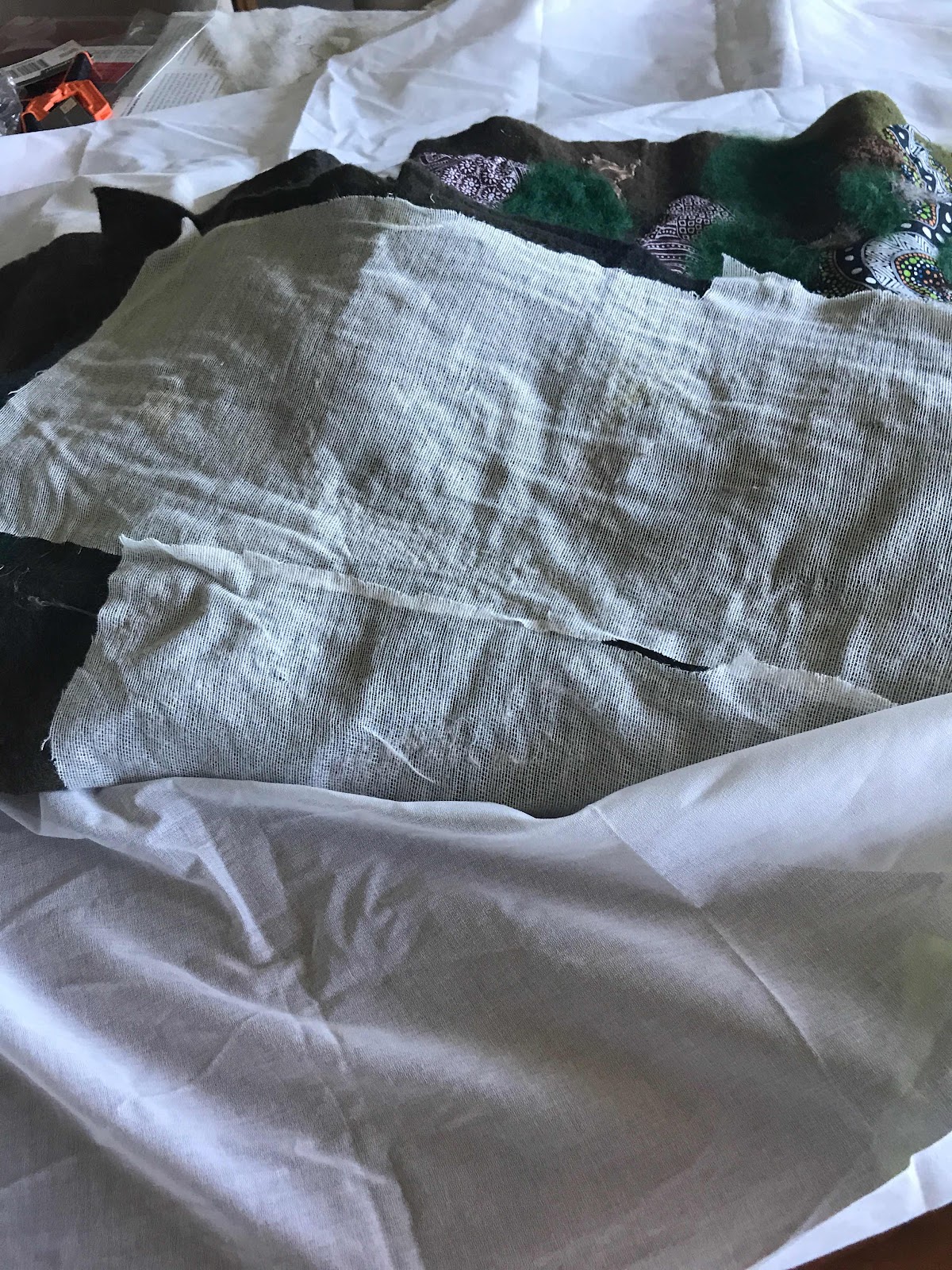
By now it was becoming apparent that the pre-felted flimsy was not sufficiently stable where I had embroidered the tree and appliquéd the leaves.  I therefore applied some strips of iron-on interfacing to the back of the tree and needle-felted any areas of the flimsy that were sagging. I then applied a fine cotton backing the whole piece.


It is not perfectly geometrical, but, I think, close enough. I added orange trees and finished the reeds.


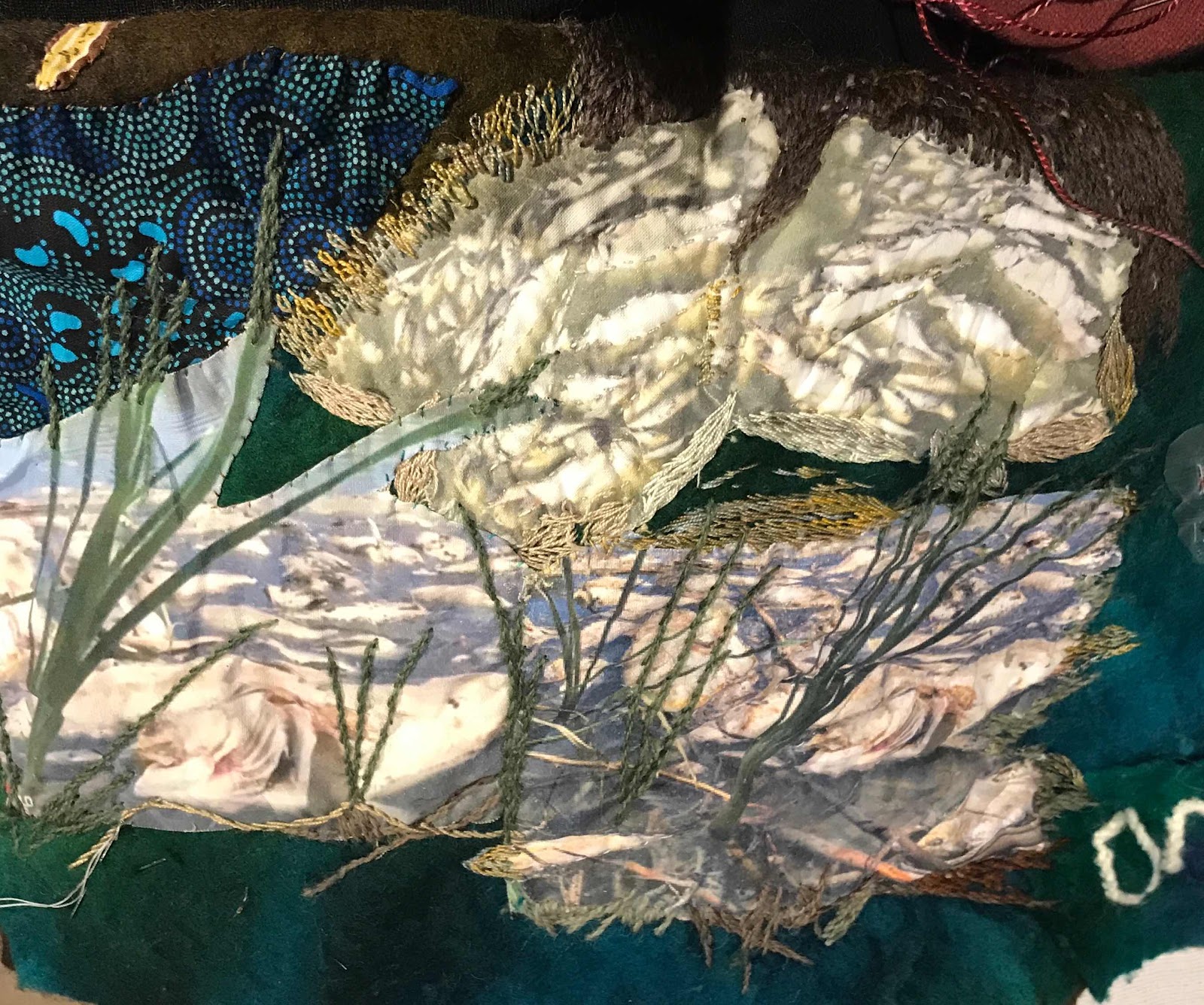
I needed to add more dead fish so printed a couple more photos, incorporating them with embroidered edges and extending the reeds.While I was about it, I extending the reeds around the edge of the river on the right bank.


Somewhere along the way, I had watched an episode of Heather Ewart’s ABC TV series Back Roads, in which she visited the Riverland. Right at the end, a farmer commented that “the river matters”. It stuck in my head and became the title of this embroidery.
 
I tried embroidering the title on the river, using Quaker stitch and some lovely variegated reddy-brown thread. To try to keep it straight and even I once again used Solvi.


I was disappointed in the result. The words were lost in the felt.


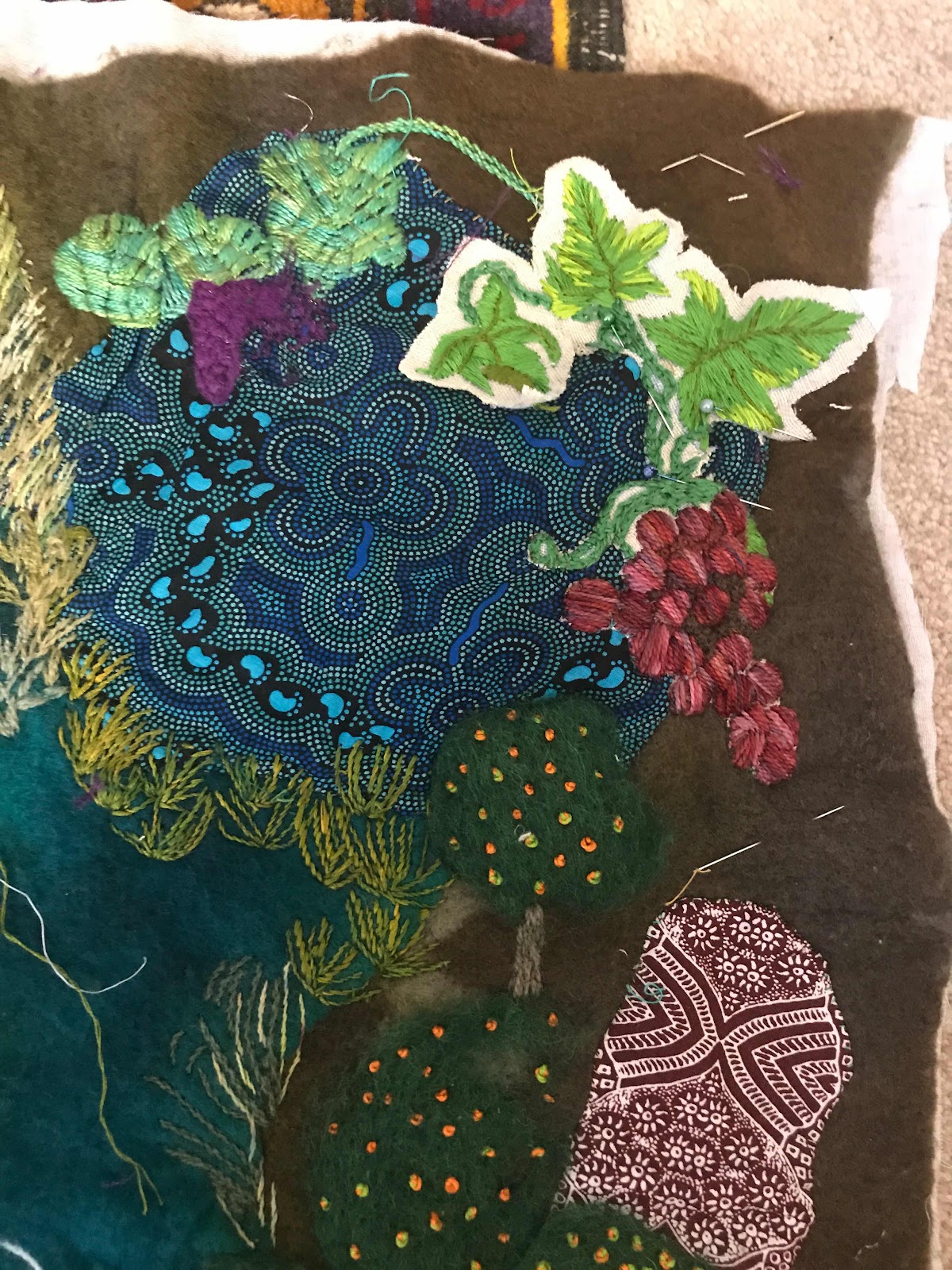
On the other hand, I had a lot of fun adding orange trees - needle felting the tops, (Veronica helped out here) embroidering the trunks with stem and Bokhara stitch and adding French knot oranges in varying shades of green to orange.

Throughout this process I shared my progress with my regular stitching friends  whose opinions helped a lot as I decided what to include or leave out.

I had a couple of attempts at adding some grapes and grapevine to the riverbank. I tried creating grapes from felt - but couldn’t get the definition I wanted.
 
Eventually I remembered my collection of iron-on transfers. I found a book of transfers that included a grapevine! I ironed sections of it on to linen, embroidered the linen, then appliqued this to the felt.

Satisfaction at last! It worked, though it wasn’t an easy process. The layers were, by now, quite thick and the linen edges frayed.  I needed to go around the edges with French knots to cover stray linen strands. This time, the reddy-brown thread worked well for the grapes!


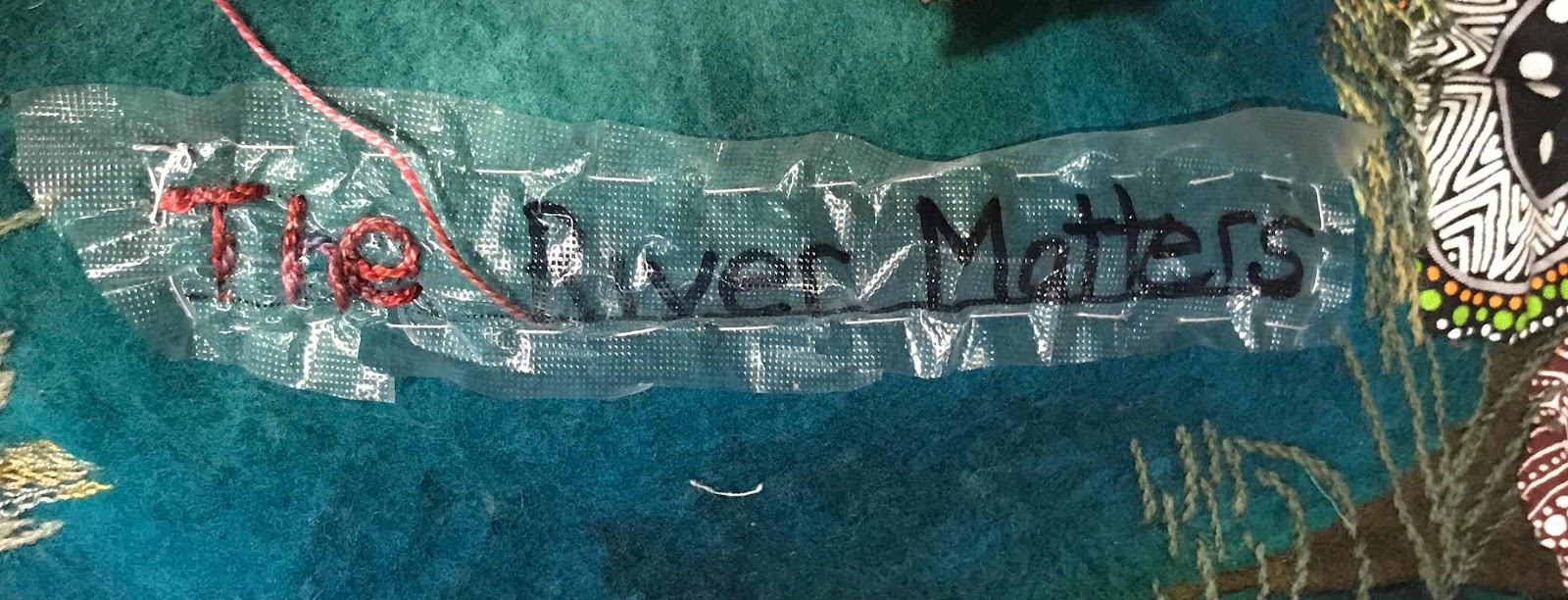
Having rediscovered my iron-on transfers, I used a 1970s Hobbytex one of an ibis to create a banner on linen, adding the title text in Quaker stitch.

This gave the prominence I was after. The top of the banner is appliqued with French knots, blending with the dots on the fabric. The bottom edge is stitched with detached fly to continue the ibis’s footprint.

Appliqued animals add, I hope, a further sense of what we owe to the river.

It was time to turn my attention to the backing of the piece. Because I want this to be in some way a useful object, rather than a picture on a wall, I had conceived it as a small blanket or rug. I needed to keep it soft and flexible. The felt fabric is wonderfully soft, but won’t take hard wear.

My original intention was to back it with another felt flimsy, then bind the edge using cotton fabric depicting fish, turtles and other sea creatures - creating the idea of an island - the land and the river surrounded by life-giving oceans.

However, in order to get the edges straight I would need to square off the felt, which I couldn’t do without losing some content. I discussed this with some members of the World Embroidery Study (WES) Group, who suggested the edge should be as dynamic as the river.

I wanted to use some appliqued panels of Spirits on the back, along with a Rainbow Serpent, who, after all, created the river.  I really wanted to use the Spirits - hoping, I guess, that they ‘have the back’ of the river. A double layer of felt flimsy would make a great rug, but not an even edge.

I went ahead and added the Spirits to the felt flimsy called “Federation”. I love the colours, and I also like the symbolism of federation - a difficult process, but one that gives all of us an obligation to the river system.


I backed them with iron-on fusible webbing, ironed them on, then stitched around the edges of each piece with French knots. It worked a treat on these fabrics.

I was then left with the challenge of putting the two pieces together. One suggestion from the WES Group was to layer the piece on to black, but to do this, I would need to put black fabric between the two flimsies and either needle-felt or applique the flimsies to the black.

After quite a bit of thought and experiment I decided to try to fold the back edge over the front and stitch it down with a fly stitch - more bird tracks!


The process of stretching the back edge over the front was not easy. I managed it on three sides, then added a strip from another flimsy to complete the last side. I used some lovely hand-dyed thread from the Stitchy Box subscription given to me by my daughter in 2017.

I am pretty pleased with the result. The piece is wonderfully soft to hold. I hope I have done justice to the river - and to its importance to those who live along its banks and care for it. 

I have turned this blog into a booklet that I submitted as part of the Exhibition entry.

Acknowledgements and Resources

There are still numerous Aboriginal language speaking groups along the Murray River (though nowhere near as many as there were before white settlement), including the Ngarrindgeri in South Australia and Yorta Yorta near Echuca in Victoria. They have cared for the river for tens of thousands of years and continue to do so.A helpful map and information can be found at http://www.murrayriver.com.au/about-the-murray/murray-river-aboriginals/

Fabric for this project came from:

·      Aboriginal Fabric Gallery, Shop 3 Capricornia Centre, 91 Todd Street  Alice Springs, PO Box 3098, Alice Springs, NT 0870, Australia, Phone +61 8 8952 6163 Email aboriginalfabrics@bigpond.com
·      One Stop Fabric Shop http://onestopfabricshop.com.au/  PO Box 371,
Figtree NSW 2525  Phone: 02) 42299262

The fabric is Dancing Spirit Brown by Colleen Wallace, Possum Land and Water Blue by Heather Kennedy, On Walkabout Blue by Karen Taylor, Waterhole Brown by Arma Price Pitjara and Snake Emu Charcoal by W Evans.

The felt flimsies came from The Thread Studio, 6 Smith Street Perth, WA 6000
Australia Phone  +61 8 9227 1561,  Email: mail@thethreadstudio.com.

Some of the threads were from those sent to me in 2017 as part of a Stitchy Box monthly subscription given to me as a gift by my daughter. https://shop.stitchybox.com/

Photos of dead fish on Menindee Lakes were from:
The Daily Telegraph, Jeremy Buckingham, Ex-Greens MP Inspects Darling River Fish Kill 19 January 2019

Members of the World Embroidery Study Group of the Embroiderers’ Guild of SA provided suggestions and feedback, as did Susan Butler, Jennifer Stehn and my family.