This is another post that will be of interest only to the most hardened of knitting nerds, and it's long. Turn back now if this puts you off!
As I wrote in my blog post about the Vikkel hat, after my steeking success last year, I decided I would get a bit more practice. When this book appeared on my radar, I thought I'd give it a go. The 21 wraps employ steeks, enabling , for the most part, all work to be in knit stitches.
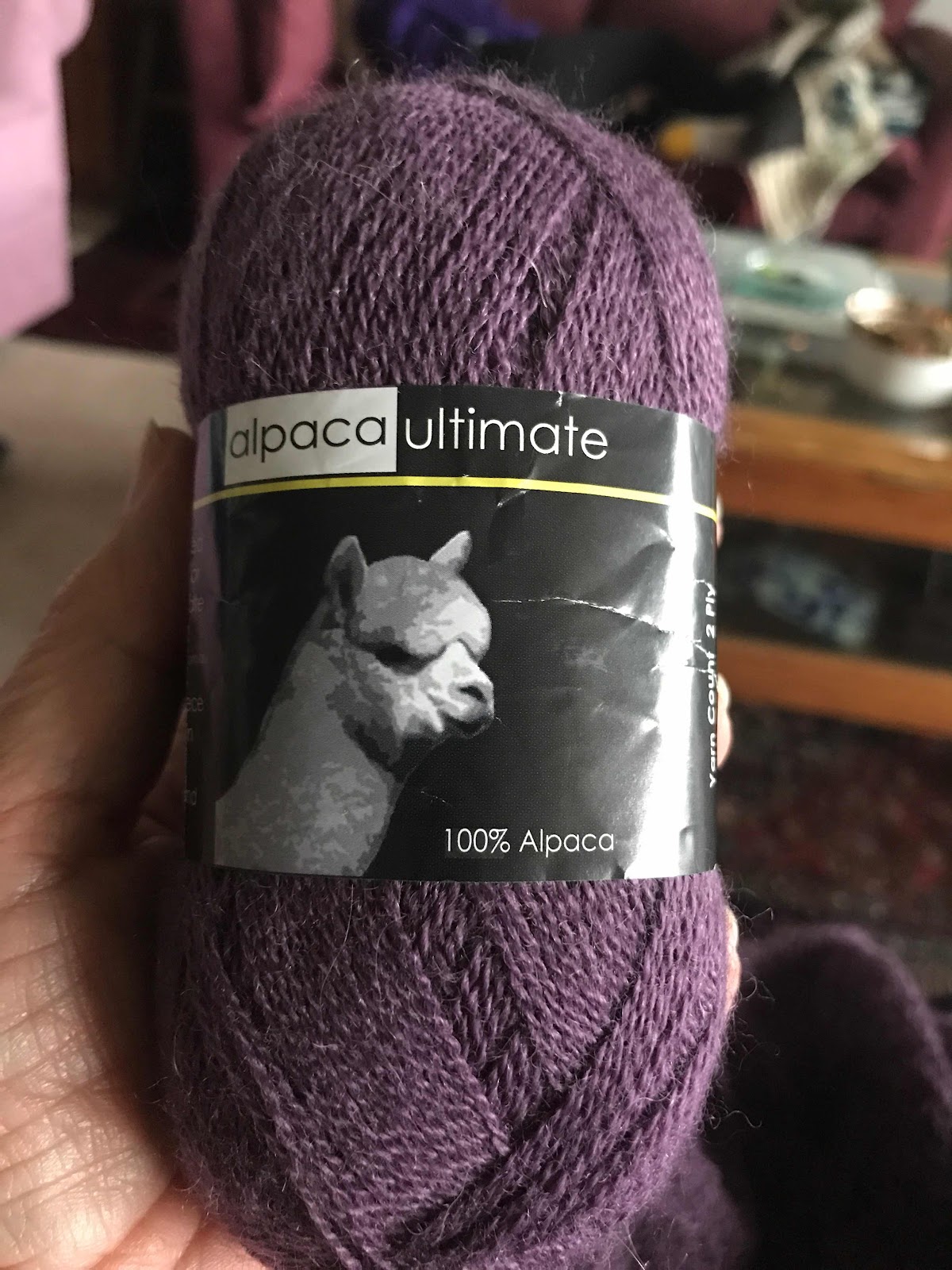
I bought some alpaca yarn from Adagio Mills - in three shades, two browns and a black. My idea was to work two-coloured shawls. I bought what I thought would be enough to make three shawls, and the three colours would give me six possible colour options.
I began with the black and lighter brown.
When I read the pattern, I decided the steek was an unnecessary complication, and began using the chart to knit back and forth. It didn't take long for me to realise that reading the chart from left to right for the purl rows was going to be slow and frustrating. I joined the work into the round and went with the steek after all.

The pattern had a 5 stitch steek. I increased it to 7 stitches to give myself leeway. In retrospect, not strictly necessary, but helpful.
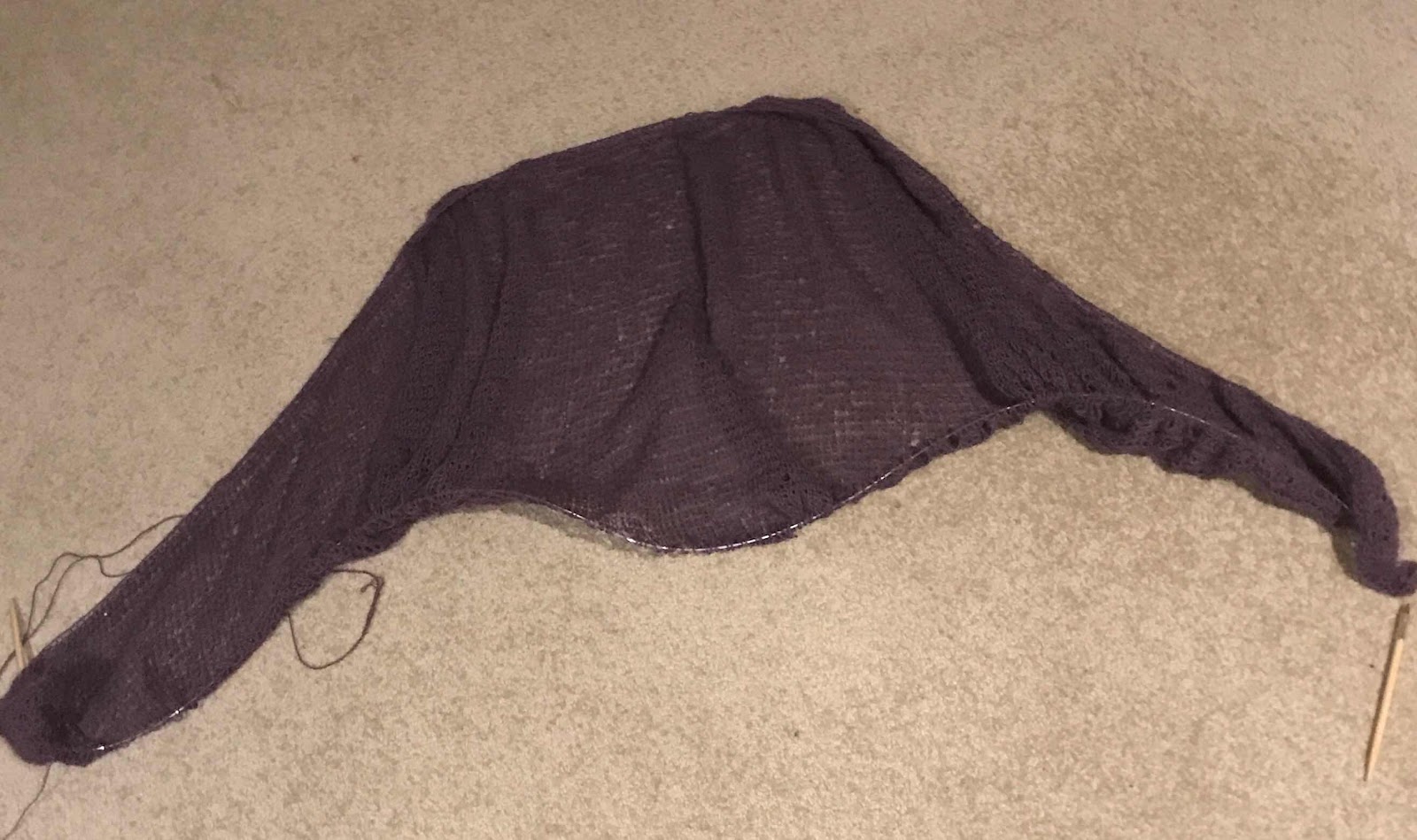
It's an 8 stitch, 8 row pattern. After a couple of repeats it was easy to remember. Each row increases by 2 stitches until there are 452 stitches on the needle - slow progress.
I didn't time my progress until there were around 340 stitches on the needle, by which time each row was taking 25 minutes. It isn't possible to keep a row counter on circular needles so I was counting rows up the steek with a goal of 200 rows. When I reached 173 rows I checked the pattern to discover the goal was 220 rows! Knit faster woman!
The alpaca knits beautifully and feels very good on the hands. It is quite dense in the two colour pattern, because of the yarn carried across the back. I am, fortunately a fairly loose knitter. It will stretch a little in blocking, but not much. I realised after about 100 rows that my yarn calculations were way out, so amended my plans. Rather than 3 shawls from the yarn, I will make 2 - and still require more yarn. I managed to order more of all 3 colours from Adagio Mill before they ran out. The dark colours run out quickly. In fact, the pattern needed even more.
Around row 216 I measured the length and, (as much as I could on a circular needle) the breadth, to find, as I suspected, it was larger than the pattern's predicted size. I therefore called it quits, and proceeded to cut the steek. I ran a row of straight machine stitching either side of the central line in the steek and cut. It wasn't as scary as the first time!
The result was pleasing: a decent size triangle and straight edges.
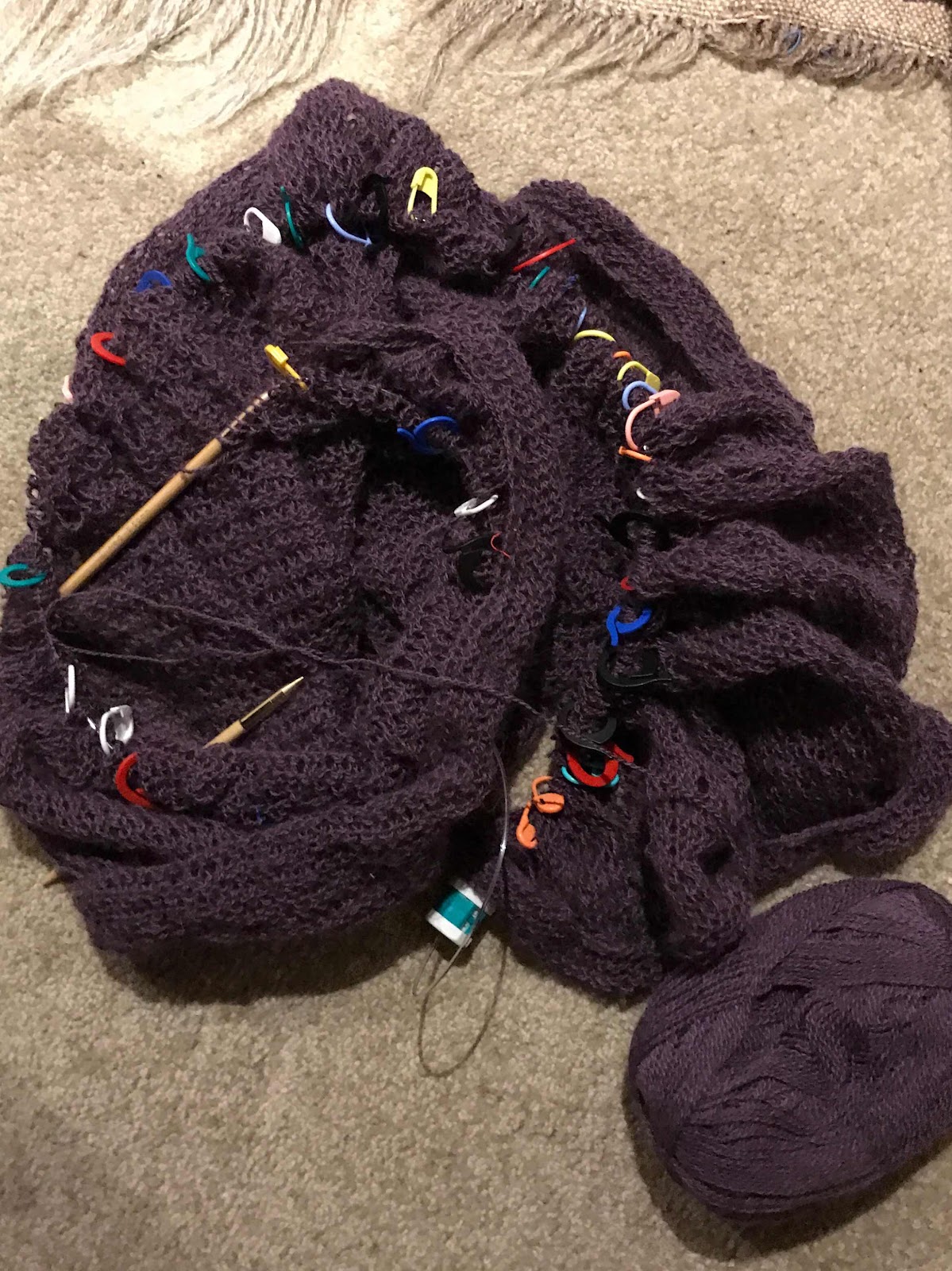
A lot trickier was the process of picking up 320 stitches evenly around the two steeked edges.
The circular needle, with 772 stitches, was crowded. I had further extenders, but needed more joiners.

The border is 12 rows. It was only after picking up the stitches that I realised the pattern was using the sandwich method of completing the steek - that is, knitting a double border, picking up a second round of (another 772) stitches on the inside of the shawl, then sealing the two border strips together with an icord, encasing the join so it isn't seen, like binding the edge of a cushion with a cord. I was not at all sure it was feasible to find the stitches to pick up between the floats on the back of the shawl.
The more immediate problem was the tightness of the stitches on the circular needle. I needed more length, had only short extensions, and no joiners. A trip to the
Yarn Trader gave me a 125cm extender and a couple of connectors. The resulting circle is huge - not quite the full length of the stitches, but workable.
As I worked the 12 rows in rib, I considered my options for neatening, or hiding, the steek - an inner border, or just neaten the raw edge?

I liked the look of the underside of the single border. On the top working edge there was no steek, and the transition to the border was smooth. It seemed a shame to turn that easy transition into a double border, losing the look of the inner rib.
My yarn calculations, once the outer border was complete, suggested that, even with the extra yarn I had ordered, I would not have enough yarn to complete an inner border but would just manage one around the two steek sides - without the icord. Furthermore, there was no more of the fawn yarn available. I ordered a ball of what looked like a similar colour in an alpaca/polwarth blend, but it was too light.
So I cast off the single side with an icord, then knit an inner border on the two steeked sides. This meant knitting back and forth, purling on the back. I'm OK with that - it was easy, relaxed knitting.

I cut any excess loose threads from the steek edge. Even so, the fold was bulkier than I'd like. The folded edge inevitably has four layers of knitting which no amount of pressing or blocking will remove.
Once the inner border was finished, I hit another snag. The pattern instructions simply said 'join the two edges', gave icord instructions, assuming a single edge. As I had no intention of trying to slip 369 stitches from the inner circular needle one by one between the 369 stitches on the outer circular needle, I went looking for instructions for joining two edges together using an icord. I found
a useful video that showed me how to begin with three cast-on stitches, then knit together three stitches, one from the cast-on, one from each edge.

It is slow, demands concentration, but works. I just had enough fawn yarn to finish the two edges, so the icord edge is black.

It needs to be worked with the wrong side facing, to get the corded edge on the right side ( upper edge in the photo above). On the wrong side it leaves a narrow gap with a running stitch effect.
Having come this far, I covered the gap by whipping over it.
To reduce the bulk over the steek, I reluctantly decided to run a row of machine stitching over it. While part of me thinks this is a shame, it is firmer and much smoother.
 I experimented with a number of embroidery stitches to work over the machine line, but rejected all of them in favour of allowing the machine stitches to sink unobtrusively into the knitting. I feel this is a bit of a compromise, but definitely the best option.

I considered blocking it on my hap stretcher. It would certainly fit. The hap stretcher, however, needs a repair to one of the screws, which I have been putting off.
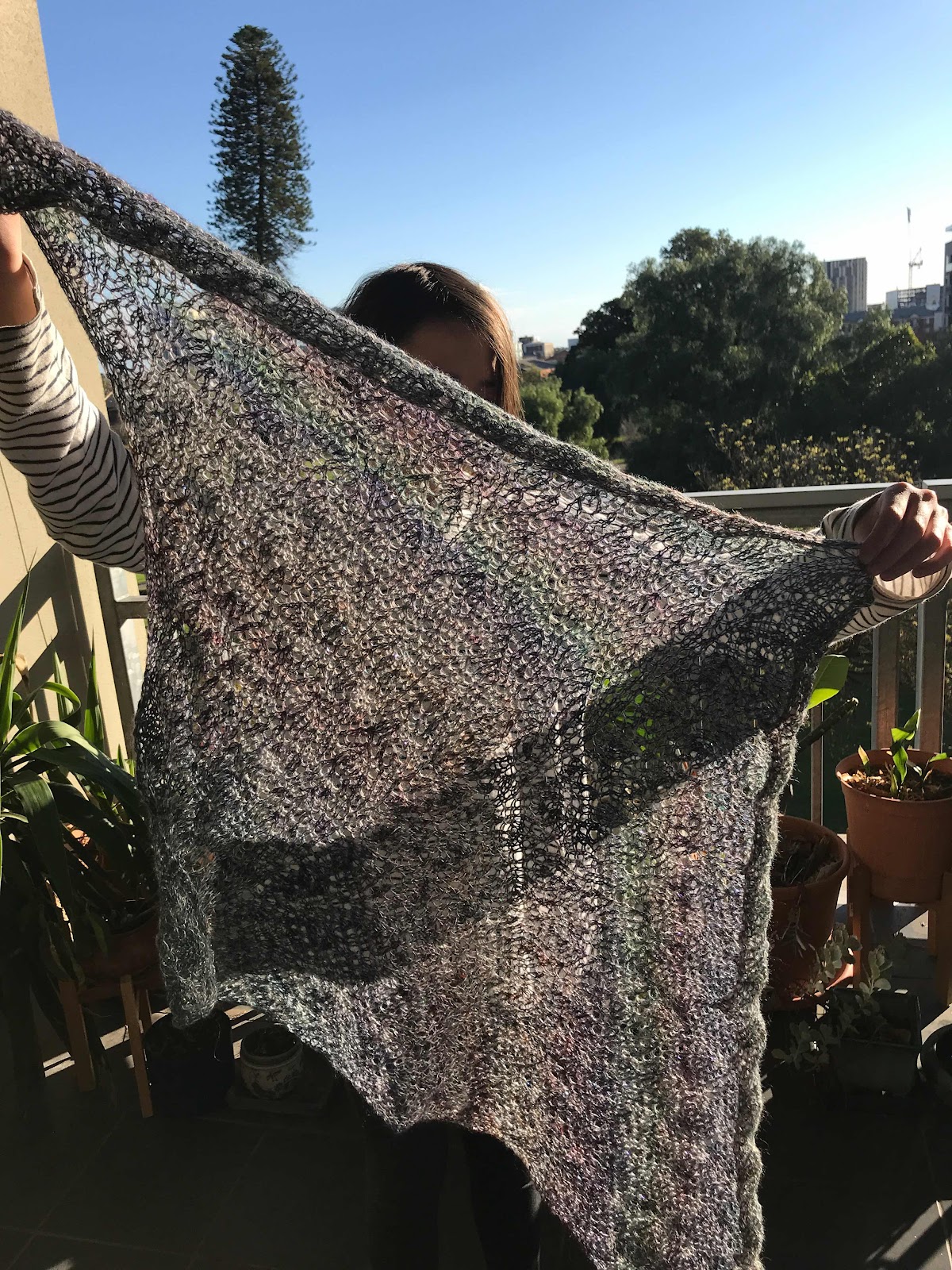
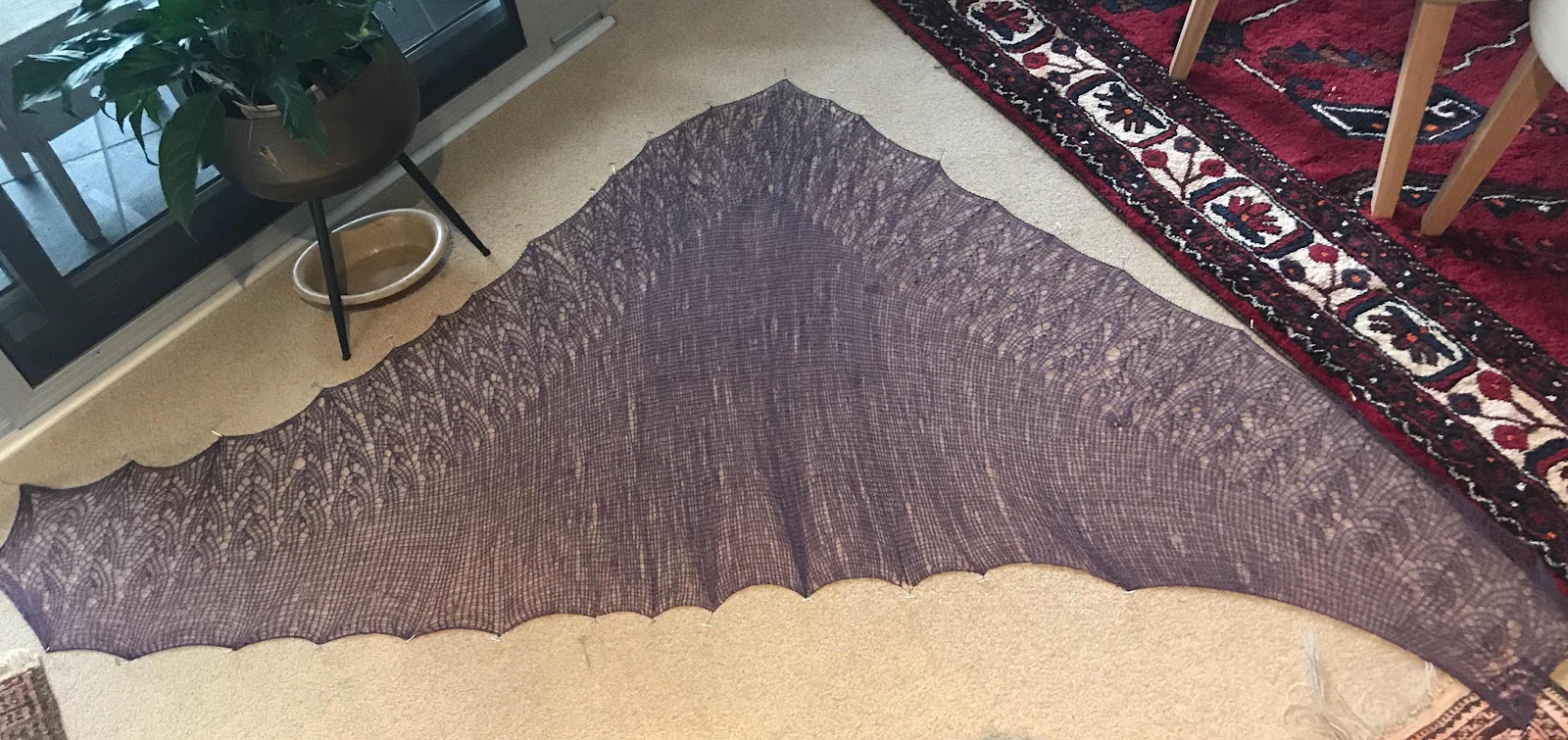
The shawl is soft, light, and cosy rather than lacy. I didn't want to lose any of the warmth and thickness by stretching it too far, so I blocked it on my dining table using a combination of blocking tiles and a polystyrene board, deliberately giving it a scalloped edge along the single border.
After 36 hours I removed the blocking pins and hung it outside for a couple more, just to ensure it was dry.
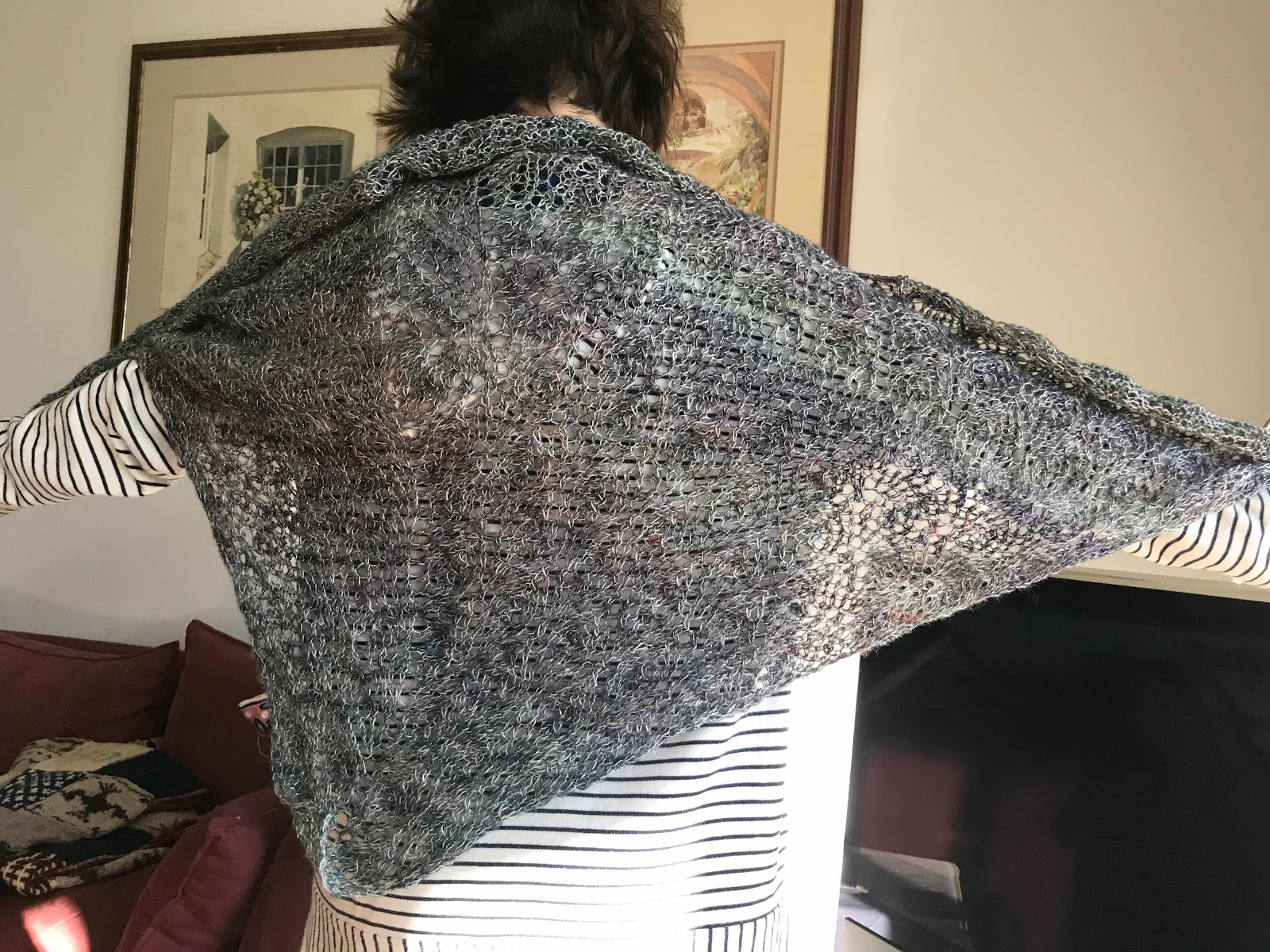
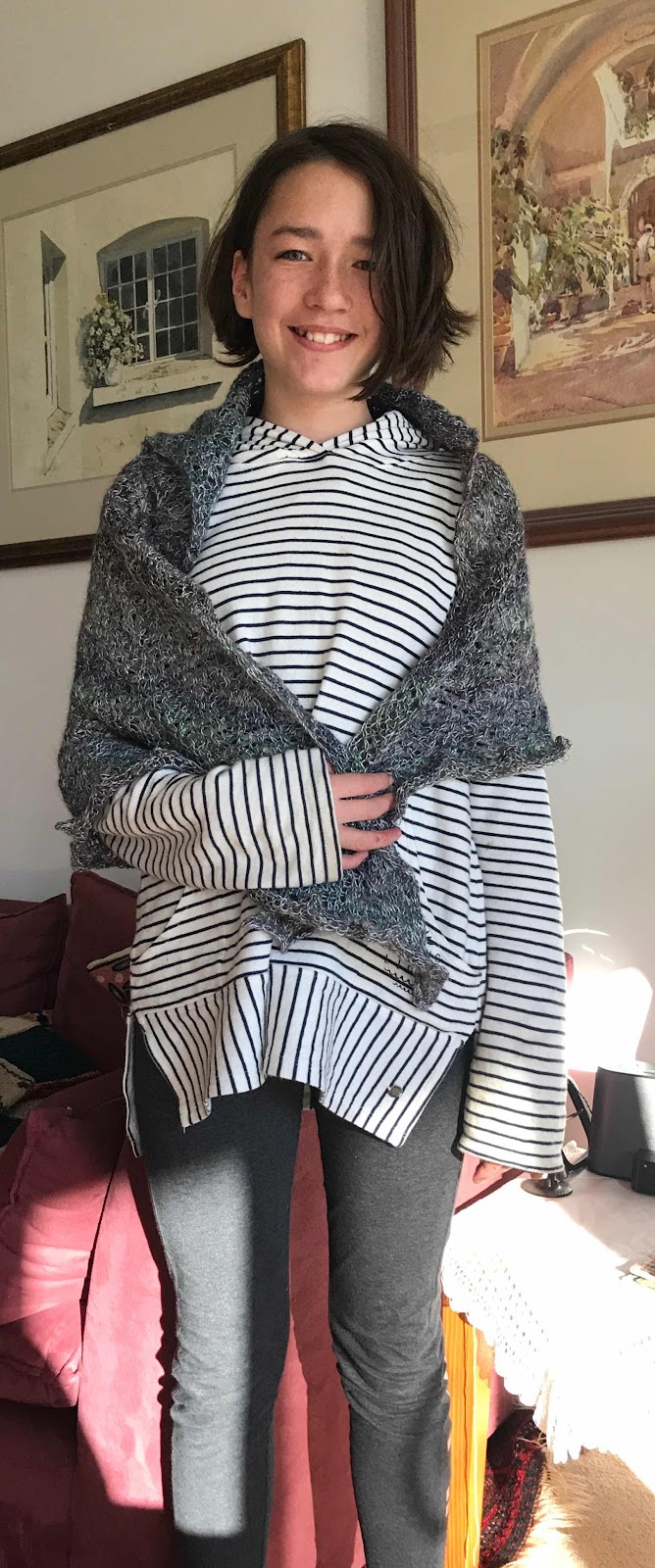
Veronica modelled it for me on Saturday.
I am really pleased with the drape and feel.
My daughter should have it in Canberra today in the expectation there are a few weeks left this year when it will be cold enough to use it .
This has been a major learning exercise. There were times when I questioned my sanity. I think clearer instructions would have helped. Nonetheless, I'm glad I figured it out, adapted and did it. I
really like the shawl. I think it will bring pleasure and get used. My first shawls were knitted from patterns in the
Prayer Shawl movement. I try to practice contemplation and blessings in all my knitting now, but particularly shawls. Even the frustrations experienced couldn't take away the calm and peace that came with knitting it.
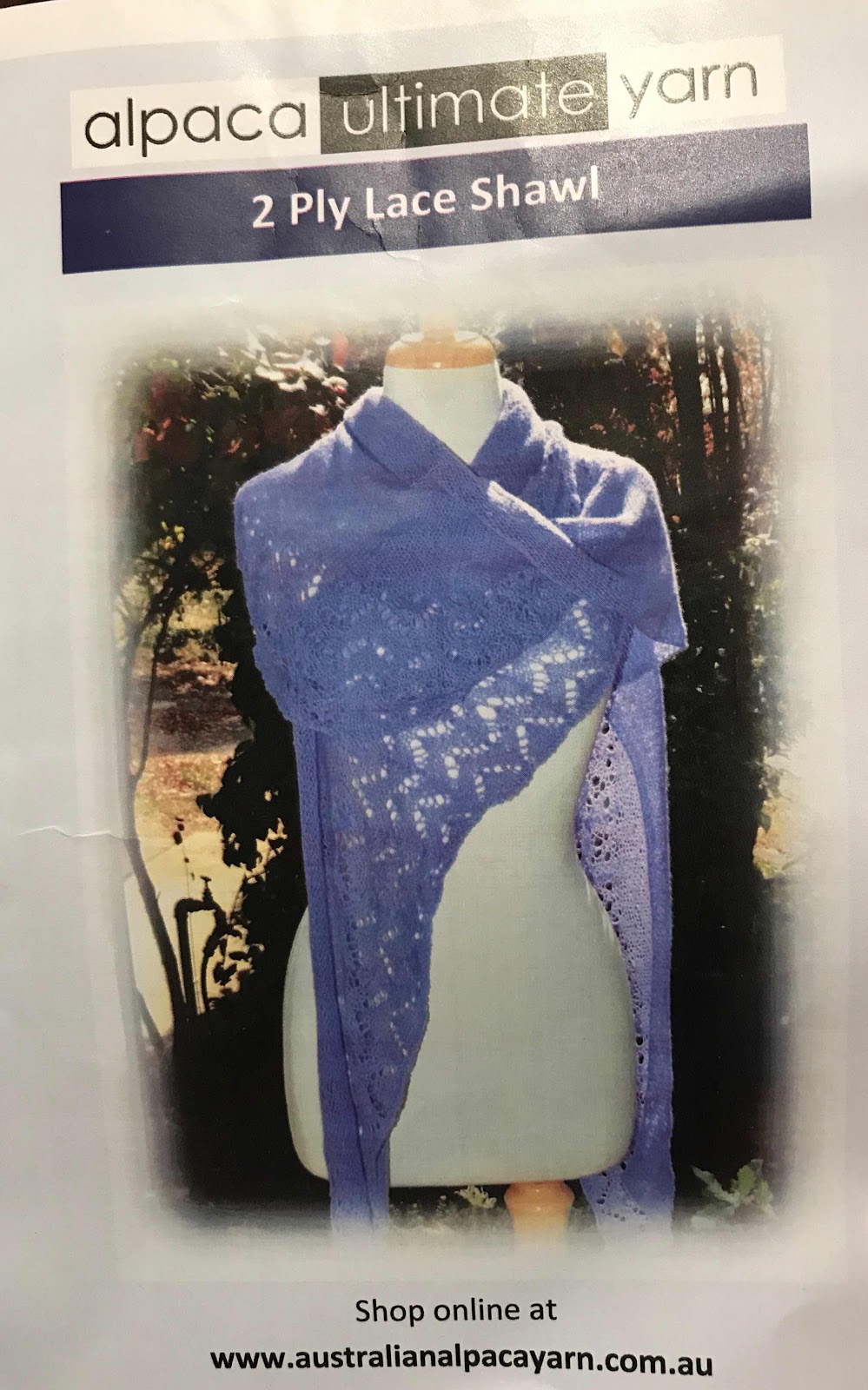
I guess that's why I'm about to cast on for the shawl shown on the cover of the book above using the remainder of the alpaca!

 As with the previous shawl, it began with 3 stitches. I worked about 3" back and forth, increasing at each end of every row until I had enough stitches to join into the round., inserting a 9 stitch steek in the process.


 Although I machined two rows either side of the centre of the steek before I cut, I ended up unpicking most of the machine thread as I stitched the edges down, because it removed elasticity.


 I was truly delighted with the result. My worry that the edge would continuously curl was unfounded. It folded neatly around the neck and fell beautifully. I was also sceptical about the usefulness of the shape, but it is well long enough to drape comfortably.