Search This Blog

Showing posts with label Shetland Wool Week. Show all posts

Sunday, May 17, 2026

Shetland Beanie2025

I bought the yarn for last year’s Shetland Wool Week beanie a year ago, when the Yarn Trader put together the Jamieson & Smith colourway, but it sat untouched until I was invited to a friend’s birthday celebration. The friend’s ancestors came from Shetland and she had hoped to visit her ancestral home again this year, but too many things got in the way. It occurred to me that the beanie might be a welcome gift - a connection as she walks along an Adelaide beach this winter.

I made a mistake straight away, using the lighter shade of purple for the band instead of the dark shade (more haste less speed). Luck was on my side. It produced a bit of a softer look.

I now use Lantern Moon ebony needles for preference (in the photo above). They don't bend, have fine points and are gentle on your hands. The finest gauge they make is 3mm, the size for the medium version of the pattern. Unfortunately, towards the end of the first pattern repeat, one of the ebony ends snapped in the middle of a row.  I have two sets of Lantern Moon exchangeables, but only one pair of 3mm ends. I also have a number of bamboo fixed circulars, but not 3mm. The only 3mm circular I had was a fixed steel. It was the right length, but the steel ends were quite long - about 15cm. They worked well enough on the main body of the beanie, but were too inflexible for the crown. Once upon a time I used steel needles for preference (when the choice was plastic or steel)  and I had forgotten how hard on the hands they are.
,
After my error with the band, I set up a set of reminders, with a loop of each colour threaded to its label and marked with it's alphabetic letter in the pattern. As the label also contains the colour number, this constitutes a complete index. I made no further colour mistakes.

Lantern Moon needles are not easy to come by in Australia. I managed to find a retailer in country NSW with some replacement points and ordered some. I continued, however, with the steel rather than waiting.  

This meant I had to switch to DPNs to finish the crown as the steel circular was simply too long and inflexible to manage the decrease.
I really like the pattern, but it was a challenge to knit. Shetland wool is a little course and splits easily. The pattern requires vigilance, a mistake of one stitch will disrupt the pattern. I made a mistake in the second row of the crown and had to undo a whole round - a very slow process as it is very, very easy to miss picking up a stitch. With 3m needles the stitches are small. The pattern sequence however, helps identify an error.


I worked on it intensely over a weekend, pushing on to finish. The design is crowned with a tassel rather than a pompom to finish, so I went with that, using all 8 colours. 


It was a surprisingly challenging project. Fortunately I really, really like the result. 

I held posting this until the gift was given. I reckon my friend likes it too!


Monday, October 7, 2024

Leftover Uradale wool shawl

For the last two weeks I have been knitting up the wool left over from the Uradale version of this year's Shetland Wool Week hat. As I posted last month, the hat  used very little of the 5 balls of wool in the kit. Rather than knit more hats, I found a shawl pattern in Martha Waterman's Traditional Knitted Lace Shawl and adapted it.


Her 'garter lace triangular shawl' has alternate bands of simple lace and garter stitch.

I began trying out the pattern as written, intending to work it in stripes of the five colours, but decided pretty quickly that the texture wasn't right for the wool (left).


Instead of the garter stitch bands, I worked bands of stocking stitch with a simple Fair Isle pattern, no 56 from Mary Jane Mucklestone's 200 Fair Isle Designs.  I began with the darkest colour, and worked bands of pattern using each of the other four colours in turn between the lace. It seemed to work.

I then moved to the next darkest colour and repeated the process, increasing as indicated in the pattern.


This worked in so far as it rationed the wool nicely  but the similarity of three of the colours didn't make for great contrast. I nevertheless continued with the scheme. Subtlety isn't a bad thing, and this was, after all, an exercise in using leftover yarn.


Making it up as I went along, and with the best part of a full ball of the dark brown, I inserted a contrasting  band  between each background colour change.


I liked the effect, so continued, working each ball until it ran out.  I soon became concerned that the shawl would end up too long and narrow to drape comfortably over the shoulders
so I began to increase at the end of every row instead of every second row. I couldn't really tell on my needles whether this was working, but stuck with it.

Obviously, as the rows got longer, the colours would not cover as many rows, but the colour sequence largely worked, I finished with a couple of dark rows of lace and cast off with this the only left over wool. Maybe I could have managed one more row - but was not risking it.

I blocked it on my dining table, which is 1.5m x 1m, so my increases seem to have worked. It is a decent size for a shawl.

It took 36 hours to dry and smelled strongly of sheep while wet, even  washed in woolwash. I hope this doesn't persist when worn. I’m airing it outside for a while and will store it with lavender.


Both the shawl and the hat are up for grabs, for gifts or trading tables. 

I find it amusing that the leftover wool produced something much larger than the original hat! I'm pretty satisfied with the result. I have a substantial stash of wool, and do not want to add to it. 

I've had much joy in the making. This is also a versatile pattern that I'm sure I will use again.


Saturday, September 21, 2024

Fair Isle Knotted Basket.


Back in March, when the program for this year's Shetland Wool Week was released, I ordered a kit for a Fair Isle Knotted Basket, which arrived, along with a copy of Shetland Fine Lace Knitting: Recreating Patterns from the Past by Carol Christiensen. The kit was waiting for a rainy day. After finishing the 2024 Shetland Wool Week hat last night, I decided it was time for a complete break from knitting, but while on a Shetland theme, out came the kit.

Fair Isle currently has a population of about 60. It is the home of a particular Strawback Chair, made from wood that washed up from shipwrecks (there are no trees on Fair Isle) and straw grown on the island, and knotted in a unique way. Through the work of Eve Eunson, Stewart Thomson and the Fair Isle Chairs Project, the chair is now classed as a Critically Endangered craft.
The Fair Isle Knotted Basket kit is a fund-raiser for the Fair Isle Chairs Project. It uses the knot technique used with straw in the Fair Isle Chair to bind together natural rope with jute string to create a small basket on a wooden base. The instructions are straightforward and relatively simple.                                         I made my basket in two sessions - about 5 hours in total. I did not find it easy. The trick is clearly mastering the captain's knot, while maintaining good tension and consistent coiling to build up the sides of the basket.  The knots, while simple, take practice.  By the end I was beginning to get the hang of it, but that didn't improve my somewhat wonky basket. The string, fortunately, comes precut - but still makes for messy work.

It’s also not something to do when wearing black wool, as I realised when I put it aside to go to bed! When I resumed the next morning I donned a cover-all apron.

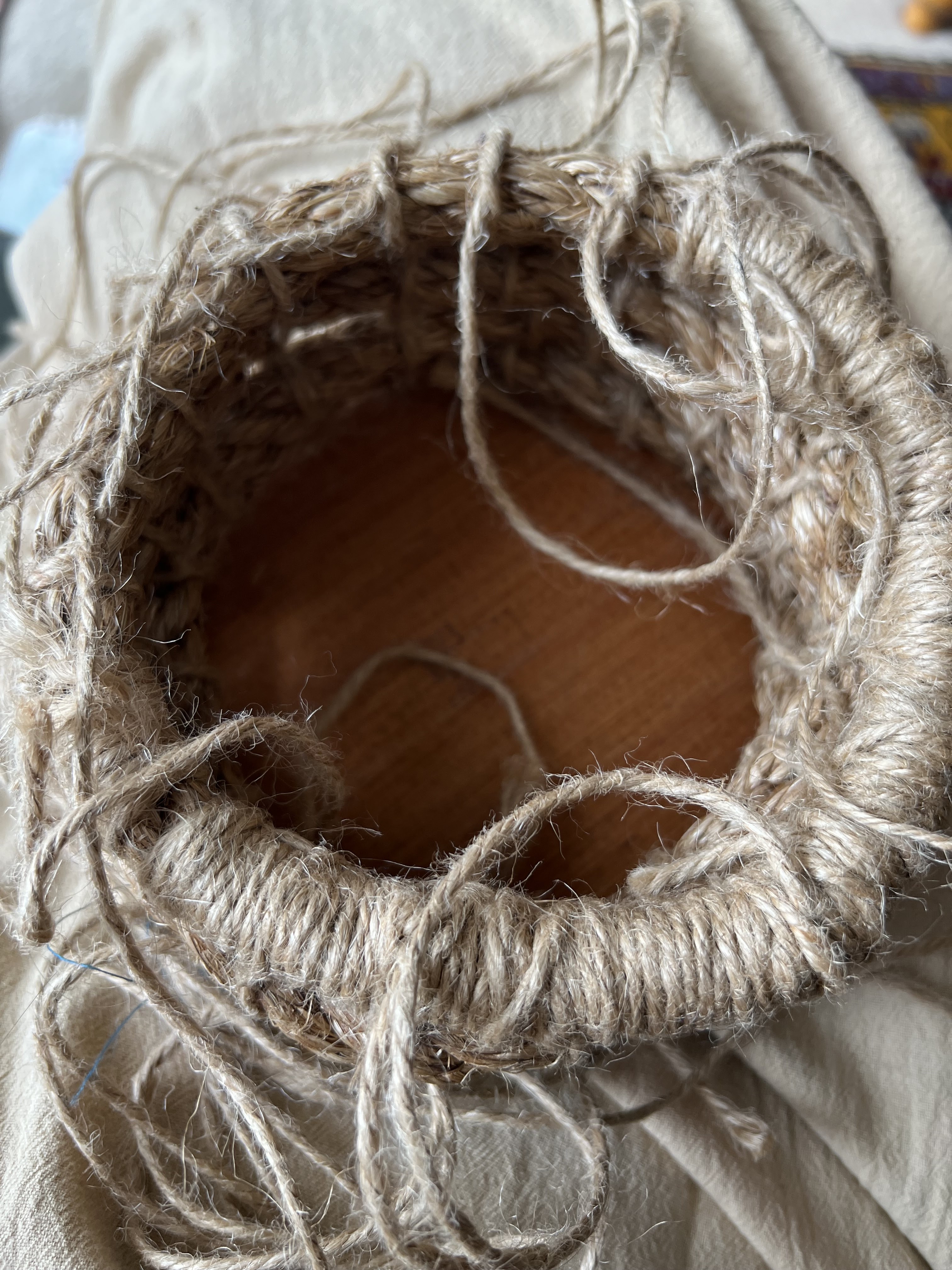
The morning task was to bind the top ring (provided as a separate piece, with ends taped together) with the remainder of the strings used to bind the sides. It’s done with a needle, no knots involved! It is, however, hard on the fingers.  

The many (24) strings have to be secured by burying deep under the binding using the supplied darning needle in a contained space. At the moment I have one sore arthritic finger. Any more and I might not have succeeded. Even so, I found this easier than coiling and knotting. It’s not embroidery, but definitely stitching.


At the end I did a bit of remediation on the start/finish point. The rope fitted perfectly, but the rough ends didn’t sit well so I secured them more tightly with a couple of ends of string. 

As I was finishing this today, it occurred to me that it is work my father and other seafaring relatives would have been skilled at. As a child my skipping ropes, much the same as provided in this kit, had beautifully knotted handles, my father’s handiwork. I also remember taking my Uncle Phil to the Maritime Museum at Port Adelaide where he lingered over a display cabinet of knotted ropes, explaining them in detail. Most Fair Isle farmers would also, of course, have been sailors.
My finished basket is nowhere near as neat and even as the one in the kit picture, but it holds a small pot plant. Making it gave me much food for thought as I pondered the lives of the crofters way up in Fair Isle, gathering wool, the flotsam and jetsam from shipwrecks, harvesting hay, making furniture and knitting clothes, and the lives of sailors, my father included, using rope and whatever came to hand, to make things to fill in the long days and nights in the North Sea. My father spent time in Scapa Flow and told me the Hebrides were the most beautiful place on earth. He could also make anything from wood or rope.
I can’t see myself making another, but I’m very pleased indeed to have made this one. It was a break I needed.              Now Air ais gu fighe, which, I think, is Scots Gaelic for back to knitting.


Friday, September 20, 2024

2024 Shetland Wool Week Hat


While I was on a hat roll, I thought I would tackle the Uradale version of this years Shetland Wool Week hat, the Islesburgh Toorie, for which I had foolishly bought the kit. There are 5 colours in the pattern and in the Uradale version these are all natural, undyed wool. All five colours are represented in the band, shown here. 


Making sure I had the right one was a bit of a challenge, so I made myself a colour chart to keep handy and check against.


The pattern is set in three sizes, achieved by varying the needle size. I made the medium size, using 2.75mm needles. My favourite ebony needles don't come below 3mm, so I had to retreat to bamboo. With a 40cm connector, it worked fairly well. The very sharp bamboo does tend to split the wool if you are not careful. 
After the band of rams heads, I optimistically misread the pattern, and began the crown. After 4 rows I realised the error, undid it and worked the missing chart.

I continued using the same circular needle to the end of the crown. It's awkward, but no more, in my view, so than other methods . 


For the last couple of hats I used short needles and a short connector to finish the crown, but I find it more comfortable and flexible to move the shortening rows along a longer connector and on to the 4" needles.


I'm not entirely convinced the subtle changes in the paler colours make a difference. 


While it does draw attention to the eyes of the sheep,  I'd like to see the starker contrast of the whitest wool throughout the whole hat.  I could make it again to try that out. The kit supplied 4x25gm balls and one 50gm. 30gm of the latter remain and 19gm, 23gm & 22gm x2 of the rest. I wish it wasn't so - I do feel the pressure to use it. 

I don't think I will make it again. I have found another pattern I think might work and be interesting to knit. I have no recipients in mind for these, but do it for the satisfaction of making them. 

If you know of a sheep farmer who would like this one, please let me know!

Tuesday, December 5, 2023

Buggiflooer Beanie 2

As you might have guessed from my last post, I am on a mission to use up the Smith and Jamieson wool I bought to make their colour way of the Shetland Wool Week Buggiflooer beanie. 

It took over a ball of the main colour to make their beanie which was a little on the large side. The russet colour wool was barely used so I began with that as my main colour in the new band. I also reduced the circumference of the band by about 3cm,  increasing to the recommended number above the band. I then chose colours from the remaining wool. The pale caramel was the obvious choice for the stripe and the dark blue provided a good contrast for the zigzag. As I didn’t want to buy more of the main colour, and I wasn’t convinced the band reduction had saved enough to keep within one ball, I worked the background of the middle section in the light caramel rather than russet.
I opted to keep the flowers in the creamy yellow, which left me a choice of mauve or light blue for the border to the flowers. I think I made the right choice, but wonder if it would not have been better to stick with the dark blue.

When I reached the crown, I reverted to the russet background.

This has been a really interesting exercise. The colours are totally different to the first one. yet they are using the exact same wools, just in very different proportions.

It still looks harmonious, indicating that it is a very well-chosen set of colours - and pattern.


I have enough wool left for one more beanie, and I can't wait to try it out. It might have to wait, however. A queue of Christmas projects has built up, and I don't think I can ignore them much longer!