Search This Blog

Showing posts with label Beanie. Show all posts

Sunday, May 17, 2026

Shetland Beanie2025

I bought the yarn for last year’s Shetland Wool Week beanie a year ago, when the Yarn Trader put together the Jamieson & Smith colourway, but it sat untouched until I was invited to a friend’s birthday celebration. The friend’s ancestors came from Shetland and she had hoped to visit her ancestral home again this year, but too many things got in the way. It occurred to me that the beanie might be a welcome gift - a connection as she walks along an Adelaide beach this winter.

I made a mistake straight away, using the lighter shade of purple for the band instead of the dark shade (more haste less speed). Luck was on my side. It produced a bit of a softer look.

I now use Lantern Moon ebony needles for preference (in the photo above). They don't bend, have fine points and are gentle on your hands. The finest gauge they make is 3mm, the size for the medium version of the pattern. Unfortunately, towards the end of the first pattern repeat, one of the ebony ends snapped in the middle of a row.  I have two sets of Lantern Moon exchangeables, but only one pair of 3mm ends. I also have a number of bamboo fixed circulars, but not 3mm. The only 3mm circular I had was a fixed steel. It was the right length, but the steel ends were quite long - about 15cm. They worked well enough on the main body of the beanie, but were too inflexible for the crown. Once upon a time I used steel needles for preference (when the choice was plastic or steel)  and I had forgotten how hard on the hands they are.
,
After my error with the band, I set up a set of reminders, with a loop of each colour threaded to its label and marked with it's alphabetic letter in the pattern. As the label also contains the colour number, this constitutes a complete index. I made no further colour mistakes.

Lantern Moon needles are not easy to come by in Australia. I managed to find a retailer in country NSW with some replacement points and ordered some. I continued, however, with the steel rather than waiting.  

This meant I had to switch to DPNs to finish the crown as the steel circular was simply too long and inflexible to manage the decrease.
I really like the pattern, but it was a challenge to knit. Shetland wool is a little course and splits easily. The pattern requires vigilance, a mistake of one stitch will disrupt the pattern. I made a mistake in the second row of the crown and had to undo a whole round - a very slow process as it is very, very easy to miss picking up a stitch. With 3m needles the stitches are small. The pattern sequence however, helps identify an error.


I worked on it intensely over a weekend, pushing on to finish. The design is crowned with a tassel rather than a pompom to finish, so I went with that, using all 8 colours. 


It was a surprisingly challenging project. Fortunately I really, really like the result. 

I held posting this until the gift was given. I reckon my friend likes it too!


Monday, June 9, 2025

Beanie top up


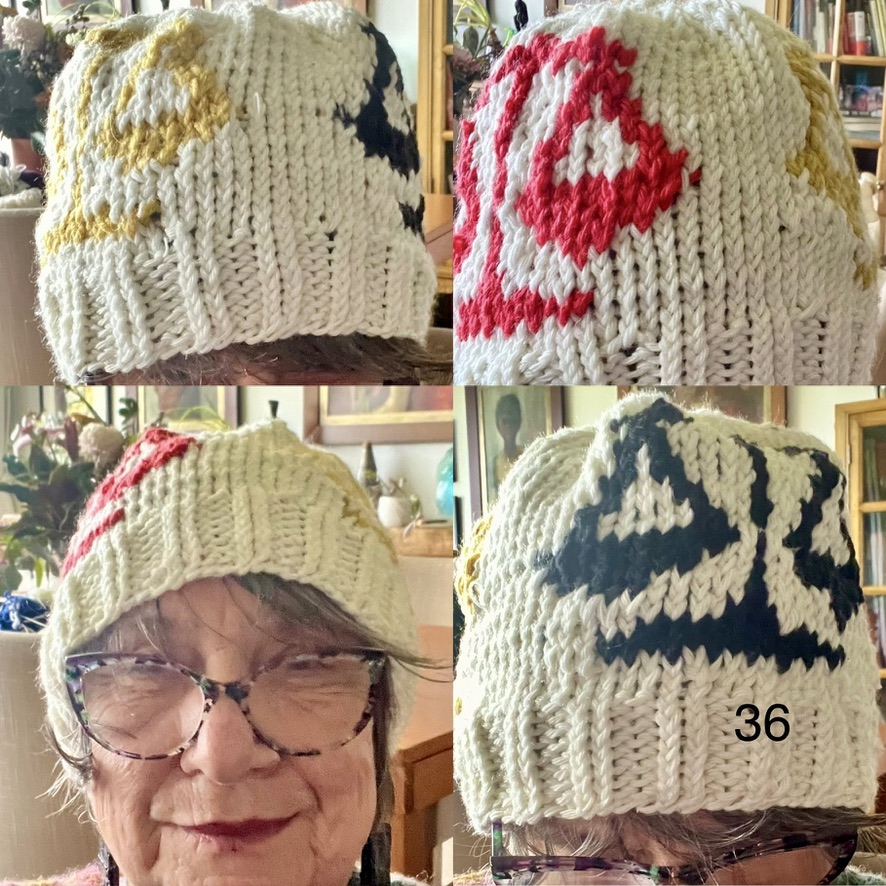
After taking a break from beanie knitting, I have been playing around with Bendigo Woollen Mills' recently released 16ply yarn, a recycled mix of natural fibres.  I bought three colours to experiment with, then ordered several balls in cream thinking it would knit quickly into a few spare beanies. 

As I had not knitted 16ply before, size adjustment was needed. I looked up standard beanie sizes.  My own head is small, and while I made allowances,  most of those I knitted veered small, so I wanted to skew a few towards large. To work this out, I looked up standard  sizes, which gave the circumference of a large beanie as 59-61cm. Since it is easier to measure it flat, I began with the flat version of the hat, a bit slower to knit, but required if the pattern has more than two colours. One or two colours are more easily knitted in the round. 

As I progressed, family members expressed  astonishment at the emerging size, and when it was large enough to hold against my own head, my daughter and I fell about laughing, my daughter insisting the only use was a tea cosy. I considered it. 

With some nervousness I decided to call upon my steeking skills. I had the distance between the motifs to play with to the left of the red scales, , so I cast off 10 stitches, then worked a sharp crown decrease. When the piece was finished I ran a row of machine stitching from the cast-off section to the band - and cut it off. I stitched the edges together by hand - very securely! The circumference is now 56cm.

A typical beanie height, is, apparently, 20-25 cm. This one is now 23cm (before a tassel!). It still looks huge, but it does at least conform to standard sizing. I'm looking for a big head to test it on.

For comparison, I found a Bendigo pattern for a beanie in this yarn and knitted a beanie in the round using the number of stitches they recommended at the cast-on, but following my pattern.

The result is a hat with a circumference of 48cm and a height of 23cm.  I suspect this is quite adequate for most larger heads, but at this stage I'm guessing. I might still have a tea cosy on my hands.

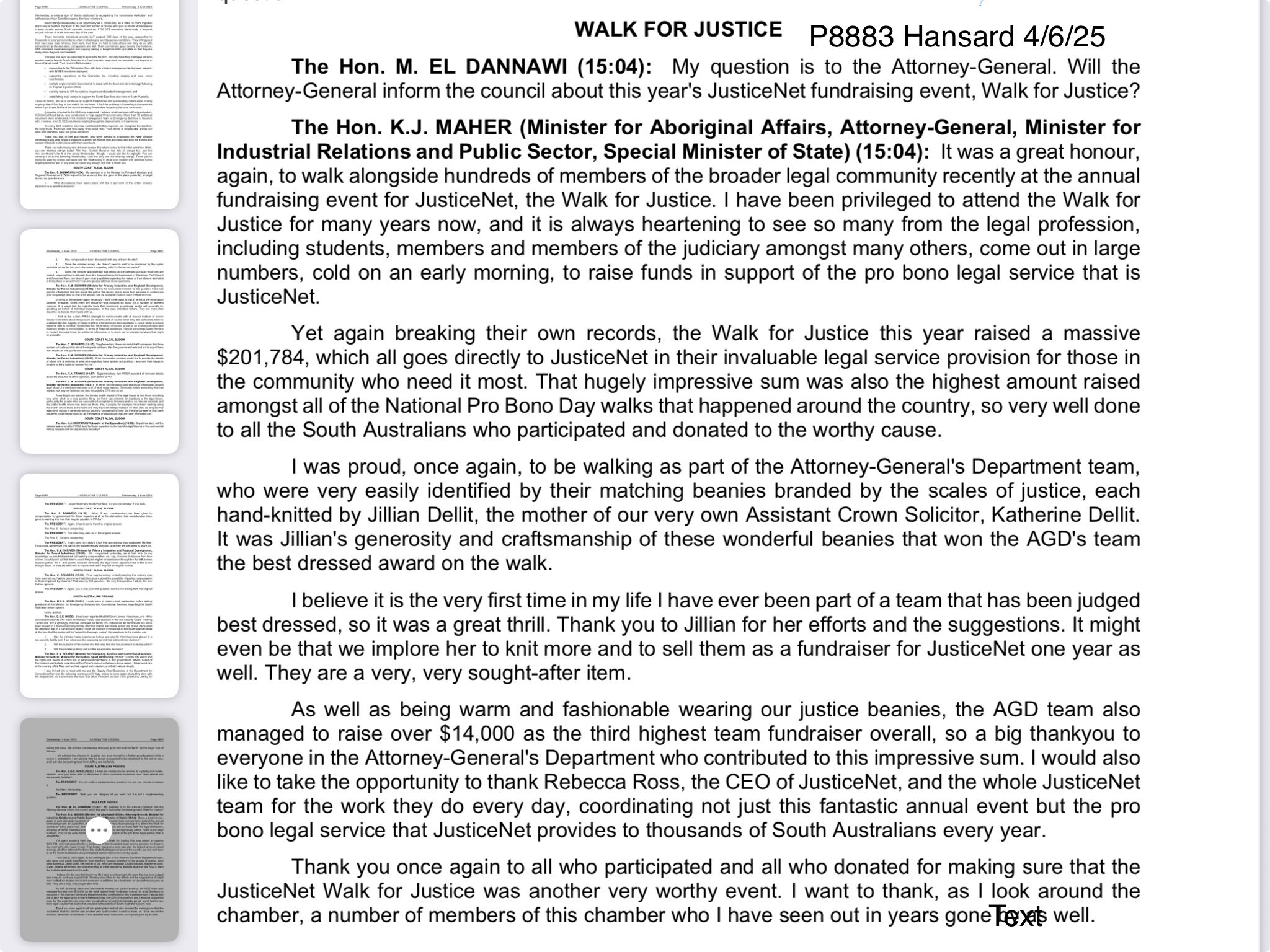
I was moved and embarrassed last week when there was a question in the South Australian Parliament about the Walk for Justice, and I was mentioned in the Attorney's reply.

Bless his little cotton socks! (no, no, I'm not knitting socks!).

Friday, December 22, 2023

Last hat post for a while - I promise!

I didn't resist the temptation to turn Santas into trees.  I worked out the mathematics of the  repeat and just jumped in.  My first dilemma was where to switch the background from green to blue. I decided to keep the light green going a fair way up the trees, setting a horizon further away.

My second was the colour of the pompom.  I went for white, partly as a contrast and partly because the white yarn is acrylic and much fluffier than the other colours which are cotton. The cotton tends to droop.  I tried the smallest pompom maker, which I haven't used before. I had a near disaster when I accidentally cut through the tie thread by mistake. There were a lot of 2.5cm threads to retrieve and tie together! 
I discussed the dilemmas with my granddaughters, who were clear that the pompom should be white, but like me, were in two minds about the horizon, so I knitted another one to see how it looked.

While I think both are OK, I do think the second is better. I also increased the size of the trees on the second one


The second pompom is also white and slightly larger.  The photo doesn't reflect the colours accurately, but  you get the idea.

I could almost knit a hat blindfolded now, but I'm not planning to try. 

There are a few embroidery projects awaiting my attention.


Sunday, November 26, 2023

Buggiflooer Beanie 1.

 Each year Shetland Wool Week has a competition for a hat design.  The winning entry is made widely available, local mills produce their own colour way for the hat and all over the world knitters join in. This year's winning designer was Alison Rendall with a design called Buggiflooer, a Shetland name for Sea Campion or Silene uniflora, which grows on the rocky shores of the Shetlands. 

I knitted several of last year's SWW hats, in 4ply cotton that I had in abundance. This year, because The Yarn Trader, my local wool store, had a good range of Jamieson & Smith wool, I decided to try knitting their colour way for this year's hat. The Yarn Trader did not have all the exact colours, but with their help, I got fairly close. 

There were challenges. The pattern controls size simply by varying needle size. I decided against knitting a swatch and opted for the smallest size needle I had in my ChiaoGoo kit - 2.75mm. 

I have a small head, and I can wear the result. I've tried it on a larger head and it's fine. Ideally I think a 2.25 might produce a better size, but that's a little tight for the thickness of the wool (and also not in my kit!)
It nevertheless looks pretty good. It will be quite warm - just what you want on Shetland.


Right is the top view, modelled over the basket in the back of the photo on the left. It has a really lovely top finish. The flowers are white in nature. I think the blue and white shading works quite well.

I wanted to finish this before our next World Embroidery Study Group meeting in early December. We are talking about knitting, and a friend and I are giving a presentation on Shetland knitting. 

In order to make a clear link to embroidery, I set about working the graph from this knitting pattern in cross stitch. 

I used thread I already had. The closest in my stash was in the DMC Etoile range - cotton with a thread of acrylic glint. 


I ran out of the dark blue background thread part way through.  Create in Stitch only had one hank in stock. It was almost enough to finish.  The orange is brighter in the cotton than on the hat, and I used it as a border all around. 

I finished the outer edge of the border in a slightly darker navy to get it done.
I turned the linen into a pouch, with a cotton lining in 
a similar colourway and a 5" zip.


Although not the original intention, the hat does fit inside the pouch. I’m not sure how many people would bother with this, but it might be useful when travelling.
It's a bit crazy, but I'm pleased to have worked the chart in two media. It is quite a different approach. It's easy to see why Fair Isle knitters used only two colours per row. The creation of floats on the back of the work adds to the thickness. Two threads add thickness, but not much bulk. More would increase the bulk significantly and risk tangles. When working the pattern in thread on a linen background, you can move where you choose, without carrying threads or increasing bulk. That produces more opportunities.

It's been a satisfying project. I'm now reworking the pattern with the same wool but remixing the colours.